- Animals
- ›Chordates
- ›Vertebrates
- ›Ray-finned Fishes
- ›Carps, Characins, Catfishes and Allies
- ›Minnows, Suckers, Carps, and Loaches
- ›Carps and Minnows
- ›True Minnows
- ›North American Minnows
- ›Cyprinella
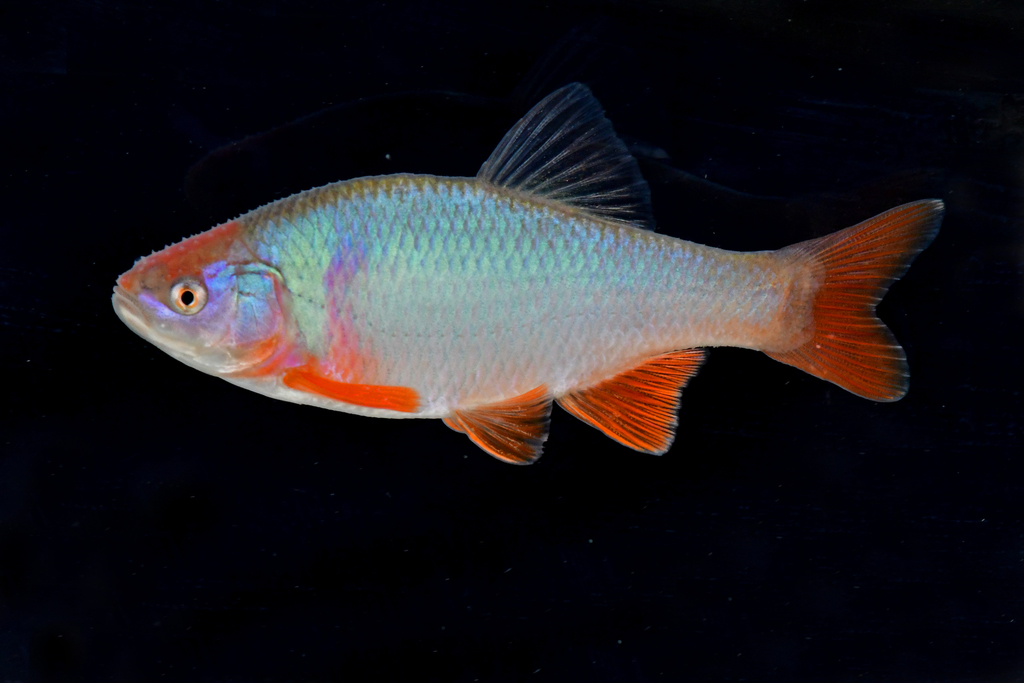
Red Shiner
Cyprinella lutrensis
The red shiner or red-horse minnow (Cyprinella lutrensis) is a species of freshwater ray-finned fish in the family Leuciscidae, the shiners, daces and minnows. They are deep-bodied and laterally compressed, and can grow to about 3 inches (7.6 cm) in length. For most of the year, both males and females have silver sides and whitish abdomens. Males in breeding coloration, though, have iridescent pink-purple-blue sides and a red crown and fins (except the dorsal fin which remains dark).
Red shiners can live up to three years. They are omnivorous; they eat both aquatic and terrestrial invertebrates, as well as algae. Red shiners have also been known to eat the eggs and larvae of native fish found in locations where they have been introduced.
From the article Red shiner on Wikipedia (CC BY-SA), quoted section by section
Range & habitat
Red shiners are found naturally in a variety of aquatic habitats, including backwaters, creek mouths, streams containing sand and silt substrates, riffles, and pools. They are tolerant of areas of frequent high turbidity and siltation, but they tend to avoid waters with high acidity. Red shiner are habitat generalists in that they are adapted to favor a wide range of environmental conditions that are not ideal to most other fish species. These include habitats degraded by human disturbance, and those with poor water quality (such as polluted waterways), natural physiochemical extremes, and seasonally intermittent flows.
Wikipedia: “Habitat”
What it does
The spawning season for red shiners is generally from mid-April through September. In addition to spawning in crevices like other members of the genus Cyprinella, red shiners also broadcast their eggs and attach them to rocks or vegetation. Females can release up to 16 batches per day with up to 71 eggs per batch. The average clutch size, however, is 585 eggs and they may have five to 19 clutches in one reproductive season. Red shiners are capable of generating viable hybrid offspring with closely related species, such as the blue shiner and the blacktail shiner.
Wikipedia: “Reproduction”
Where it lives
Recorded sightings
—
geo-referenced records in GBIF, from museums, herbaria and field observers.
Drag the globe to turn it. Dots are where records exist, not a range map; darker means more records.
In the stacks
Searching the stacks…
Every page naming Cyprinella lutrensis in the Biodiversity Heritage Library →
This page is assembled live from iNaturalist, GBIF, Wikipedia, the Source Library and the Internet Archive. It is not yet part of the hand-edited codex. iNaturalist taxon 98905.