- Animals
- ›Chordates
- ›Vertebrates
- ›Ray-finned Fishes
- ›Spiny-rayed fishes
- ›Leaffishes, Snakeheads, and Gouramis
- ›Gouramis
- ›Gouramis
- ›Luciocephaline Gouramis
- ›Ctenops
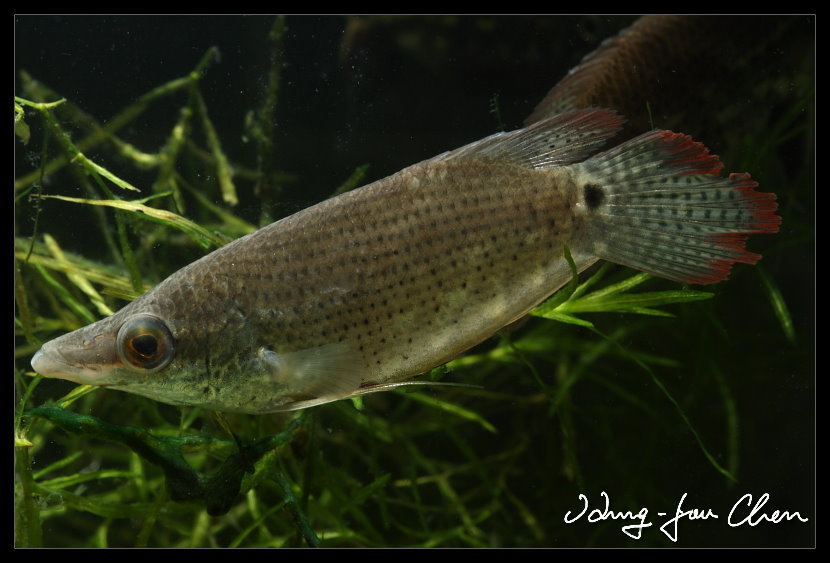
Frail Gourami
Ctenops nobilis
The frail gourami (Ctenops nobilis) or noble gourami is a mouth brooding species of gourami native to northeastern India and Bangladesh. It grows to a length of 10 cm (3.9 in). It is only seldom found in the aquarium trade, due to its extreme sensitivity to shipping stress and high levels of aggression. The frail gourami is the only known member of its genus.
From the article Frail gourami on Wikipedia (CC BY-SA), quoted section by section
Range & habitat
These micro-predators live in the clear, overgrown, slow-flowing waters of eastern India, northern Bangladesh, the Sikkim state, west Bengal, Bihar, the Assam states, and just discovered, Nepal. This adaptive species have also been recorded where foliage and vegetation is scarce. In their native habitat, during the months of June and July, monsoons are common. Temperatures range from 59–90 degrees Fahrenheit, or 15–32 degrees Celsius, with the cold extremes at the most northerly reaches of its range. Its habitats are subject to severe seasonal changes in water change, volume, and flow. In Bangladesh, in a slow-moving, shallow stream containing clear water with a substrate of sand and organic detritus, the frail gourami was observed alongside sympatric species including Pseudolaguvia muricata, Barilius barna, B. bendelisis, B. tileo, Devario devario, Oreichthys cosuatis, Psilorhynchus sucatio, Lepidocephalichthys guntea, Acanthocobitis botia, Schistura corica, S. savona, Amblyceps mangois, Mystus bleekeri, Olyra longicaudata, Conta conta, Hara jerdoni, Pseudolaguvia ribeiroi, P. …
Wikipedia: “Natural habitat”
What it does
Females have a slimmer head and jaw shape compared to males. Males have a rounder jaw for mouth brooding (carrying eggs in the mouth). The ritual can last for many hours. The female, after laying the eggs, diligently collects every one of them and expels them from her mouth for the male to hold with his anal fin and place in his mouth. They continue this process until every egg is laid and guard the area at the same time. The males are then the parental egg-bearer and gain a cryptic and strange marble patterning. Feeding then is greatly reduced in the male, or ceases altogether. The eggs stay in his mouth for about 7–20 days, and then release free-swimming fry. This intelligent species shows a learning process in younger or inexperienced individuals as they gain knowledge of how to hold the eggs properly without swallowing them.
Wikipedia: “Life cycle”
Where it lives
Recorded sightings
—
geo-referenced records in GBIF, from museums, herbaria and field observers.
Drag the globe to turn it. Dots are where records exist, not a range map; darker means more records.
In the stacks
Searching the stacks…
Every page naming Ctenops nobilis in the Biodiversity Heritage Library →
This page is assembled live from iNaturalist, GBIF, Wikipedia, the Source Library and the Internet Archive. It is not yet part of the hand-edited codex. iNaturalist taxon 98773.