- Fungi Including Lichens
- ›Basidiomycete Fungi
- ›Higher Basidiomycetes
- ›Mushrooms, Bracket Fungi, Puffballs, and Allies
- ›Agaricomycetidae
- ›Common Gilled Mushrooms and Allies
- ›Pluteineae
- ›amanita mushrooms and allies
- ›Amaniteae
- ›Amanita
- ›Amanita
- ›Amanita
- ›Gemmatae
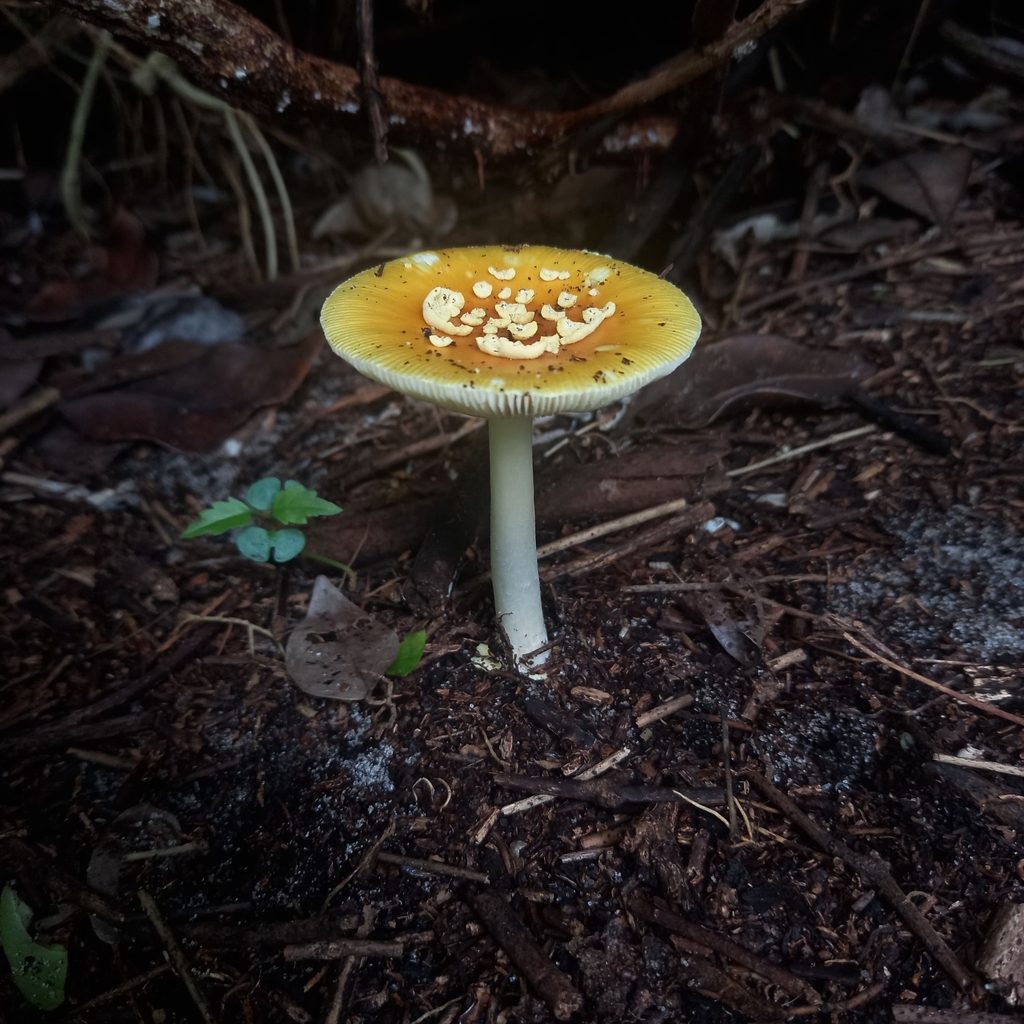
Amanita viscidolutea
Amanita viscidolutea is a species of agaric fungus in the family Amanitaceae native to Brazil.
From the article Amanita viscidolutea on Wikipedia (CC BY-SA), quoted section by section
Description
Amanita viscidolutea has a yellow pileus of 4–6 centimetres (1+1⁄2–2+1⁄2 inches) in diameter, plane to depressed, with distinct striate white margin and yellowish-white patches of universal veil at center. Lamellae are free, yellowish-white, truncate to rounded-truncate. The stipe is 8–12 cm (3–4+1⁄2 in) tall and about 38 millimetres (1+1⁄2 in) wide, yellowish-white and exannulate, with bulb-shaped remnants of universal veil encircling stipe base. It has a pleasant aroma. Basidiospores are inamyloid.
Range & habitat
Native to Brazil, this species is solitary to subgregarious, and grows in sandy soil. It is associated and thus possibly in mycorrhizal symbiosis with Coccoloba and Guapira species.
Wikipedia: “Distribution and habitat”
Where it lives
Recorded sightings
—
geo-referenced records in GBIF, from museums, herbaria and field observers.
Drag the globe to turn it. Dots are where records exist, not a range map; darker means more records.
In the stacks
Searching the stacks…
Every page naming Amanita viscidolutea in the Biodiversity Heritage Library →
This page is assembled live from iNaturalist, GBIF, Wikipedia, the Source Library and the Internet Archive. It is not yet part of the hand-edited codex. iNaturalist taxon 986101.