- Animals
- ›Chordates
- ›Vertebrates
- ›Ray-finned Fishes
- ›Salmons, Pikes and Mudminnows
- ›Salmons, Trouts, and Whitefishes
- ›Salmons, Trouts, and Whitefishes
- ›Whitefishes
- ›Coregonus
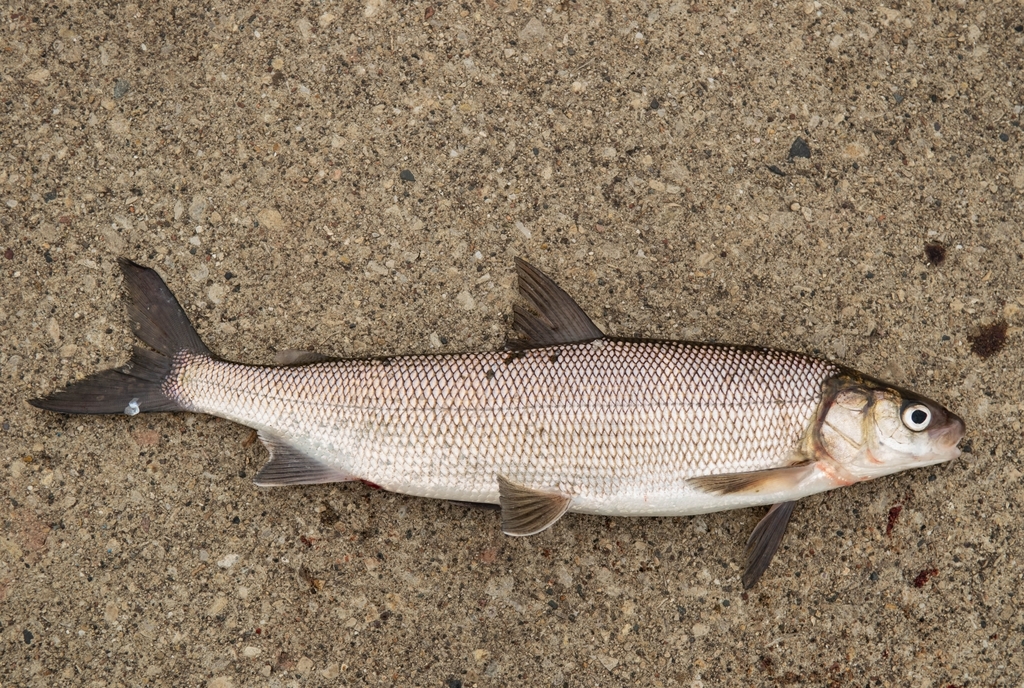
Lake Whitefish
Coregonus clupeaformis
The lake whitefish (Coregonus clupeaformis) is a species of freshwater whitefish from North America. Lake whitefish are found throughout much of Canada and parts of the northern United States, including all of the Great Lakes. The lake whitefish is sometimes referred to as a "humpback" fish due because of its small head size in relation to the length of the body. It is a valuable commercial fish and also occasionally taken by sport fishermen. Smoked, refrigerated, or vacuum-packed lake whitefish fillets are available in North American grocery stores. Other vernacular names used for this fish include Otsego bass, Sault whitefish, gizzard fish, common whitefish, eastern whitefish, Great Lakes whitefish, humpback whitefish, inland whitefish and whitefish.
From the article Lake whitefish on Wikipedia (CC BY-SA), quoted section by section
Description
The lake whitefish is similar in appearance to other whitefishes in the Coregoninae subfamily of the salmon family Salmonidae, such as the northern cisco (Coregonus artedi). As with all salmonids, it has an adipose fin. To the distinction from cisco, the lake whitefish has a snout which overhangs the short lower jaw, so that the mouth opens in a slightly inferior position. Thus the fish can feed on the bottom of lake beds or grab food particulates out of the water or from the surface of a water body. The cisco in turn has a short snout with a lower jaw that extends beyond the snout. Both the cisco and lake whitefish are discernible from the mooneye due to the small posterior dorsal adipose fin. In early life stages the cisco and lake whitefish are indistinguishable based on morphological characters alone, with genetic analyses being necessary to reliably identify species. Another notable feature of the lake whitefish is the presence of two small flaps in each nostril. Its coloration is typically silver to white with an olive to pale-green or brown dorsal hues. The ventral fins are white, and the tail has a dark posterior edge. Lake whitefish from inland lakes can reach a weight upwards of 5 pounds (2,300 g); the largest caught on rod and reel weighed 14 pounds 6 oz, from Meaford, Ontario, in 1984. On average, the lake whitefish weighs around 4 pounds. …
Range & habitat
Lake whitefish are cool water fish. They are found in a large number of inland lakes, and they have been known to enter brackish water. The lake whitefish is distributed from Alaska and western Canada to the Atlantic coastal drainage of Maine and in New Brunswick north to Labrador.
Wikipedia: “Habitat”
What it does
Lake whitefish spawn from September through January in water two to four metres in depth during the night. In the autumn, mature lake whitefish enter the shallows to lay their eggs on shoals of rubble and gravel. There is no parental care of the young. In the following spring the young will hatch. In northwestern Canada, a large spawning migration enters the Athabasca Delta in late summer, moving upstream in the Athabasca River. The longest single movement of a tagged whitefish was 388 km (241 mi), from Fort McMurray to the north shore of Lake Athabasca in Alberta.
Wikipedia: “Reproduction”
In human culture
The scientific genus name Coregonus (co-regg'-on-us) means "angle eye" in Greek, and the species name clupeaformis means "herring-shaped" in Latin.
Wikipedia: “Etymology”
Where it lives
Recorded sightings
—
geo-referenced records in GBIF, from museums, herbaria and field observers.
Drag the globe to turn it. Dots are where records exist, not a range map; darker means more records.
In the stacks
Searching the stacks…
Every page naming Coregonus clupeaformis in the Biodiversity Heritage Library →
This page is assembled live from iNaturalist, GBIF, Wikipedia, the Source Library and the Internet Archive. It is not yet part of the hand-edited codex. iNaturalist taxon 98445.