- Animals
- ›Chordates
- ›Vertebrates
- ›Birds
- ›Swifts and Hummingbirds
- ›Hummingbirds
- ›Jacobins and Topazes
- ›Topaza
On eBird ↗
Fiery Topaz
Live sightings near you, the range map, bar charts of when it is seen, and Macaulay Library photos and recordings.
Fiery Topaz
Topaza pyra
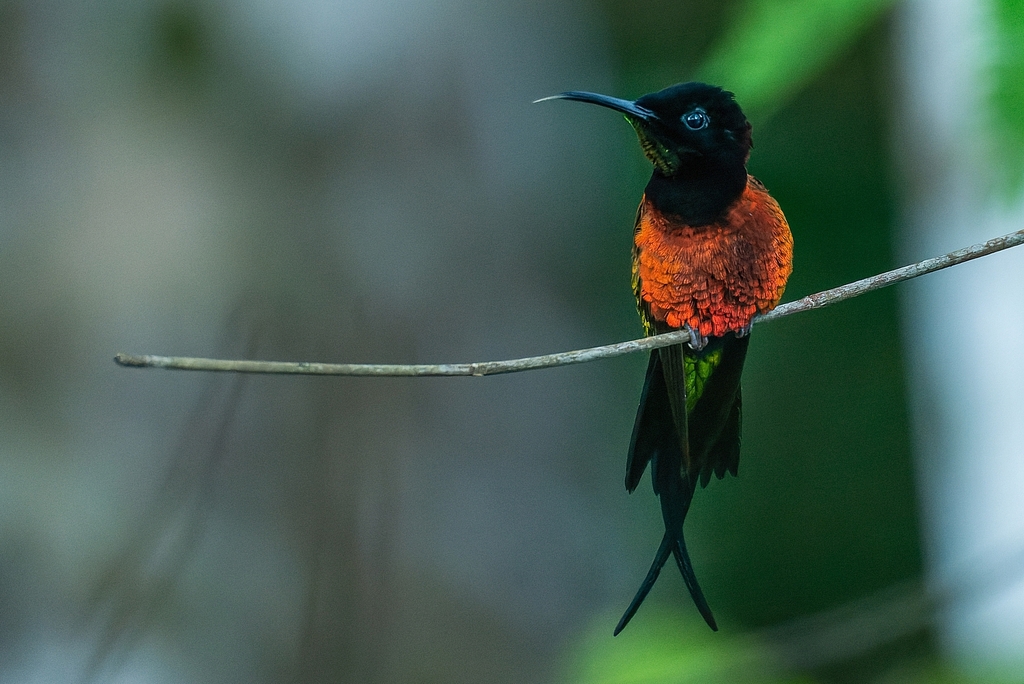
The fiery topaz (Topaza pyra) is a species of hummingbird in the family Trochilidae. It has brilliant iridescent plumage and resides in northern South America, where it consumes nectar and insects.
From the article Fiery topaz on Wikipedia (CC BY-SA), quoted section by section
Description
Topaza pyra can reach a body length of about 19 cm (7.5 in). There is strong sexual dimorphism between the males and females. Both have a dark brown iris, but males are larger on average than females. Males of these brilliantly marked hummingbirds have a back, lower breast, upperwing-coverts, and outer webs of the innermost two remiges that are shining orange-red, becoming more orange on the belly, shading over the rump into the yellow-green/green uppertail-coverts. The top and sides of the head are velvet black, with an iridescent green and orange red throat and a thick, decurved and a rather short bill (about 25 mm (0.98 in). They have two characteristic elongated central tails (about 64 mm (2.5 in). The male's bill is black, and it has gray feet.
Females are shining green above, with a coppery red gorget bordered by a narrow orange-yellow-green band. The rest of the head is medium to bluish-green, with the breast less bluish. Tail is purplish red. Female bills are black like the male's, but their feet are orange/flesh colored. The upper and under-tail coverts have orange highlights in the males, as opposed to blue-green in the females, and are somewhat lengthened and loose-webbed. This species is very similar to crimson topaz. Topaza pyra can be distinguished from the closely related Topaza pella by their shorter beaks, longer wings, longer tail, and thinner rectrices.
Range & habitat
Topaz hummingbirds as a group are endemic to the Amazonian rainforest. This species has a very large range. T. pyra can be found in Brazil, Colombia, Ecuador, Peru and Venezuela. Its natural habitat is subtropical or tropical moist lowland forest, at an elevation up to 500 metres (1,600 ft) above sea level. They are encountered high in the canopy and prefer the edges of forests and clearings near water, and are often seen close to river banks.
Wikipedia: “Distribution and habitat”
What it does
Little is known about the behavior of these birds, as there have been few observations made of them in the wild, but they have been observed feeding and interacting with one another over a rocky streams in the foothills of their territory. They are also known to nest in small lichen-covered cups low over the water, like other hummingbirds. The males are rather territorial, and usually ward off intruders around flowering areas.
Wikipedia: “Behavior and ecology”
At the table
As with their behavior, more observational studies of these birds is needed. However, it is known that this species is mainly nectarivorous, and feeds at flowers, vines, and epiphytes from eye level to high in the canopy, preferring high flowering vines. They also feed on insects.
Wikipedia: “Food and feeding”
Listen
Looking for field recordings…
Where it lives
Recorded sightings
—
geo-referenced records in GBIF, from museums, herbaria and field observers.
Drag the globe to turn it. Dots are where records exist, not a range map; darker means more records.
In the stacks
Searching the stacks…
Every page naming Topaza pyra in the Biodiversity Heritage Library →
This page is assembled live from iNaturalist, GBIF, Wikipedia, the Source Library and the Internet Archive. It is not yet part of the hand-edited codex. iNaturalist taxon 980024.