- Animals
- ›Chordates
- ›Vertebrates
- ›Birds
- ›Pelicans, Herons, Ibises, and Allies
- ›Ibises and Spoonbills
- ›Theristicus
On eBird ↗
Andean Ibis
Live sightings near you, the range map, bar charts of when it is seen, and Macaulay Library photos and recordings.
Andean Ibis
Theristicus branickii
The Andean ibis (Theristicus branickii) is a species of bird in the family Threskiornithidae. It is found in grassland and fields in western South America. This species was considered a subspecies of the black-faced ibis, and some taxonomic authorities (including the American Ornithological Society) still consider it so.
From the article Andean ibis on Wikipedia (CC BY-SA), quoted section by section
Description
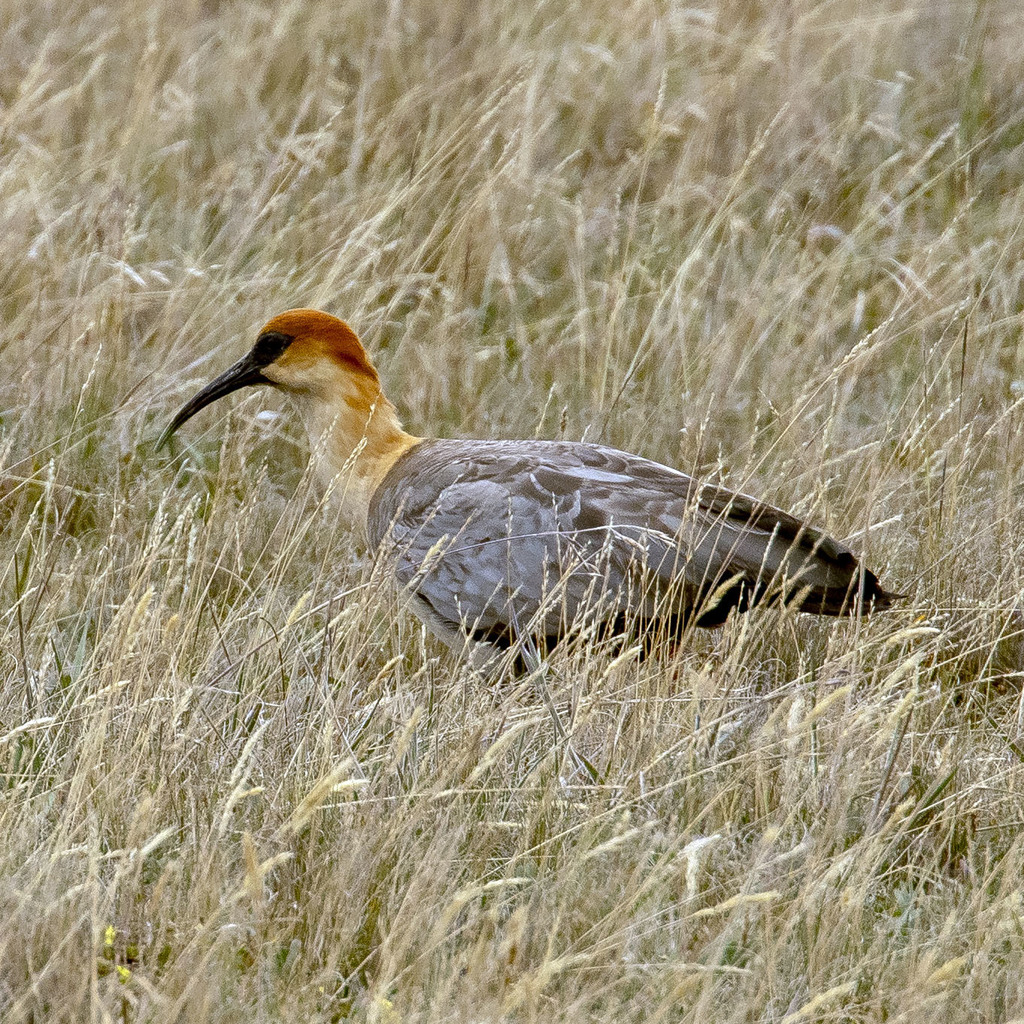
It has a total length of approximately 75 centimetres (30 in). The head, neck and lower chest are buffish, the crown and nape are cinnamon, the upperparts and (often incomplete) chest-band are grey, the belly and flight feathers are black, and the wing-coverts are whitish (though not contrasting strongly with the grey upperparts). The bill, throat-wattle and bare skin around the eyes are blackish and the legs are red. The throat-wattle is smaller, the bill is shorter, the wing-coverts are greyer, the lower chest is paler and the cinnamon on the crown and nape is brighter and more extensive when compared to the black-faced ibis.
Range & habitat
The Andean ibis is restricted to altitudes of 3,000 to 5,000 metres (9,800 to 16,400 ft) in the Andean highlands of Bolivia, Peru and Ecuador. It is generally uncommon, and formerly also occurred in Lauca in far northern Chile.
Wikipedia: “Distribution and status”
Listen
Looking for field recordings…
Where it lives
Recorded sightings
—
geo-referenced records in GBIF, from museums, herbaria and field observers.
Drag the globe to turn it. Dots are where records exist, not a range map; darker means more records.
In the stacks
Searching the stacks…
Every page naming Theristicus branickii in the Biodiversity Heritage Library →
This page is assembled live from iNaturalist, GBIF, Wikipedia, the Source Library and the Internet Archive. It is not yet part of the hand-edited codex. iNaturalist taxon 980019.