On eBird ↗
Morepork
Live sightings near you, the range map, bar charts of when it is seen, and Macaulay Library photos and recordings.
Morepork
Ninox novaeseelandiae
The morepork (Ninox novaeseelandiae), also known by its Māori name ruru, is a small brown owl found in New Zealand, the Australian islands of Norfolk Island, and formerly on Lord Howe Island. Its names (also including boobook and mopoke) are onomatopoeic, owing to the species’ distinctive calls. Three subspecies of the morepork are recognised, one of which is extinct and another that exists only as a hybrid population.
First described by Johann Friedrich Gmelin in 1788, the morepork was thought to be the same species as the Australian boobook (N. boobook), native to Australia, Timor-Leste and New Guinea, something that endured for more than two hundred years, until 1999. Similarly, it was also considered the same as the Tasmanian boobook (N. leucopsis) until 2022.
From the article Morepork on Wikipedia (CC BY-SA), quoted section by section
Description
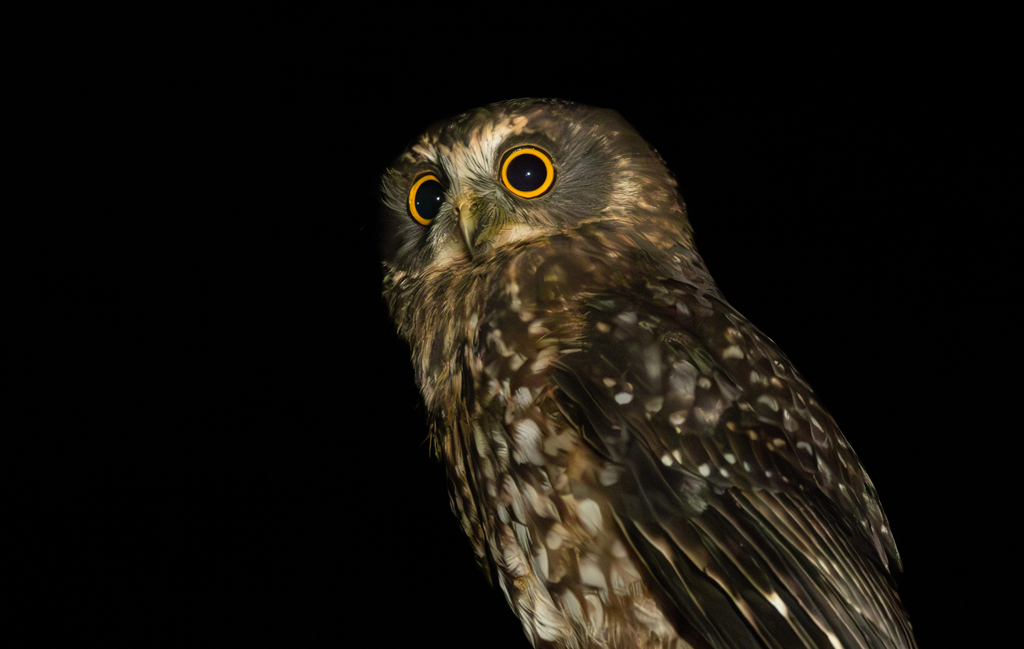
The morepork is 26 to 29 cm (10 to 11.5 in) long, with the female slightly larger than the male. Females are slightly heavier at 170–216 g (6.0–7.6 oz) compared with the male's 140–156 g (4.9–5.5 oz). The morepork has generally dark brown head and upperparts, with pale brown spots on head and neck and white markings on the rest of the upperparts, with a pale yellow-white supercilium (eyebrow), dark brown ear coverts, and buff cheeks. The eyes are yellow to golden-yellow. The feathers of the chin and throat are buff with dark brown shafts. The feathers of the underparts are mostly dark brown with buff and white spots and streaks, with the larger markings on the belly making it look paler overall. The upper tail is dark brown with lighter brown bars. The cere and bill is pale blue-grey with a black cutting edge. The feet are orange or yellow with blackish claws. Young moreporks do not attain adult plumage properly until their third or fourth year. The tips of juvenile's feathers are white and fluffy, remnants of the nestlings' down. These are worn away over time, persisting longest on the head. The feathers of the head, neck, and underparts are fluffier overall. Their plumage is a darker and more greyish brown overall than that of adults.
Range & habitat
In New Zealand's North Island, it is common from Rangaunu Harbour south to southern Taranaki and west of Tauranga, Lake Taupō, and Whanganui, as well as between Murupara and the Hangaroa River in the northeast, and southern Manawatū, Wellington, and Wairarapa in the south, and uncommon outside these areas. In the South Island, it is more common west of the Southern Alps, around Marlborough and in Southland. It is common on Stewart Island and offshore islands. In New Zealand, it primarily inhabits forests dominated by Podocarpus, Nothofagus, Metrosideros, and other hardwoods, up to the alpine tree line. On Norfolk Island, it lives in forests of Norfolk Island pine (Araucaria heterophylla).
Wikipedia: “Distribution and habitat”
What it does
They are usually seen singly, in pairs, or in small family groups of an adult pair and up to three young. Swamp harriers could feasibly prey on young moreporks. During the day, moreporks sleep in roosts. Although mainly nocturnal, they are sometimes active at dawn and dusk. The main hunting times are evenings and mornings, with brief bursts of activity through the night. On dark nights, they often perch through the middle hours, and particularly if the weather is bad, may hunt by daylight, instead.
Breeding. Moreporks nest anywhere the trees are large enough to have hollows.
Feeding. Although their main hunting technique is perch-and-pounce, they are agile birds with a swift, goshawk-like wing action and the ability to maneuver rapidly when pursuing prey or hawking for insects. They hunt a variety of animals – mainly large invertebrates including scarab and huhu beetles, moths and caterpillars, spiders, grasshoppers, and in New Zealand, wētā. They also take almost any suitably sized prey, particularly small birds, rats, and mice. They can find suitable food in pine forests as well as native forest.
Vocalisation. Moreporks have multiple distinct vocalisations. The "more-pork" call for which they are named is heard most frequently, but other vocalisations include a high pitched yelping call, a whistling call similar to kiwi, and a lower pitched "quork-quork" rumbling call. …
Wikipedia: “Behaviour”
Listen
Looking for field recordings…
Where it lives
Recorded sightings
—
geo-referenced records in GBIF, from museums, herbaria and field observers.
Drag the globe to turn it. Dots are where records exist, not a range map; darker means more records.
In the stacks
Searching the stacks…
Every page naming Ninox novaeseelandiae in the Biodiversity Heritage Library →
This page is assembled live from iNaturalist, GBIF, Wikipedia, the Source Library and the Internet Archive. It is not yet part of the hand-edited codex. iNaturalist taxon 979817.