 NL·0686
Herbarium of the Nature Library
- Name
- Calidris pygmaea
- Family
- Scolopacidae
- Native to
- Breeds in Chukotka and northern Kamchatka, Russia; migrates via the coasts of Japan, Korea and China (especially the Yellow Sea); winters mainly in Myanmar (Gulf of Mottama) and Bangladesh
- Habitat
- Tundra, Mudflat, Coastal
On eBird ↗
Spoon-billed Sandpiper
Live sightings near you, the range map, bar charts of when it is seen, and Macaulay Library photos and recordings.
Spoon-billed sandpiper
Calidris pygmaea
Also calledSháo zuǐ yù 勺嘴鹬 (Chinese) · Herashigi ヘラシギ (Japanese) · Kulik-lopaten (Russian)
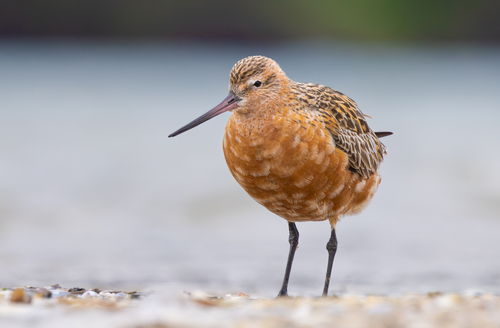
A sparrow-sized sandpiper with a unique spatula-shaped bill tip, breeding only on coastal tundra in Chukotka and northern Kamchatka and migrating around 8,000 km down the East Asian–Australasian Flyway to winter mainly in Bangladesh and Myanmar. Only around 400–450 adult birds survive.
The spoon-billed sandpiper is a small wader which breeds on the coasts of the Bering Sea and winters in Southeast Asia. This species is highly threatened, and it is said that since the 1970s the breeding population has decreased significantly. By 2000, the estimated breeding population of the species was 350–500. Wikipedia
What it can do
- iSpoon-shaped bill tip used to sweep through soft mud for tiny invertebrates
- iiMigrates about 8,000 km each way along the East Asian–Australasian Flyway
- iiiDepends on a few critical tidal mudflats as staging sites, especially in the Yellow Sea
In the field
Field marks
- aSmall, stint-sized sandpiper
- bBlack bill broadening into a flat spatula at the tip (best seen head-on or in profile at close range)
- cBreeding: rufous head, neck and breast
- dWinter: pale grey above, white below, with a white forehead
- Voice
- A soft, rasping 'preep' in flight; males give a buzzing, trilling song in display flight on the breeding grounds
- Not to be confused with
- Red-necked stint is almost identical in size and plumage but has a fine, pointed bill; check the bill tip carefully and watch for the sweeping feeding action.
- Where to see it
- Gulf of Mottama (Martaban), Myanmar, and Sonadia Island, Bangladesh, in winter; Rudong and Tiaozini mudflats, Jiangsu, China, on migration
- When
- Winter visitor to Bangladesh and Myanmar (Nov–Mar); passage migrant in China (Apr–May, Sep–Oct); breeds Jun–Aug in Chukotka
Listen
Looking for field recordings…
Life & habits
- Diet
- Small invertebrates: worms, crustaceans, insect larvae; seeds on the breeding grounds
- Habitat
- Lagoon spits and coastal tundra when breeding; tidal mudflats on migration and in winter
- Size
- About 14–16 cm long
Feeds with a sweeping side-to-side motion of the bill, like a tiny spoonbill, in shallow water and soft mud.
Where it lives
Recorded sightings
—
geo-referenced records in GBIF, from museums, herbaria and field observers.
Native range
Breeds in Chukotka and northern Kamchatka, Russia; migrates via the coasts of Japan, Korea and China (especially the Yellow Sea); winters mainly in Myanmar (Gulf of Mottama) and Bangladesh
Drag the globe to turn it. Dots are where records exist, not a range map; darker means more records.
In the old herbals & bestiaries
No plate in the Source Library names this exact species, so these show its closest relatives as the old naturalists drew them: same genus, or the same kind of animal. Click a plate to read the page it came from, with translation.


In the stacks
Searching the stacks…
Every page naming Calidris pygmaea in the Biodiversity Heritage Library →
Marginalia
Since 2012 a 'head-starting' project in Meinypilgyno, Chukotka, has collected eggs, hatched them in incubators and released fledglings to raise breeding success. The Tiaozini mudflats where it stages became part of China's Yellow Sea World Heritage site in 2019.
Curiosity
Its spoon-shaped bill is already present when the chick hatches.
Kinship





Fact-checked: 1 correction made to this sheet. Photographs: iNaturalist contributors under the licences shown. Records: GBIF.org. Historical plates: Source Library (CC BY-SA 4.0; originals public domain). Summary text: Nature Library editors and Wikipedia (CC BY-SA). Medicinal and edibility notes are historical and educational, not advice. iNaturalist taxon 979640.