On eBird ↗
Sumatran Frogmouth
Live sightings near you, the range map, bar charts of when it is seen, and Macaulay Library photos and recordings.
Sumatran Frogmouth
Batrachostomus poliolophus
The Sumatran frogmouth (Batrachostomus poliolophus), also known as the short-tailed frogmouth and the pale-faced frogmouth, is a nocturnal bird belonging to the family Podargidae. It is endemic to the island of Sumatra in Indonesia.
From the article Sumatran frogmouth on Wikipedia (CC BY-SA), quoted section by section
Description
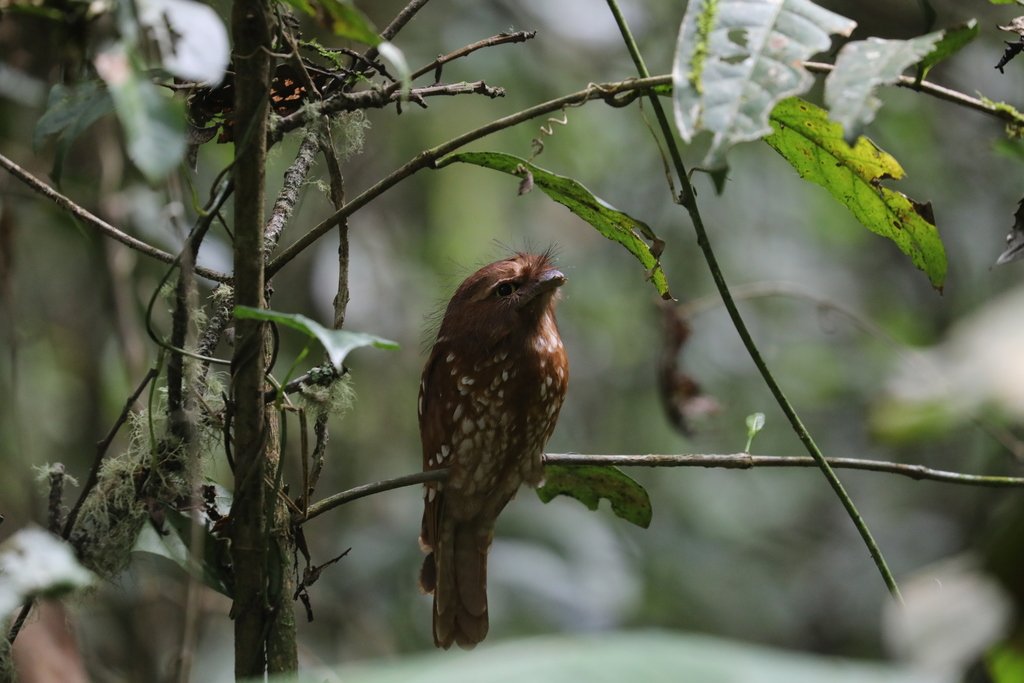
B. poliolophus has a large, arched bill with a light-brown to straw-yellow color. Its face is adorned with bristles, mainly on the forehead and ear coverts. It can be distinguished from other frogmouths by its tail, which is considerably shorter than its wings. It is sexually dimorphic. Males are mostly a dull dark brown with some black speckling and have a collar of white to pale buff feathers. Their underside is a lighter brown with black bars. A pattern of cream-buff spots covers the throat, sometimes extending to the breast and belly. The plumage of females is mainly rufous-brown with faint black barring. Unlike the males, the underside is generally of a similar color to the wings. The greater coverts and the upper breast sometimes exhibit white spots. The colar is variable, but generally similar to that of males.
Range & habitat
This species is native to the Barisan mountains of the island of Sumatra. It is known to inhabit lowland and montane tropical forests with elevations ranging from 600 to 1200 meters.
Wikipedia: “Habitat and distribution”
What it does
Due to the rarity and nocturnal nature of this species, very few observations of its behavior have been published.
Vocalizations. The vocalization of this species has been described as an undulating whistling accompanied by 5–7 notes ("wa") with a descending pitch. Other calls include repeated and wavering "weeeow" notes, as well as a repeated, high pitched whistle sound ("tsiutsiu"). Some sources describe these vocalizations as having a wheezing or asthmatic quality.
Diet. This species is known to feed on insects such as crickets and small beetles.
Reproduction. The nest of B. poliolophus is described in one account as being very small relative to the size of the adult bird. The main material used in the construction of nests was parental down, as well as organic matter such as lichen or moss. The clutch consisted of a single, white egg of an oval shape. This species has a generation time of 7.5 years.
Wikipedia: “Behavior”
Listen
Looking for field recordings…
Where it lives
Recorded sightings
—
geo-referenced records in GBIF, from museums, herbaria and field observers.
Drag the globe to turn it. Dots are where records exist, not a range map; darker means more records.
In the stacks
Searching the stacks…
Every page naming Batrachostomus poliolophus in the Biodiversity Heritage Library →
This page is assembled live from iNaturalist, GBIF, Wikipedia, the Source Library and the Internet Archive. It is not yet part of the hand-edited codex. iNaturalist taxon 979626.