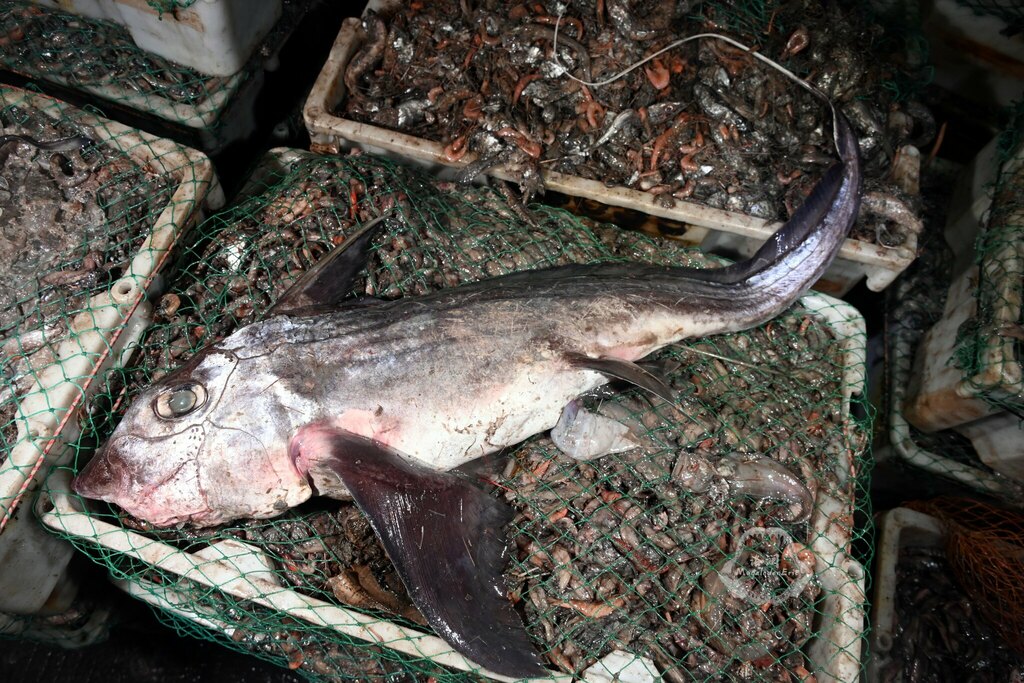
Silver Chimaera
Chimaera phantasma
The silver chimaera (Chimaera phantasma), or ginzame, is a species of holocephalan in the family Chimaeridae. They are found in the deep sea along the coast of East Asia, from Japan to Indonesia. They are chondrichthyans, closely related to sharks and rays, which means that they have a fully cartilaginous skeleton with no true bones.
Silver chimaeras have stout, triangular snouts and long tapered bodies ending in thin, whip-like tails. They grow to a maximum length of 110 cm (43 in) for both males and females. They have two dorsal fins. The anterior dorsal fin is tall, narrow, and triangular with a single hard spine at the front. The posterior dorsal fin is short and elongated and lacks spines. Silver chimaera pectoral fins are broad and triangular and span about a third of the chimaera's body length. Silver chimaeras have exceptionally long tails, with the length of the tail (measured from the end of the anal fin to the tip of the tail) being about a third of the chimaera's total length. The caudal fin is divided into two small, symmetrical lobes above and below the base of the tail. Silver chimaeras are pale and silvery, with dark lateral stripes. They have unique dentition compared to other chondrichthyans. Silver chimaeras have flat tooth plates which grow continuously, like rodent teeth. There are two symmetrical pairs of tooth plates in the top jaw and one pair in the bottom jaw.
From the article Silver chimaera on Wikipedia (CC BY-SA), quoted section by section
Description
The silver chimaera grows to a maximum length of 110 cm (43 in) in both males and females, and they reach sexual maturity at lengths greater than 65 cm (26 in). Their heads are stout and triangular, and their mouths are located on the bottom of their heads, facing the seafloor. Silver chimaeras have flat tooth plates which grow continuously, like rodent teeth. There are two pairs of tooth plates in the top jaw and one pair in the bottom jaw. A silver chimaera's pectoral fins are broad and triangular. These fins are quite flexible, compared to other chondrichthyans, and they are the primary fins used for generating power for swimming. They have both an anterior and posterior dorsal fin. The anterior dorsal fin is tall and triangular, with a single venomous spine at the front of the fin. The posterior dorsal fin is very long and flat, and spans a large portion of the chimaera's body, from the middle of the torso to the base of the tail. Silver chimaeras have long, whip-like tails, which have two symmetrical caudal fin lobes above and below the base of the tail. A silver chimaera is primarily pale silver in coloration, with dark stripes running down the sides of the body. Silver chimaeras have four gill openings covered by a single cartilaginous operculum. …
Wikipedia: “Anatomy and appearance”
Range & habitat
Silver chimaeras are found along the continental shelf and upper slope of the East China Sea. They have been found at depths between 20–960 m (66–3,150 ft), but they are most common around depths of 500 m (1640 ft). They live off the coast of East Asia, from the north tip of Japan to the north of Indonesia.
Wikipedia: “Distribution and habitat”
What it does
Silver chimaeras are deep benthic and neritic predators, meaning that they primarily feed along the deep seafloor and the continental shelf. Their primary prey items are mollusks and crustaceans, though they also eat soft-bodied prey like jellyfish and sea squirts. Silver chimaeras are prey for sharks and seals and are also occasionally eaten by other chimaeras. Silver chimaeras primarily hunt using electroreceptive organs called ampullae of Lorenzini, which can detect small electrical fields created by living creatures. These ampullae are mostly found on the snout and are particularly concentrated on the underside of the head, near the mouth. Silver chimaeras also have a well-developed sense of smell, and they have adapted to have naso-oral grooves on their skin connecting the nostrils to the mouth. This allows a near constant flow of water to the olfactory system, allowing the silver chimaera to constantly smell its surroundings.
Diet. Silver chimaeras primarily prey on benthic invertebrates, such as crustaceans, echinoderms, and mollusks. Chimaeras use their electroreception to detect these organisms hiding under sand and rocks, then crush through their tough shells using their tooth plates. Silver chimaeras also consume soft-bodied prey, such as anemones, tunicates, jellyfish, polychaetes, and salps. …
Wikipedia: “Ecology and behavior”
Where it lives
Recorded sightings
—
geo-referenced records in GBIF, from museums, herbaria and field observers.
Drag the globe to turn it. Dots are where records exist, not a range map; darker means more records.
In the stacks
Searching the stacks…
Every page naming Chimaera phantasma in the Biodiversity Heritage Library →
This page is assembled live from iNaturalist, GBIF, Wikipedia, the Source Library and the Internet Archive. It is not yet part of the hand-edited codex. iNaturalist taxon 97520.