- Fungi Including Lichens
- ›Basidiomycete Fungi
- ›Higher Basidiomycetes
- ›Mushrooms, Bracket Fungi, Puffballs, and Allies
- ›Shelf Fungi
- ›Bracket Fungi
- ›Trametes
- ›Trametes cinnabarina
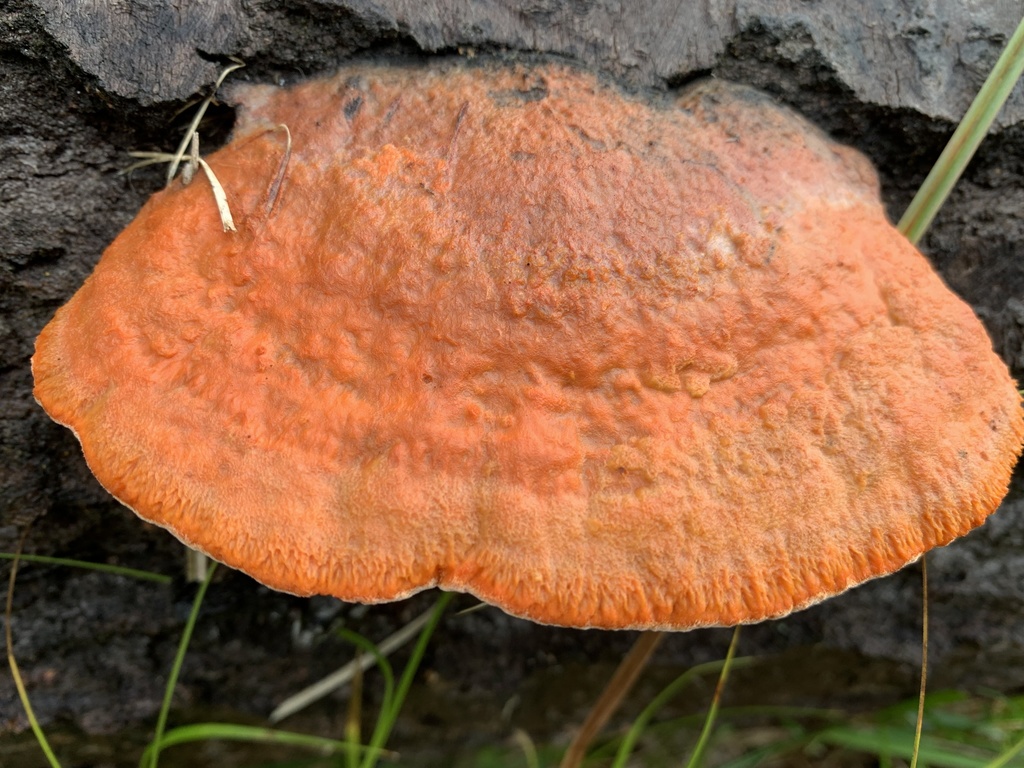
Northern Cinnabar Polypore
Trametes cinnabarina
Pycnoporus cinnabarinus, also known as the cinnabar polypore, is a saprophytic, white rot decomposer.
Its fruit body is a bright orangish shelf fungus up to 12 centimetres (4+3⁄4 in) across and 1.5 cm (5⁄8 in) thick. It stains dark in potassium hydroxide. There 2–4 pores per mm. The spore print is white.
From the article Pycnoporus cinnabarinus on Wikipedia (CC BY-SA), quoted section by section
What it does
Pycnoporus cinnabarinus contribute to forest ecological heath by breaking down lignin in the wood of dead trees. Its ability to break down lignin facilitates nutrient cycling in mostly deciduous and temperate woodlands that contain hardwoods. Although primarily recognized as a saprophytic fungus, it has also been observed in mycorrhizal relationships under certain forest conditions which is not fully understood. This species has also drawn attention for its potential biotechnological applications one of which includes natural flavor production and green chemistry.
Wikipedia: “Ecology”
Where it lives
Recorded sightings
—
geo-referenced records in GBIF, from museums, herbaria and field observers.
Drag the globe to turn it. Dots are where records exist, not a range map; darker means more records.
In the stacks
Searching the stacks…
Every page naming Trametes cinnabarina in the Biodiversity Heritage Library →
This page is assembled live from iNaturalist, GBIF, Wikipedia, the Source Library and the Internet Archive. It is not yet part of the hand-edited codex. iNaturalist taxon 974663.