- Animals
- ›Chordates
- ›Vertebrates
- ›Cartilaginous Fishes
- ›Sharks and Rays
- ›Sharks
- ›Galean Sharks
- ›Ground Sharks
- ›Catsharks
- ›Cephaloscyllium
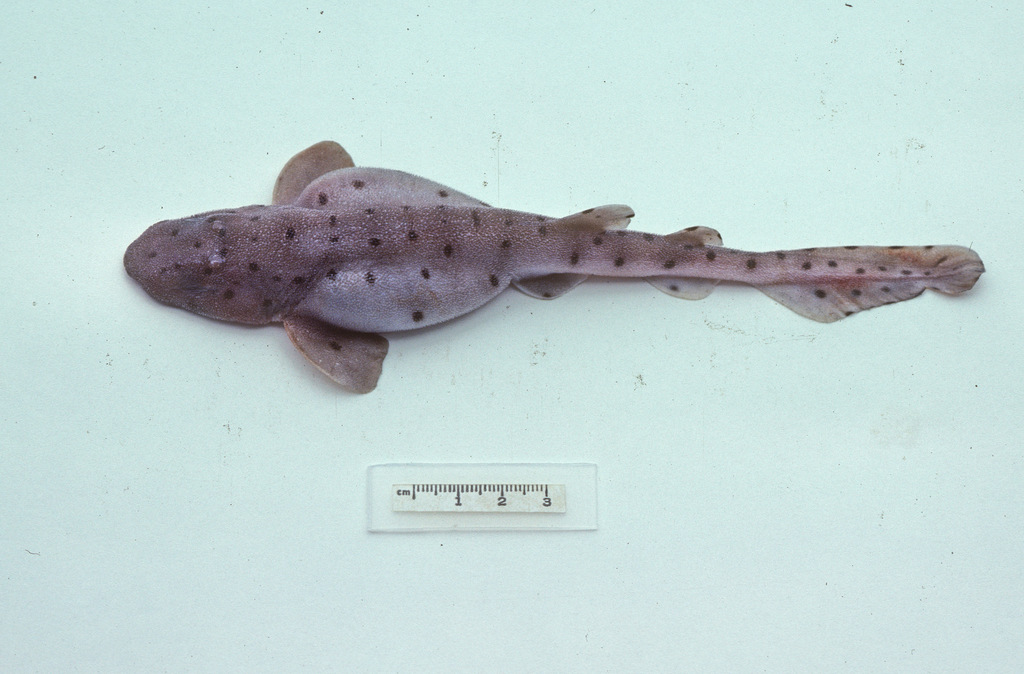
Saddled Swellshark
Cephaloscyllium variegatum
The saddled swellshark (Cephaloscyllium variegatum) is a rare species of catshark, and part of the family Scyliorhinidae, endemic to Eastern Australia. This bottom-dwelling species is found on the outer continental shelf and upper continental slope at a depth of 115–605 m (377–1,985 ft). It is a robustly built shark with a short, broad, flattened head and a capacious mouth. Adults are patterned with saddles on a brownish or grayish background, which varies between tropical and temperate sharks; juveniles are light-colored with many spots. This shark reaches 74 cm (29 in) in length. Like other swellsharks, it can inflate itself as a defensive measure. Reproduction is oviparous.
From the article Saddled swellshark on Wikipedia (CC BY-SA), quoted section by section
Description
The saddled swellshark reaches a maximum known length of 74 cm (29 in). It has a moderately stocky body and a short, variably wide, and strongly flattened head. The snout is broadly rounded, with the nostrils preceded by laterally expanded flaps of skin that do not reach the large mouth. The slit-like eyes are positioned high on the head and followed by tiny spiracles. The tooth rows number 68–82 in the upper jaw and 68–80 in the lower jaw. The very small teeth have three cusps, with the central one the longest and sometimes 1–2 additional lateral cusplets. In females the central cusp is smaller than in males. There are no furrows at the corners of the mouth, and the upper teeth are exposed when the mouth is closed. The fourth and fifth gill slits lie over the pectoral fin bases and are shorter than the first three. The pectoral fins are large and broad, with rounded margins. The first dorsal fin is fairly angular and originates over the middle of the pelvic fin bases. The second dorsal fin is much smaller and lower than the first, originating behind the anal fin origin. The pelvic fins are small, with elongate, relatively short claspers in males. The anal fin is substantially larger and deeper than the second dorsal fin. The caudal fin is deep, with a distinct lower lobe and a strong ventral notch near the tip of the upper lobe. …
Range & habitat
The saddled swellshark is found off the eastern coast of Australia, as far north as Rockingham Bay in Queensland and as far south as Tathra in New South Wales, and perhaps also the Britannia Seamount near Brisbane. It is a bottom-dwelling species that inhabits the outer continental shelf and upper continental slope at a depth of 115–605 m (377–1,985 ft).
Wikipedia: “Distribution and habitat”
What it does
Like other members of its genus, the variegated swellshark can inflate itself with water or air as a defensive measure. This species is oviparous, with its eggs contained in smooth, brownish capsules about 7 cm (2.8 in) long. The egg capsule is thick and rounded, with flanged lateral margins and a pair of horns at each end, which support very long, coiled tendrils. The smallest known free-swimming specimen measured 17 cm (6.7 in) long; males mature sexually at a length of 55–60 cm (22–24 in).
Wikipedia: “Biology and ecology”
Where it lives
Recorded sightings
—
geo-referenced records in GBIF, from museums, herbaria and field observers.
Drag the globe to turn it. Dots are where records exist, not a range map; darker means more records.
In the stacks
Searching the stacks…
Every page naming Cephaloscyllium variegatum in the Biodiversity Heritage Library →
This page is assembled live from iNaturalist, GBIF, Wikipedia, the Source Library and the Internet Archive. It is not yet part of the hand-edited codex. iNaturalist taxon 97018.