- Animals
- ›Chordates
- ›Vertebrates
- ›Cartilaginous Fishes
- ›Sharks and Rays
- ›Sharks
- ›Galean Sharks
- ›Ground Sharks
- ›Catsharks
- ›Cephaloscyllium
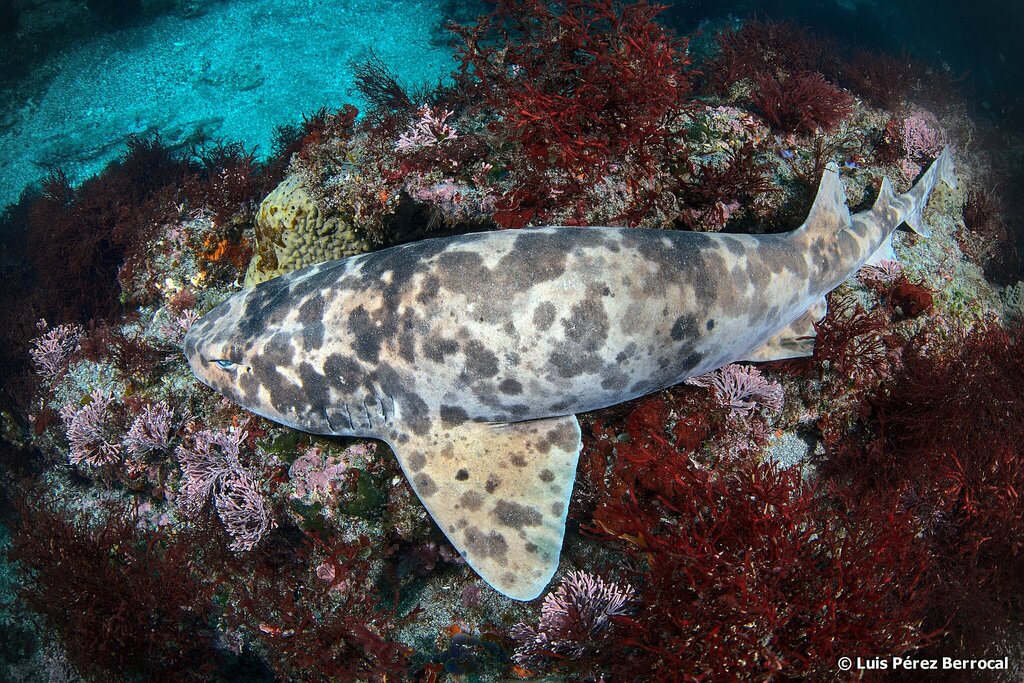
Japanese Swellshark
Cephaloscyllium umbratile
The blotchy swellshark or Japanese swellshark (Cephaloscyllium umbratile) is a common species of catshark, belonging to the family Scyliorhinidae. The Blotchy swellshark is found at depths of 90–200 m (300–660 ft) in the northwestern Pacific Ocean, from Japan to Taiwan. It is benthic in nature and favors rocky reefs. Reaching 1.4 m (4.6 ft) in length, this thick-bodied shark has a broad head, large mouth, and two unequally-sized dorsal fins positioned far back past the pelvic fins. It can be identified by its dorsal coloration, consisting of seven brown "saddles" and extensive darker mottling on a light tan background. This species has often been confounded with the draughtsboard shark (C. isabellum) and the Sarawak pygmy swellshark (C. sarawakensis) in scientific literature.
Voracious and opportunistic in feeding habits, the blotchy swellshark is known to consume numerous types of fishes and invertebrates, including an unusually high diversity of cartilaginous fishes. Like other Cephaloscyllium species, it is capable of rapidly inflating its body as a defense against predators. This species is oviparous, with females laying encapsulated eggs two at a time. There is no well-defined breeding season and reproduction occurs year-round. The eggs hatch after approximately one year. The blotchy swellshark is harmless and fares well in captivity. It is caught as bycatch in commercial bottom trawls, though its population does not seem to have suffered from fishing activity.
From the article Blotchy swellshark on Wikipedia (CC BY-SA), quoted section by section
Description
The maximum reported length of the blotchy swellshark is 1.4 m (4.6 ft). It has a firm, stout body with a soft, distensible abdomen, and a short, broad, flattened head. The snout is proportionately long and rounded, with large nostrils divided by short, triangular flaps of skin in front. The small, horizontally oval eyes are placed high on the head and equipped with rudimentary nictitating membranes (protective third eyelids). A tiny spiracle lies closely behind each eye. Behind the spiracle are five pairs of gill slits, which are short and become progressively smaller posteriorly. The capacious mouth forms a broad arch, and lacks furrows at the corners. The small teeth have a central cusp flanked by a smaller cusplet on both sides. There are around 59 tooth rows in the upper jaw and 62 tooth rows in the lower jaw. The pectoral fins are moderately large and wide, with rounded tips. The dorsal fins have rounded apexes and are placed well back on the body, the first originating behind the midpoints of the small pelvic fins. The first dorsal fin is about twice as high as the second. The anal fin is nearly as large as the first dorsal fin and placed slightly ahead of the second dorsal fin. The caudal fin is large and broad, with the upper lobe longer than the lower and bearing a prominent ventral notch near the tip. …
Range & habitat
The blotchy swellshark is known to inhabit the northwestern Pacific Ocean from Hokkaido, Japan southward to Taiwan, including the Yellow Sea. Its range may extend as far as New Guinea. This abundant species is a bottom-dweller that inhabits rocky reefs on the continental shelf, at depths of 90–200 m (300–660 ft).
Wikipedia: “Distribution and habitat”
What it does
Like other members of its genus, when threatened the blotchy swellshark is capable of rapidly inflating its stomach with water or air. This allows the shark to wedge itself inside a rocky crevice, becoming extremely difficult to remove. This species is an opportunistic, highly voracious predator; one recorded female 1 m (3.3 ft) long had 10 fish about 20 cm (7.9 in) long and 15 squid about 15 cm (5.9 in) long in her stomach. Predominantly piscivorous, this species is known to prey upon hagfish and at least 50 species of bony fishes, including fast-swimming types that inhabit open water; significant prey species include the mackerel Scomber japonicus, the sardine Sardinops melanostictus, the filefish Thamnaconus modestus, and the hakeling Physiculus japonicus. Unusually for such a small shark, it also feeds on at least 10 species of cartilaginous fishes, including lantern sharks, catsharks (particularly the cloudy catshark, Scyliorhinus torazame, and its eggs), the electric ray Narke japonica, and skates (including their eggs). It also cannibalizes smaller members of its own species. Cephalopods, mostly the squid Doryteuthis bleekeri and the cuttlefish Sepia spp., are also frequently taken, while crabs, shrimp, and isopods are occasionally consumed. …
Wikipedia: “Biology and ecology”
Where it lives
Recorded sightings
—
geo-referenced records in GBIF, from museums, herbaria and field observers.
Drag the globe to turn it. Dots are where records exist, not a range map; darker means more records.
In the stacks
Searching the stacks…
Every page naming Cephaloscyllium umbratile in the Biodiversity Heritage Library →
This page is assembled live from iNaturalist, GBIF, Wikipedia, the Source Library and the Internet Archive. It is not yet part of the hand-edited codex. iNaturalist taxon 97017.