- Animals
- ›Chordates
- ›Vertebrates
- ›Cartilaginous Fishes
- ›Sharks and Rays
- ›Sharks
- ›Squalean Sharks
- ›Squaliform Sharks
- ›Lantern Sharks
- ›Centroscyllium
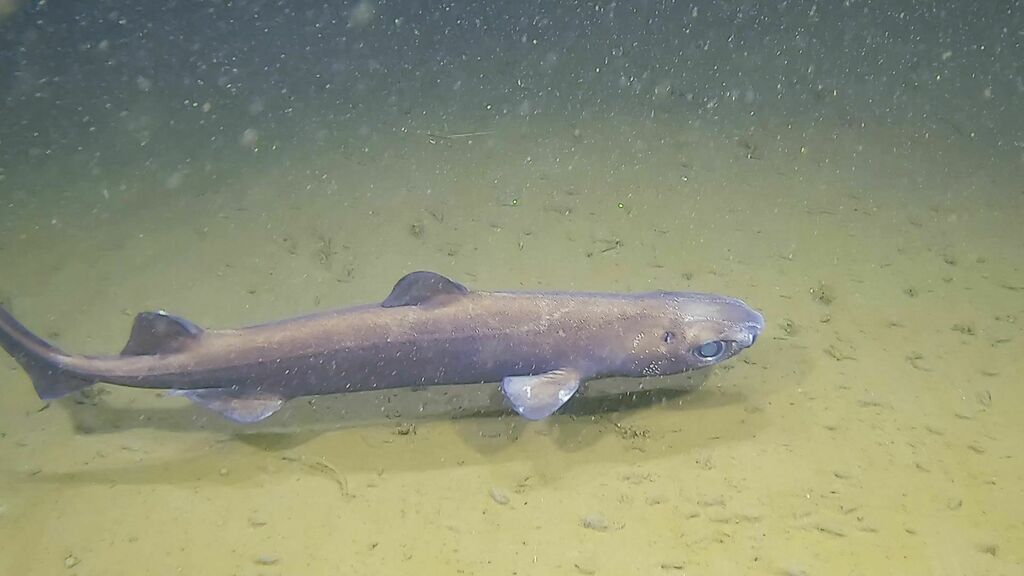
Black Dogfish
Centroscyllium fabricii
The black dogfish (Centroscyllium fabricii) is a species of dogfish shark in the family Etmopteridae. It is common over the outer continental shelf and continental slope at depths of 180–2,250 m (590–7,380 ft). Females generally inhabit deeper water than males, and depending on the region, smaller sharks may occur at different depths than larger ones. This species is distributed widely in the Atlantic Ocean, from Greenland and Iceland to Virginia and West Africa in the north, and off southwestern Africa and Argentina in the south. The largest member of its family, the black dogfish, typically measures 60–75 cm (24–30 in) long. It has a stocky, dark brown body that is darker below than above, and bears scattered, minute bioluminescent organs. Its two dorsal fins are preceded by stout spines, and the anal fin is absent.
Active and schooling, the black dogfish is an opportunistic predator and scavenger that mainly consumes bony fishes, crustaceans, and cephalopods. It is aplacental viviparous, with females producing litters of four to 40 pups that are sustained to term by a yolk sac. There is no well-defined breeding season, and mating and birthing take place year-round. The black dogfish contributes significantly to the bycatch of deep-sea commercial fisheries operating in the North Atlantic; it is of little commercial value and is usually discarded.
From the article Black dogfish on Wikipedia (CC BY-SA), quoted section by section
Description
Adult black dogfish typically measure 60–75 cm (24–30 in) in length and can reach 1.1 m (3.6 ft), making it the largest member of its family. Females attain a larger ultimate size than males. The shark has a rather stocky and laterally compressed body, with a moderately long, thick, and flattened snout that forms a very broad arch at the front. The sizable, horizontally oval eyes are a reflective green in life and lack nictitating membranes (protective third eyelids); they are followed a short distance behind by much smaller spiracles (accessory respiratory openings). The nostrils are anteriorly placed and preceded by short flaps of skin. The mouth is wide and evenly arched, with thin lips and short but deep furrows around the corners. There are around 34 tooth rows in either side of both jaws; each tooth has three (occasionally up to five) slender cusps, with the central one the longest. Both dorsal fins are immediately preceded by stout, grooved spines, with the second much longer than the first. The small first dorsal fin has a rounded apex and a nearly straight trailing margin, with its origin lying behind the pectoral fins. The second dorsal fin is rather angular and has about double the area of the first, with its origin located opposite the midpoint of the pelvic fin bases. The pectoral fins are small and rounded. …
Range & habitat
The black dogfish is a common species, with a wide but discontinuous distribution in the temperate waters of the Atlantic Ocean; its range abuts, but does not extend into, the Arctic Ocean. In the northeast, it occurs from Iceland to Sierra Leone, including the Faroe Islands, southern Norway, and the Rockall Trough and Porcupine Seabight off Ireland. In the northwest, it is found from southern Greenland and Baffin Island to Virginia, being particularly abundant in the Laurentian Channel, and may occur further south to the Gulf of Mexico off Alabama. In the southeast, it is found off Namibia and South Africa as far as Cape Agulhas. In the southwest, it has been recorded from the Beagle Channel at the southern tip of Argentina. Inhabiting the outer continental shelf and continental slope, the black dogfish is found mostly near the bottom in water 180–2,250 m (590–7,380 ft) deep. It is most common at depths of 800–1,200 m (2,600–3,900 ft) off Iceland, 1,250–1,500 m (4,100–4,920 ft) in the Rockall Trough, 500–1,300 m (1,600–4,300 ft) off Greenland, 350–500 m (1,150–1,640 ft) off northern Canada, and below 500 m (1,600 ft) off southern Africa. The species may venture closer to the surface in the northern extreme of its range, particularly during the dark, cold winter months. …
Wikipedia: “Distribution and habitat”
What it does
The black dogfish forms shoals or schools that tend to be larger during the winter and spring. Though fairly active, its swimming muscles exhibit lower activity of glycolytic enzymes and higher activity of creatine phosphokinase compared to the shallow-water spiny dogfish (Squalus acanthias), suggesting a lesser capacity for bursts of speed. The lipid-filled liver comprises about one-fifth of its total weight and functions in maintaining neutral buoyancy. Potential predators of the black dogfish are larger sharks and bony fishes. It is one of several deep-sea sharks parasitized by the barnacle Anelasma squalicola, which attaches in front of the second dorsal fin and impairs the reproductive development of its host. Other known parasites of this species include the fluke Otodistomum cestoides, the copepods Neoalbionella fabricii and Neoalbionella centroscyllii, and the protozoans Haemogregarina delagei and Trypanosoma rajae.
Apparently opportunistic in feeding habits, the black dogfish typically hunts in open water, but also scavenges off the bottom. The bulk of its diet consists of a variety of bony fishes, including rattails, whitings, rockfishes, lanternfishes, and barracudinas, as well as pelagic crustaceans such as krill and shrimp, and cephalopods. Fish become a progressively more important food source as the shark ages, while crustaceans become less important. …
Wikipedia: “Biology and ecology”
Where it lives
Recorded sightings
—
geo-referenced records in GBIF, from museums, herbaria and field observers.
Drag the globe to turn it. Dots are where records exist, not a range map; darker means more records.
In the stacks
Searching the stacks…
Every page naming Centroscyllium fabricii in the Biodiversity Heritage Library →
This page is assembled live from iNaturalist, GBIF, Wikipedia, the Source Library and the Internet Archive. It is not yet part of the hand-edited codex. iNaturalist taxon 96968.