- Animals
- ›Chordates
- ›Vertebrates
- ›Ray-finned Fishes
- ›Carps, Characins, Catfishes and Allies
- ›Minnows, Suckers, Carps, and Loaches
- ›Suckers
- ›Suckers
- ›Typical Suckers
- ›Catostomus
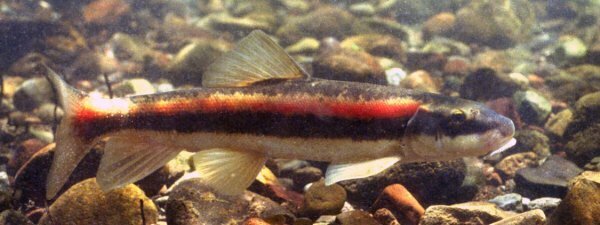
Tahoe sucker
Catostomus tahoensis
The Tahoe sucker (Catostomus tahoensis) is a freshwater Cypriniform fish inhabiting the Great Basin region of the Western United States.
From the article Tahoe sucker on Wikipedia (CC BY-SA), quoted section by section
Description
The Tahoe sucker is a large, long fish with a tapering head. It can grow up to 24 inches (610 mm) in larger lakes, but rarely exceeds 6 inches (152.4 mm) in streams. Its rather large suckermouth is located on the bottom of the head, commonly referred to as a subterminal mouth. Where its lower lips are thick and fleshy, its upper lips contain 2–4 rows of papillae. The caudal fin is moderately forked. There are 83 to 87 scales in the lateral line. They are very dark above, lighter below, with dusky fins. Breeding males display a bright red lateral line and breeding tubercles on the anal fin and tail.
Range & habitat
These fish are native to the Lahontan Basin of southeastern Oregon, Nevada, and northeastern California, and southwestern Idaho, as seen in the image below.
The Tahoe sucker is one of the most common fishes found in the Lahontan Basin, making up a majority of the native fish populations. It has also been introduced into the upper Sacramento River system. The total adult population is believed to number over 100,000, and it is considered to be common or abundant in its various habitats. The Tahoe sucker is considered a stream generalist, however it reaches its greatest size and numbers in lakes and reservoirs. They are predominantly found in cool streams, but are capable of withstanding temperatures of around 25 °C (77 °F). In Lakes, Suckers may grow to exceed 60 centimetres (24 in) in length, compared to 15 centimetres (5.9 in) in streams. Suckers are able to grow to such larger sizes in lakes by feeding along the bottom of the lake, sometimes as deep as 300 metres (980 ft). Adults occupy moderate to deeper depths. Young are found in shallow waters or tributary streams, where water travels slower.
Occupied watersheds. …
Wikipedia: “Distribution and habitat”
What it does
The Trophic position of Tahoe suckers within Cascade Lake indicates a primarily small organism based-diet. Tahoe suckers are omnivorous, and feed on a mix of algae, detritus, and various forms of invertebrates. Suckers typically feed at night time, in order to avoid predation from larger fish such as Lake Trout. While Suckers are still juvenile they feed on Cladocera's and small organisms found in or around algae.
Wikipedia: “Diet habits”
Where it lives
Recorded sightings
—
geo-referenced records in GBIF, from museums, herbaria and field observers.
Drag the globe to turn it. Dots are where records exist, not a range map; darker means more records.
In the stacks
Searching the stacks…
Every page naming Catostomus tahoensis in the Biodiversity Heritage Library →
This page is assembled live from iNaturalist, GBIF, Wikipedia, the Source Library and the Internet Archive. It is not yet part of the hand-edited codex. iNaturalist taxon 96874.