- Animals
- ›Chordates
- ›Vertebrates
- ›Cartilaginous Fishes
- ›Sharks and Rays
- ›Sharks
- ›Galean Sharks
- ›Ground Sharks
- ›Requiem Sharks
- ›Carcharhinus
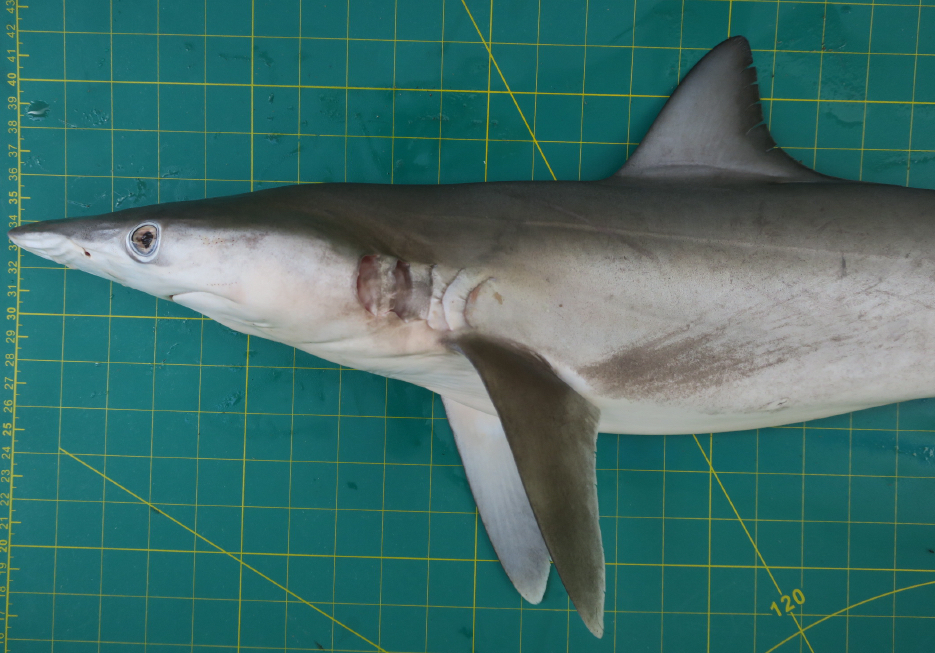
Hardnose Shark
Carcharhinus macloti
The hardnose shark (Carcharhinus macloti) is a species of requiem shark, in the family Carcharhinidae, so named because of the heavily calcified cartilages in its snout. A small bronze-coloured shark reaching a length of 1.1 m (3.6 ft), it has a slender body and a long, pointed snout. Its two modestly sized dorsal fins have distinctively elongated rear tips. The hardnose shark is widely distributed in the western Indo-Pacific, from Kenya to southern China and northern Australia. It inhabits warm, shallow waters close to shore.
Common and gregarious, the hardnose shark is a predator of bony fishes, cephalopods, and crustaceans. This species is viviparous, with the growing embryos sustained to term via a placental connection to their mother. Females have a biennial reproductive cycle and bear litters of one or two pups after a twelve-month gestation period. The hardnose shark is fished for meat throughout its range and, given its low reproductive rate, the International Union for Conservation of Nature (IUCN) has listed it as Near Threatened.
From the article Hardnose shark on Wikipedia (CC BY-SA), quoted section by section
Description
The hardnose shark is a slim-bodied species with a long, narrow, and pointed snout. Unlike in other Carcharhinus species, its rostral (snout) cartilages are highly calcified, hence the name "hardnose". The circular eyes are rather large and equipped with protective nictitating membranes. There is a narrow lobe of skin on the anterior rim of each nostril. The arched mouth bears inconspicuous furrows at the corners; some sources report that the hyomandibular pores (a series of pores above the corners of the mouth) are enlarged, while others report that they are not. The upper teeth number 29–32 rows and have a narrow, smooth-edged central cusp with very coarse serrations at the base on either side. The lower teeth number 26–29 rows and are narrow and smooth-edged. There are five pairs of fairly short gill slits. The pectoral fins are fairly short and pointed, with a falcate (sickle-like) shape. The first dorsal fin is medium-sized and triangular, and originates roughly over the pectoral fin free rear tips. The second dorsal fin is small and low, and originates over the middle of the anal fin base. Both dorsal fins have very long free rear tips, and there is a subtle midline ridge between them. A prominent notch is present on the caudal peduncle at the dorsal origin of the caudal fin. …
Range & habitat
The hardnose shark is common and widely distributed in the tropical western Indo-Pacific. It is found from Kenya to Myanmar in the Indian Ocean, including Sri Lanka and the Andaman Islands. In the Pacific Ocean, it is found from Vietnam to Taiwan and southern Japan, in Indonesia, and off New Guinea and northern Australia. It is usually found in shallow, inshore waters, but has been reported to a depth of 170 m (560 ft). Tagging data has shown that this shark tends not to make long-distance movements, with 30% of re-caught individuals having moved less than 50 km (30 mi) from their initial tagging location. The longest known distance travelled by an individual is 711 km (442 mi).
Wikipedia: “Distribution and habitat”
What it does
The hardnose shark forms large groups, often associating with spottail sharks and Australian blacktip sharks (C. tilstoni). Males and females generally roam separately from each other. Bony fishes form the main part of this shark's diet, with cephalopods and crustaceans making up the remainder. Parasites of this species include the nematode Acanthocheilus rotundatus and the tapeworm Otobothrium carcharidis. The hardnose shark is viviparous; like in other requiem sharks, once the embryos exhaust their yolk supply, the empty yolk sac develops into a placental connection through which the mother provides nutrition. Females give birth once every other year to one or two pups, following a gestation period of twelve months. Newborns measure 45–55 cm (18–22 in) long, and sexual maturity is attained at 70–75 cm (28–30 in) long. The maximum lifespan is at least 15–20 years.
Wikipedia: “Biology and ecology”
Where it lives
Recorded sightings
—
geo-referenced records in GBIF, from museums, herbaria and field observers.
Drag the globe to turn it. Dots are where records exist, not a range map; darker means more records.
In the stacks
Searching the stacks…
Every page naming Carcharhinus macloti in the Biodiversity Heritage Library →
This page is assembled live from iNaturalist, GBIF, Wikipedia, the Source Library and the Internet Archive. It is not yet part of the hand-edited codex. iNaturalist taxon 96761.