- Animals
- ›Chordates
- ›Vertebrates
- ›Reptiles
- ›Snakes and Lizards
- ›Lizards
- ›Skinks and allies
- ›Skinks
- ›Eugongyline skinks
- ›Oligosoma
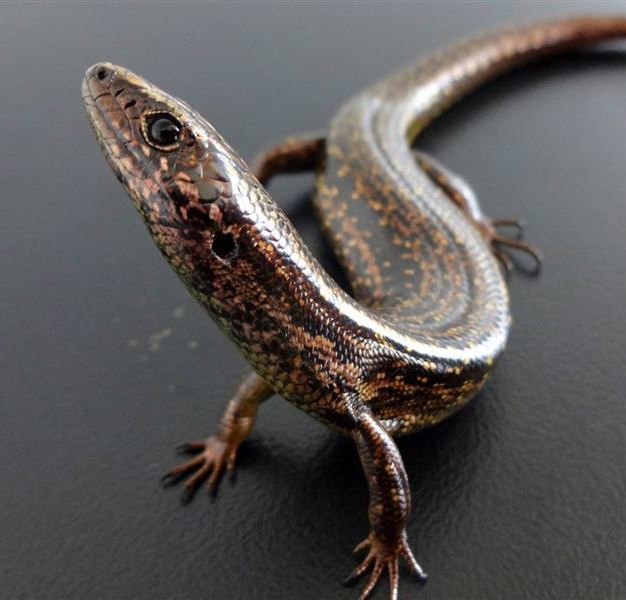
Chesterfield Skink
Oligosoma salmo
The Chesterfield or Kapitia skink (Oligosoma salmo) is a species of skink found in New Zealand. Only discovered in 1994 and for years not recognised as a distinct species, it is endemic to a narrow 1 km strip of coastal vegetation on the West Coast of New Zealand, 15 km north of Hokitika. There are fewer than 200 individuals remaining in the wild. Oligosoma salmo is the only New Zealand skink with a prehensile tail, suggesting it was once arboreal and inhabited coastal forest, which was subsequently cleared for dairy farming. Following the partial destruction of its remaining habitat in 2018 by a cyclone, a small captive breeding population was established at Auckland Zoo.
From the article Oligosoma salmo on Wikipedia (CC BY-SA), quoted section by section
Description
O. salmo is similar to the speckled skink (O. infrapunctatum), but with a more slender build, glossier, and with its distinctive patterning underneath the tail. Kapitia skinks are up to 85 mm from snout to vent (usually < 75 mm, typically 65–75 mm) with a tail longer than the body. They weigh up to 10.5 g. Their back is brown with light and dark flecks and no mid-dorsal stripe; their underside is yellow and unmarked, with a pinkish tinge around the throat. They have a golden, glossy sheen. The underside of the tail begins yellow and then changes abruptly to a mottled pattern of scales in grey, black, and a distinctive shade of pinkish orange. Down each flank is a red-brown stripe, edged in black and flecked and fringed with a pale band above and below with heavily notched margins. The pattern of notches and flecks in the lateral band is unique for each skink, and can be used to identify captured individuals.
Range & habitat
Chesterfield is an area mostly composed of dairy farms with few houses. To the west is the Tasman Sea, and to the east State Highway 6 and a plateau of regenerating scrub. O. salmo are found in a small strip of coastal vegetation approximately 1 km long and only 5 m wide. Since their discovery in the 1990s, their pasture habitat has been converted into dairy farms, and they only occur in highly modified non-native vegetation between dairy paddocks and beachfront sand dunes, sheltering under debris (such as discarded corrugated iron), driftwood, shrubs, and rough pasture grass. Unlike all other New Zealand skinks, this species has a prehensile tail it uses to grip objects and aid climbing. Researchers noticed that when they picked up a Chesterfield skink, it would wrap its tail about their fingers, something a speckled skink could not do. The tail has a noticeably firm grip, with the contracted muscles forming ridges along its length, and is able to suspend the entire skink unaided. This suggests O. salmo is adapted to climbing trees, and that its current habitat is what remained when the coastal forest behind the beach was cleared for farming.
Wikipedia: “Range and habitat”
What it does
Kapitia skinks reach sexual maturity relatively slowly, at about 4 years of age, and give birth in late summer, around February (like all but one of New Zealand's native skinks, they bear live young rather than lay eggs). One of the skinks captured in 2018 and sent to Auckland Zoo subsequently gave birth to five young. These skinks primarily hunt invertebrates, but may have fed on berries before the coastal forest was cleared. They are diurnal, basking in the sun, but hiding if disturbed.
Wikipedia: “Ecology”
Where it lives
Recorded sightings
—
geo-referenced records in GBIF, from museums, herbaria and field observers.
Drag the globe to turn it. Dots are where records exist, not a range map; darker means more records.
In the stacks
Searching the stacks…
Every page naming Oligosoma salmo in the Biodiversity Heritage Library →
This page is assembled live from iNaturalist, GBIF, Wikipedia, the Source Library and the Internet Archive. It is not yet part of the hand-edited codex. iNaturalist taxon 965976.