- Animals
- ›Chordates
- ›Vertebrates
- ›Cartilaginous Fishes
- ›Chimaeras
- ›Chimaeras
- ›Plownose Chimaeras
- ›Callorhinchus
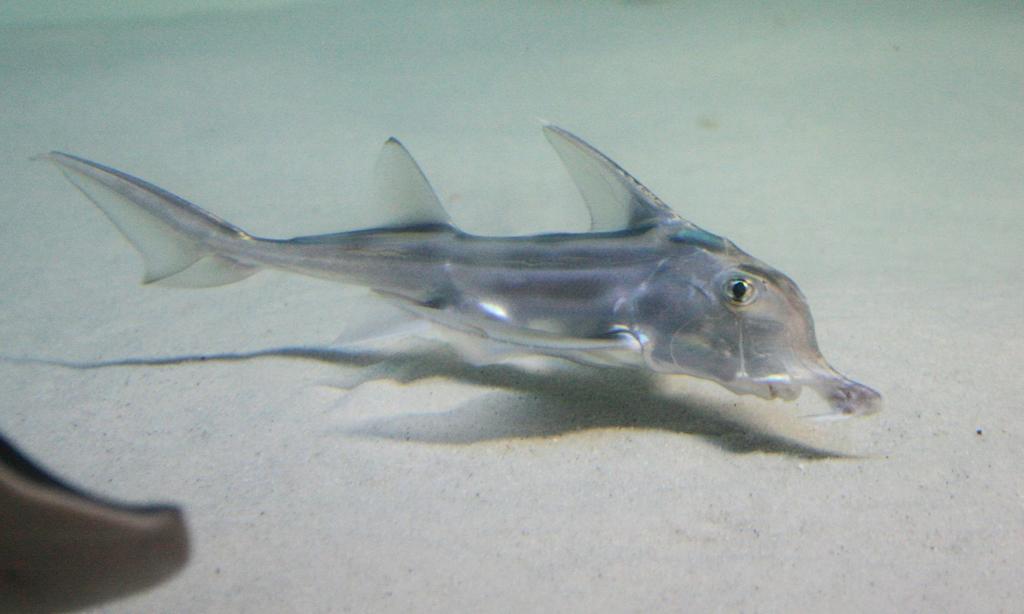
Cape Elephantfish
Callorhinchus capensis
The Cape elephantfish (Callorhinchus capensis) is species of chimaera (a type of cartilaginous fish) in the genus Callorhinchus. It is native to the waters surrounding South Africa. It is sometimes called the St Joseph shark, though it is not a true shark.
From the article Cape elephantfish on Wikipedia (CC BY-SA), quoted section by section
Description
Adult Cape elephantfish can be anywhere from 45–120 centimetres (1.48–3.94 ft) in length and weigh between 3–5 kilograms (6.6–11.0 lb) with females tending to be larger than males. They are silver to bronze overall and generally have a more yellowish hue than their close relatives in the genus Callorhinchus. They have a dark band down the middle of the back which the dorsal fins interrupt and the fins tend to be a bit darker than the rest of the body. Cape elephantfish have two dorsal fins which are very distant from each other on the back, the second being slightly longer than the first. The primary dorsal fin begins before the insertion of the pectoral fins and has a long venomous spine on its anterior side which is free from the fin in its upper ¾ section. This spine is serrated at its tip. The secondary dorsal fin begins posterior to the base of the pelvic fins and ends just at the base of the caudal (tail) fin. The caudal fin itself is heterocercal, meaning the vertebral column extends into the upper lobe and consists of two lobes separated by a deep notch. They have enlarged pectoral fins which allow them to swim slowly at the bottom of the water column. This feature as well as the reduced caudal fin is exhibited by many deep water, slow moving fish as adaptations for this lifestyle. …
Range & habitat
Cape elephantfish are found on continental shelves in the waters surrounding South Africa, and are the only members of the Callorhinchus genus in this area. They have been reported as far north as Natal and Namibia. They are found down to 399 metres (1,309 ft) deep but they become less common with increasing depth. Cape elephantfish prefer habitat in sheltered bays with cold, murky water and soft substrate. Juveniles tend to be found closer to shore while the larger adults can be found further from shore and at deeper depth. They are only found in salt water and never in brackish or fresh water.
Wikipedia: “Distribution”
What it does
Cape elephantfish feed on bottom-dwelling invertebrates found in the soft substrate of their habitat. They use their proboscis to probe in this substrate for food items. They most commonly feed on bivalves (Most frequently Phaxas decipens) and crustaceans, but occasionally eat gastropods such as Nassarius speciosus, polychaetes, and even some fish like the Southern African anchovy (Engraulis capensis). The Cape elephantfish is nocturnal (more active at night than during the day). Cape elephantfish are preyed upon by Cape fur seals and sharks. Recent evidence has suggested that seals prey on Chondrichthyans more than we previously suspected. This was difficult to discover as these fish do not leave behind hard parts for researchers to find in scat, such as bones or otoliths, like teleostian fish do. Chondrichthyans such as Cape elephantfish are preyed upon by pinnipeds at depths of up to at least 600m off the coasts of Namibia and South Africa, and Cape elephantfish are particularly vulnerable as they are the only chondrichthyan in the southeastern Atlantic that regularly seeks out shallow water. Researchers monitoring Cape fur seals have found many seals dead or injured due to Cape elephantfish spines embedded in their necks. …
Wikipedia: “Ecology”
Where it lives
Recorded sightings
—
geo-referenced records in GBIF, from museums, herbaria and field observers.
Drag the globe to turn it. Dots are where records exist, not a range map; darker means more records.
In the stacks
Searching the stacks…
Every page naming Callorhinchus capensis in the Biodiversity Heritage Library →
This page is assembled live from iNaturalist, GBIF, Wikipedia, the Source Library and the Internet Archive. It is not yet part of the hand-edited codex. iNaturalist taxon 96474.