- Fungi Including Lichens
- ›Ascomycete Fungi
- ›Sac Fungi and Lichens
- ›Leotiomycetes
- ›Helotiales
- ›Drepanopezizaceae
- ›Blumeriella
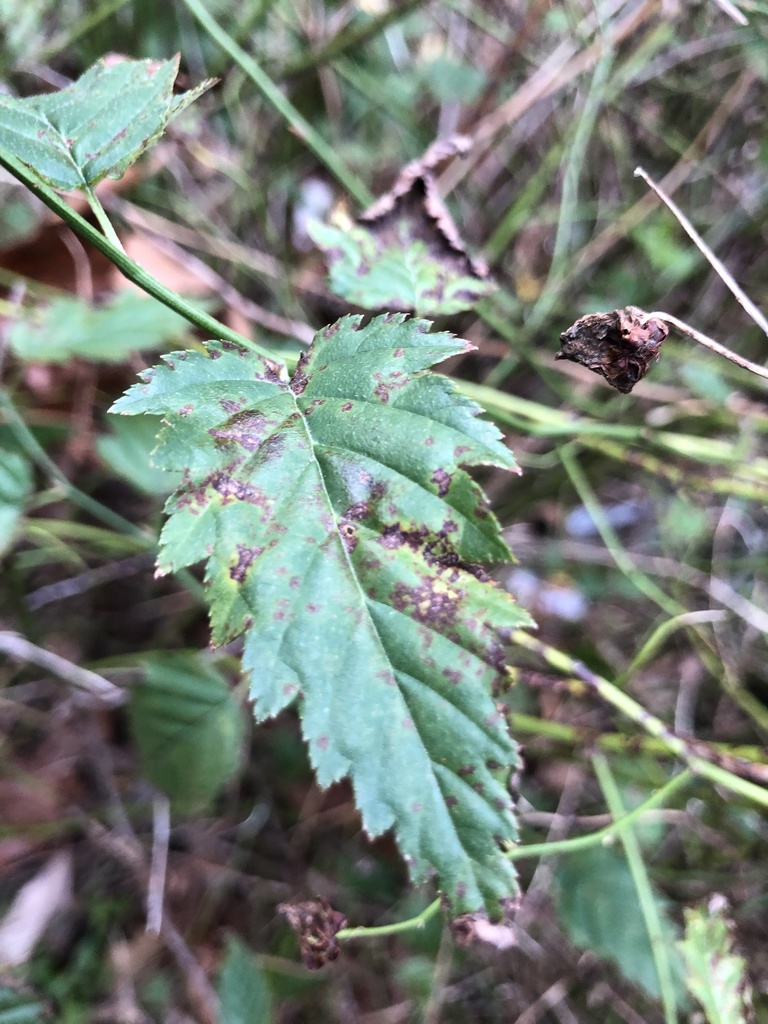
Blumeriella kerriae
Blumeriella kerriae is a species of fungus in the family Drepanopezizaceae.
From the article Blumeriella kerriae on Wikipedia (CC BY-SA), quoted section by section
Description
The structures of this fungal pathogen appear on both sides of the leaves of the plant as small red-brown spots, typically measuring 1-5mm in diameter, with dark purple borders. On the stem, the lesions caused by the pathogen are slightly sunken and purple-brown in color. If the pathogen is allowed to spread, the lesions will eventually take over and the plant will turn brown and then die. A key diagnostic feature of Blumeriella kerriae is the presence of acervuli containing conidiophores and conidia within the lesions and leaf spots. The spores may be visible as white clusters in the center of the spots, particularly in wet conditions. The conidia are filiform, curved, hyaline, and 1–3 septate. The morphology of Blumeriella kerriae is an important factor in identifying and managing the disease, as it helps distinguish it from other plant pathogens that may cause similar symptoms.
Range & habitat
Blumeriella kerriae is limited to the leaves and stems of plants in the Kerria genus, which includes early flowering, deciduous shrubs that are common in gardens. The most popular of these shrubs is Kerria japonica, commonly known as Japanese Kerria. These shrubs grow in full to part-shade landscapes and are cold hardy. They grow best in USDA zones 4 through 9, UK zone 4, and central and southern China to southern Korea and Japan. The fungus thrives in moist conditions, and can quickly become difficult to control. Due to these factors, the popularity of Kerria shrubs has dropped significantly in areas where Blumeriella kerriae has been identified.
Wikipedia: “Habitat and distribution”
Where it lives
Recorded sightings
—
geo-referenced records in GBIF, from museums, herbaria and field observers.
Drag the globe to turn it. Dots are where records exist, not a range map; darker means more records.
In the stacks
Searching the stacks…
Every page naming Blumeriella kerriae in the Biodiversity Heritage Library →
This page is assembled live from iNaturalist, GBIF, Wikipedia, the Source Library and the Internet Archive. It is not yet part of the hand-edited codex. iNaturalist taxon 963955.