- Fungi Including Lichens
- ›Ascomycete Fungi
- ›Sac Fungi and Lichens
- ›Arthoniomycetes
- ›Arthoniales
- ›Roccellaceae
- ›Dirina
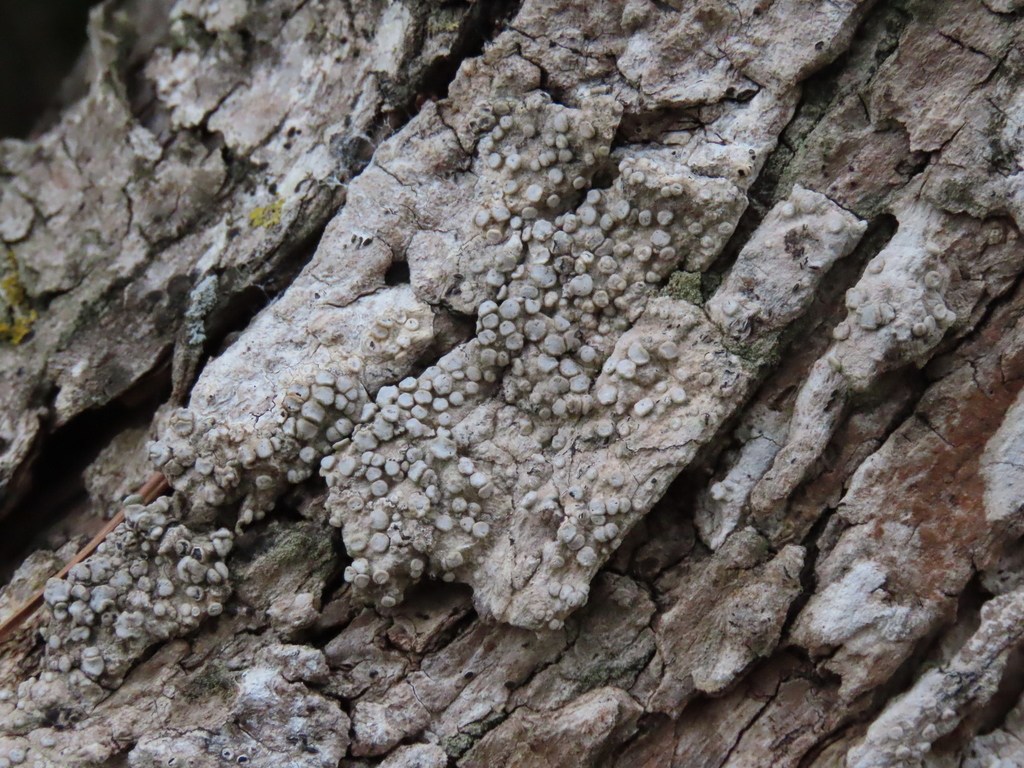
Dirina ceratoniae
Dirina ceratoniae is a species of crustose lichen in the family Roccellaceae. It is found in Europe, where it grows on both bark and on calcium-rich rock. The lichen was formally described as a new species in 1810 by Swedish lichenologist Erik Acharius. Elias Magnus Fries transferred the taxon to genus Dirina in 1831.
The lichen has a creamy white to whitish-green thallus with a slightly roughened surface that is 0.1–1.0 mm thick, and a chalk-like medulla. The soralia, if present (usually if apothecia are absent) are maculate to confluent. Apothecia, if present, have a circular outline, a diameter of 0.5–3.0 mm; the apothecial discs are pruinose, white- to dark grey in colour, and are surrounded by a thalline margin. Ascospores measure 21–26 by 4–5 μm. The expected results of chemical spot tests are C+ (red) on the thallus surface, C− on the medulla, and C+ (faintly red to negative) on the apothecial discs. Lichen products that occur in Dirina ceratoniae are erythrin, lecanoric acid, and an unidentified substance.
Where it lives
Recorded sightings
—
geo-referenced records in GBIF, from museums, herbaria and field observers.
Drag the globe to turn it. Dots are where records exist, not a range map; darker means more records.
In the stacks
Searching the stacks…
Every page naming Dirina ceratoniae in the Biodiversity Heritage Library →
This page is assembled live from iNaturalist, GBIF, Wikipedia, the Source Library and the Internet Archive. It is not yet part of the hand-edited codex. iNaturalist taxon 960985.