- Animals
- ›Chordates
- ›Vertebrates
- ›Birds
- ›Pelicans, Herons, Ibises, and Allies
- ›Ibises and Spoonbills
- ›Bostrychia
On eBird ↗
Sao Tome Ibis
Live sightings near you, the range map, bar charts of when it is seen, and Macaulay Library photos and recordings.
São Tomé Ibis
Bostrychia bocagei
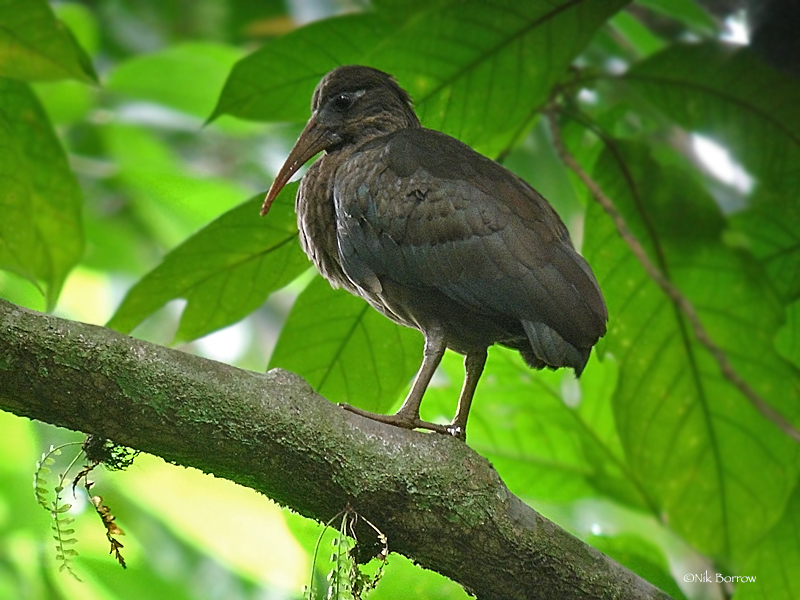
The São Tomé ibis (Bostrychia bocagei), also known as the dwarf olive ibis or the dwarf ibis, is a critically endangered bird that is endemic to São Tomé off the western coast of Central Africa in the Gulf of Guinea. Discovered in the 1800s by Francisco Newton, it was once thought to be a subspecies of the larger olive ibis, but is now classified as a distinct species.
Living with 19 other species of endemic birds on the island, the dwarf ibis is one of 10 that are threatened for extinction. B. bocagei prefers the southern forests almost exclusively living there in nests that are high up in the trees to avoid predators. Aside from predation, other common threats to the species include overhunting and habitat loss as a result of overexploitation of resources by the people of São Tomé. Although no specific conservation reforms have been enacted to help B. bocagei, indirect efforts to help biodiversity on São Tomé in general have been instituted, such as the ECOFAC program and the establishment of a national park.
From the article São Tomé ibis on Wikipedia (CC BY-SA), quoted section by section
Description
The São Tomé ibis measures 248 mm on its wings, 75 mm on its bill, 52 mm on its tarsus, and 95 mm on its tail, on average. The head is a dull olive color with black surrounding the eyes and the base of the bill. The tectrix (wing coverts) and mantle of the bird are slightly bronzed. Most of the time, the dwarf ibis is silent, but when it is disturbed, it gives off differing coughed grunts. When going to roost, it lets out a harsh honking. Its call could also be described as a stressed Walalalala.
Range & habitat
The São Tomé ibis was discovered in the late 1800s by Francisco Newton, a Portuguese collector, inhabiting the island of São Tomé off the coast of Western Africa. Alongside 19 other endemic species of birds, the São Tomé ibis is one of the 10 that are threatened for extinction, but little has been done to protect the island's very high biodiversity. It is found in primary forest below 450 m altitude, being seen almost exclusively in the southern forests. The decision of the ibis to nest higher up is related to predation avoidance. The nests appear both higher up and away from running water, most likely to avoid snakes and introduced mammals that could exploit the eggs, such as rats and Mona monkeys. Recently, it has been seen more and more in the newly created Obô Natural Park, which spans the majority of the western side of the island. It forages for food on the forest floor with sparse undergrowth, especially where the ground has been disturbed by feral pigs, and in swampy areas bordering watercourses.
Wikipedia: “Habitat and ecology”
What it does
B. Bocagei chooses to nest between 8m and 16m up in the trees in the forests. The nests were composed primarily of twigs and other biomass material, with leaves and feathers lining the inside. The nests had diameters of between 330 and 370 mm x 260–360 mm.
Wikipedia: “Behavior”
Listen
Looking for field recordings…
Where it lives
Recorded sightings
—
geo-referenced records in GBIF, from museums, herbaria and field observers.
Drag the globe to turn it. Dots are where records exist, not a range map; darker means more records.
In the stacks
Searching the stacks…
Every page naming Bostrychia bocagei in the Biodiversity Heritage Library →
This page is assembled live from iNaturalist, GBIF, Wikipedia, the Source Library and the Internet Archive. It is not yet part of the hand-edited codex. iNaturalist taxon 95892.