On eBird ↗
Mauritius Scops-Owl
Live sightings near you, the range map, bar charts of when it is seen, and Macaulay Library photos and recordings.
Mauritius Scops-Owl
Otus sauzieri
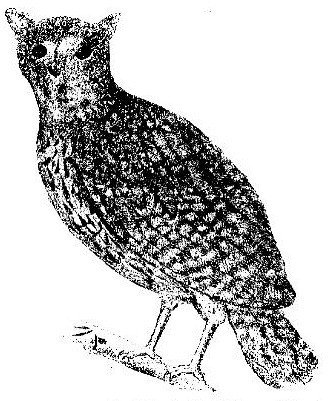
The Mauritius scops owl (Otus sauzieri), also known as the Mauritius owl or Mauritius lizard owl, is an extinct species of scops owl that lived on the Mascarene island of Mauritius. Contemporary accounts of owls include mentions in 17th-century reports from Mauritius, a drawing made around 1770, and a detailed description of a killed specimen from 1837. After the owls had disappeared, subfossils were found in the Mare aux Songes swamp. These remains became the basis of the new species Strix sauzieri in 1893 and two other species were later named: Scops commersoni based on the drawing and description in 1896, and Strix newtoni based on a smaller fossil in 1907.
Later writers doubted whether three distinct owl species had lived on Mauritius, and concluded in 1994 that the known evidence represented a single species. It was placed in the new genus Mascarenotus along with the extinct owls of the two other Mascarene Islands, the Rodrigues scops owl and the Réunion scops owl. A 2018 ancient DNA study found the Mascarene owls to be derived from different lineages within the scops owl genus Otus that originated in Southeast Asia, therefore not constituting their own genus, leaving the Mauritian species as O. sauzieri.
From the article Mauritius scops owl on Wikipedia (CC BY-SA), quoted section by section
Description
Unlike the other Mascarene owls, the external features of the Mauritius scops owl were recorded in detail, owing to Desjardins' description and Jossigny's drawing, which are still valuable for characterising the species. It was a large owl, with a body length of 36.5–42 cm (14.4–16.5 in), or an average of 39.5 cm (15.6 in), extrapolated from subfossils. This increased size was shared by the three Mascarene owls, whereas other Otus owls are smaller, with the largest extant species, the giant scops owl (O. gurneyi), reaching 30–35 cm (12–14 in). According to Desjardins, the wingspan of the Mauritius species was 59.4 cm (23.4 in), the wings were proportionally short and round, and the legs were long. The Mauritius scops owl had prominent, brown ear-tufts and featherless tarsi (the part between the ankle and the toes). The upper parts of the plumage were dark brown and the feathers of the head, neck and back had rufous edges. The tail was rufous-brown and was marbled with rufous. The wings were brown with irregular white, pale buff, and brown bands. The throat and sides of the body were whitish, and the rest of the underparts were dark buff with whitish spots. Its white eyebrows (or supercilia) and bristles were unique among the owl species in the Indian Ocean region. …
What it does
Nothing was recorded about the habits of the Mauritius scops owl. It was one of three birds of prey on Mauritius, and these probably occurred in all forest types. Mourer-Chauviré and colleagues pointed out in 1994 that in the two Caribbean owl species, long legs correlate with catching birds on islands where mammals are absent, and that the Mascarene owls could therefore have hunted similar prey. Cheke and Hume stated in 2008 that lizards were probably more abundant and easier to catch in the Mascarene Islands, and that the large size and long legs of the owls suggest they preyed on terrestrial lizards, probably forest skinks such as Telfair’s skink and the Macchabé skink, and perhaps small birds. The French sailor Julien Tafforet specifically stated in 1726 that the Rodrigues scops owl fed on small birds and lizards. Louchart and colleagues added in 2018 that as well as very large local skinks and geckos and occasional small or medium-sized birds, the owls probably also fed on introduced animals such as rats after humans arrived. Hume suggested in 2013 that the owl may have required large trees for nesting and roosting; Tafforet described similar behaviour for the Rodrigues species. …
Wikipedia: “Behaviour and ecology”
Listen
Looking for field recordings…
Where it lives
Recorded sightings
—
geo-referenced records in GBIF, from museums, herbaria and field observers.
Drag the globe to turn it. Dots are where records exist, not a range map; darker means more records.
In the stacks
Searching the stacks…
Every page naming Otus sauzieri in the Biodiversity Heritage Library →
This page is assembled live from iNaturalist, GBIF, Wikipedia, the Source Library and the Internet Archive. It is not yet part of the hand-edited codex. iNaturalist taxon 956116.