- Fungi Including Lichens
- ›Ascomycete Fungi
- ›Sac Fungi and Lichens
- ›Leotiomycetes
- ›Helotiales
- ›Pezizellaceae
- ›Calycina
- ›Calycina citrina
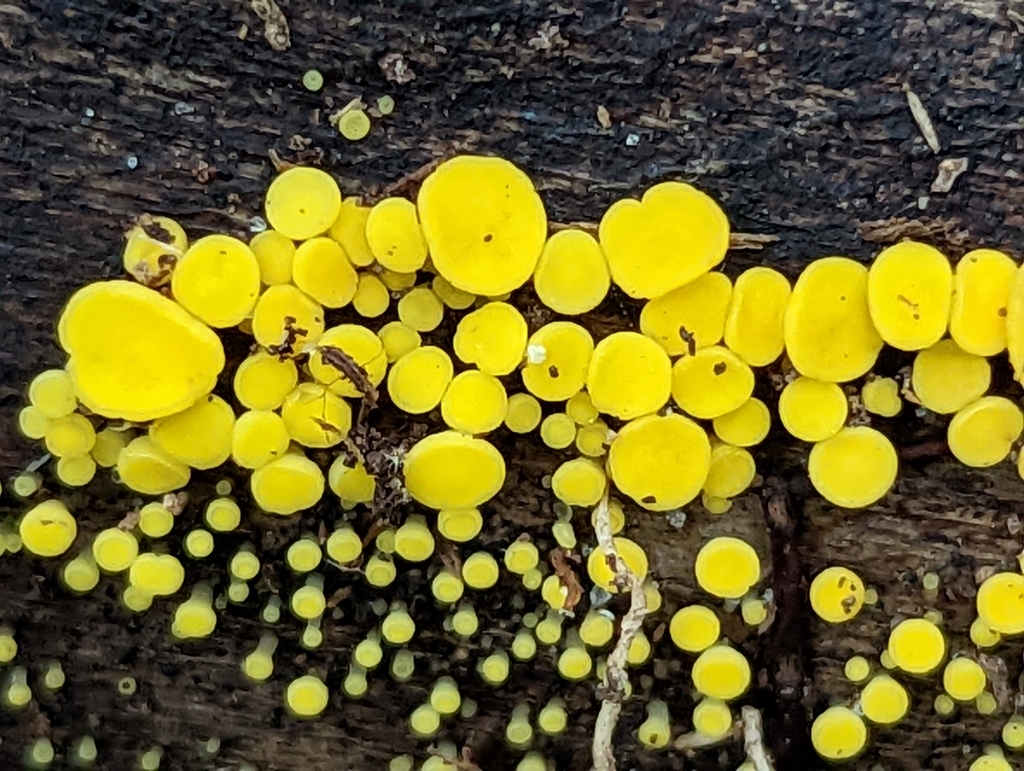
Yellow Fairy Cups
Calycina citrina
Calycina citrina, commonly known as yellow fairy cups or lemon discos, is a species of fungus in the family Pezizellaceae. The fungus produces tiny yellow cups up to 3 mm (1⁄8 in) in diameter, often without stalks, that fruit in groups or dense clusters on decaying deciduous wood that has lost its bark. The widely distributed species is found in North Africa, Asia, Europe, North America, and Central and South America. Found in late summer and autumn, the fungus is fairly common, but is easily overlooked owing to its small size. There are several similar species that can in most cases be distinguished by differences in color, morphology, or substrate. Microscopically, C. citrina can be distinguished from these lookalikes by its elliptical spores, which have a central partition, and an oil drop at each end.
From the article Calycina citrina on Wikipedia (CC BY-SA), quoted section by section
Description
Fruit bodies begin as spherical, closed globules, before expanding. The smooth, bright yellow fruit bodies are small—typically less than 3 mm (1⁄8 in) in diameter and up to 1 mm (1⁄32 in) high—and shallowly cup- or disc-shaped. The inner surface is smooth, and bright yellow, while the outer surface is a paler yellow. In mass, the spore color is white. The stalk is broad, pale yellow in color, and short to nearly absent; when present it is rarely more than 1 mm. The fruit bodies may be so numerous that their shapes are distorted by overcrowding. Fruit bodies that have dried are wrinkled and have a dull orangish-brown color. The fruit bodies have no distinctive taste nor odor, and are not edible. The smooth spores are roughly elliptical, measuring 8–14 by 3–5 μm; in maturity they have one cross-wall, and oil drops at either end. The asci (spore-bearing cells) measure 100–135 by 7–10 μm. The paraphyses are shaped liked narrow cylinders with diameters up to 1.5 μm, and have tips that are rounded or somewhat club-shaped. β-Carotene is the predominant pigment responsible for the yellow color of the fruit body.
Similar species. There are several small yellow discomycetes with which C. citrina might be confused. Lookalikes include the acorn cup (Hymenoscyphus fructigenus) that grows on fallen acorns and hickory nuts. …
Range & habitat
Calycina citrina is saprobic, and so obtains nutrients by breaking down complex organic molecules into simpler ones. Fruit bodies are typically encountered growing in dense clusters on the surface of rotten wood (especially deciduous trees), particularly beech. They have also been found growing on the fruit bodies of the polypore fungus Daedaleopsis confragosa. In a study of the succession of fungi associated with the decay of a 120-year-old healthy beech tree uprooted by strong winds, C. citrina was found on the wood about three years after the fall. It appeared after early colonizers such as Quaternaria quaternata, Tubercularia vulgaris (the anamorph form of Nectria cinnabarina), and Bulgaria inquinans, and was followed by Stereum hirsutum and Nectria cinnabarina.
Wikipedia: “Distribution”
What it does
The widespread fungus is known from North Africa, Asia, Europe, North America, Central and South America, Australia, and New Zealand. It is one of the most common of the small discomycetes.
Wikipedia: “Ecology”
Where it lives
Recorded sightings
—
geo-referenced records in GBIF, from museums, herbaria and field observers.
Drag the globe to turn it. Dots are where records exist, not a range map; darker means more records.
In the stacks
Searching the stacks…
Every page naming Calycina citrina in the Biodiversity Heritage Library →
This page is assembled live from iNaturalist, GBIF, Wikipedia, the Source Library and the Internet Archive. It is not yet part of the hand-edited codex. iNaturalist taxon 955949.