- Animals
- ›Chordates
- ›Vertebrates
- ›Birds
- ›Cranes, Rails, and Allies
- ›Rails, Gallinules, and Coots
- ›Aphanapteryx
On eBird ↗
Red Rail
Live sightings near you, the range map, bar charts of when it is seen, and Macaulay Library photos and recordings.
Red Rail
Aphanapteryx bonasia
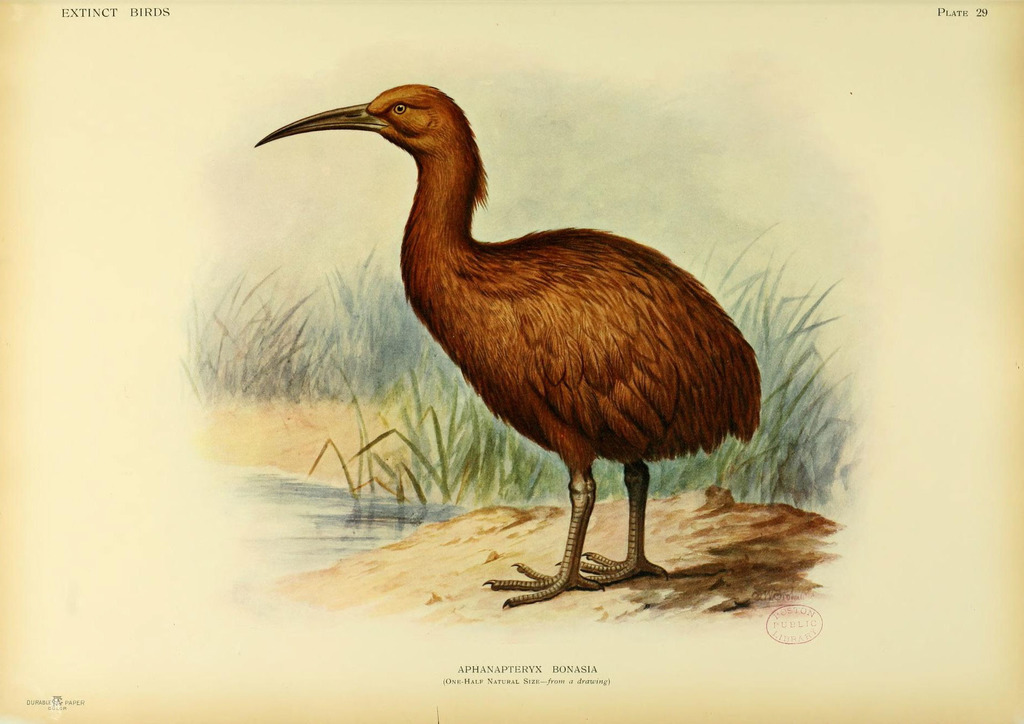
The red rail (Aphanapteryx bonasia) is an extinct species of rail that was endemic to the Mascarene island of Mauritius, east of Madagascar in the Indian Ocean. It had a close relative on Rodrigues island, the likewise extinct Rodrigues rail (Erythromachus leguati), with which it is sometimes considered congeneric, but their relationship with other rails is unclear. Rails often evolve flightlessness when adapting to isolated islands, free of mammalian predators, and that was also the case for this species. The red rail was a little larger than a chicken and had reddish, hairlike plumage, with dark legs and a long, curved beak. The wings were small, and its legs were slender for a bird of its size. It was similar to the Rodrigues rail, but was larger, and had proportionally shorter wings. It has been compared to a kiwi or a limpkin in appearance and behaviour.
This bird is believed to have fed on invertebrates, and snail shells have been found with damage matching an attack by its beak. Human hunters took advantage of an attraction red rails had to red objects by using coloured cloth to lure the birds so that they could be beaten with sticks. Until subfossil remains were discovered in the 1860s, scientists only knew the red rail from 17th century descriptions and illustrations. These were thought to represent several different species, which resulted in a large number of invalid junior synonyms. It has been suggested that all late 17th-century accounts of the dodo actually referred to the red rail, after the former had become extinct.
From the article Red rail on Wikipedia (CC BY-SA), quoted section by section
Description
From the subfossil bones, illustrations and descriptions, it is known that the red rail was a flightless bird, somewhat larger than a chicken. Subfossil specimens range in size, which may indicate sexual dimorphism, as is common among rails. It was about 35–40 cm (14–16 in) long, and the male may have weighed 1.3 kg (2.9 lb) and the female 1 kg (2.2 lb). Its plumage was reddish brown all over, and the feathers were fluffy and hairlike; the tail was not visible in the living bird and the short wings likewise also nearly disappeared in the plumage. It had a long, slightly curved, brown bill, and some illustrations suggest it had a nape crest. The bird perhaps resembled a lightly built kiwi, and it has also been likened to a limpkin, both in appearance and behaviour. The cranium of the red rail was the largest among Mascarene rails, and was compressed from top to bottom in side view. The premaxilla that comprised most of the upper bill was long (nearly 47% longer than the cranium) and narrow, and ended in a sharp point. The narial (nostril) openings were 50% of the rostrum's length, and prominent, elongate foramina (openings) ran almost to the front edge of the narial opening. The mandibular rostrum of the lower jaw was long, with the length of the mandibular symphysis (where the halves of the mandible connect) being about 79% of the cranium's length. …
What it does
Contemporary accounts are repetitive and do not shed much light on the life history of the red rail. Based on fossil localities, the bird widely occurred on Mauritius, in montane, lowland, and coastal habitats. The shape of the beak indicates it could have captured reptiles and invertebrates, and the differences in bill length suggests the sexes foraged on items of different sizes. It may also have scavenged breeding colonies of birds and nesting-sites of tortoises, as the Rodrigues rail did. No contemporary accounts were known to mention the red rail's diet, until the 1660s report of Johannes Pretorius about his stay on Mauritius was published in 2015, where he mentioned that the bird "scratches in the earth with its sharp claws like a fowl to find food such as worms under the fallen leaves." Milne-Edwards suggested that since the tip of the red rail's bill was sharp and strong, it fed by crushing molluscs and other shells, like oystercatchers do. There were many endemic land-snails on Mauritius, including the large, extinct Tropidophora carinata, and subfossil shells have been found with puncture holes on their lower surfaces, which suggest predation by birds, probably matching attacks from the beak of the red rail. …
Wikipedia: “Behaviour and ecology”
Listen
Looking for field recordings…
Where it lives
Recorded sightings
—
geo-referenced records in GBIF, from museums, herbaria and field observers.
Drag the globe to turn it. Dots are where records exist, not a range map; darker means more records.
In the stacks
Searching the stacks…
Every page naming Aphanapteryx bonasia in the Biodiversity Heritage Library →
This page is assembled live from iNaturalist, GBIF, Wikipedia, the Source Library and the Internet Archive. It is not yet part of the hand-edited codex. iNaturalist taxon 94249.