- Fungi Including Lichens
- ›Basidiomycete Fungi
- ›Higher Basidiomycetes
- ›Mushrooms, Bracket Fungi, Puffballs, and Allies
- ›Shelf Fungi
- ›Bracket Fungi
- ›Cerioporus
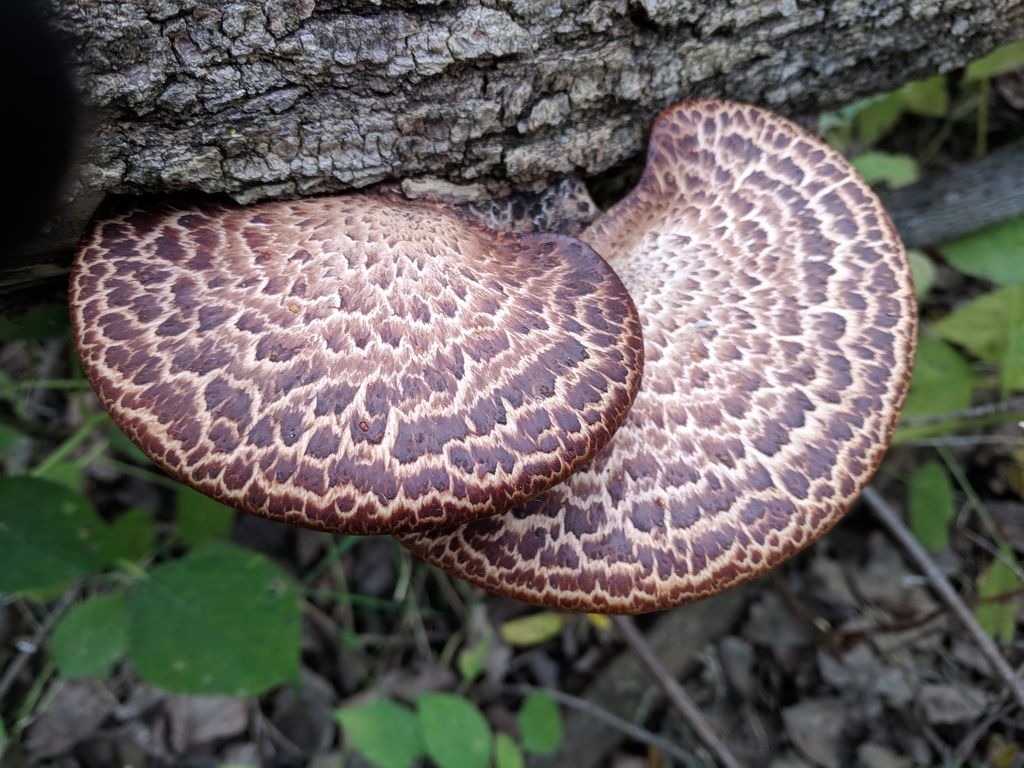
Dryad's Saddle
Cerioporus squamosus
Polyporus squamosus aka Cerioporus squamosus (yet to be confirmed new taxonomy) is a basidiomycete bracket fungus, with common names including dryad's saddle and pheasant's back mushroom. It has a widespread distribution, being found in North America, Australia, Asia, and Europe, where it causes a white rot in the heartwood of living and dead hardwood trees. The name "dryad's saddle" refers to creatures in Greek mythology called dryads who could conceivably fit and ride on this mushroom,...
From the article Cerioporus squamosus on Wikipedia (CC BY-SA), quoted section by section
Description
Dryad's saddle is an annual mushroom commonly found attached to dead logs and stumps or on living hardwood trees at one point with a thick stem. Generally, the fruit body is round and between 8–30 centimetres (3–12 inches) across – exceptionally 60 cm (24 in) – and up to 10 cm (4 in) thick. The body can be yellow to brown and has "squamules" or scales on its upper side. On the underside one can see the pores that are characteristic of the genus Cerioporus; they are made up of tubes packed together closely. The tubes are between 1 and 12 mm (1⁄16 and 1⁄2 in) long. The stalk is 3–12 cm (1–4+1⁄2 in) long and 1.5–3.5 cm (1⁄2–1+1⁄2 in) thick. The mushroom's smell resembles that of watermelon rind. The fruit body produces a white spore print. The spores are 11–15 x 4–5 μm and are long and smooth ellipsoids. They can be found alone, in clusters of two or three, or forming shelves. Young specimens are soft but toughen with age. It is particularly common on dead elm and is also found on living maple trees. The fruit bodies, or "shelves" can grow rapidly. One studied by pioneer botanist Sir William J. Hooker at Dalbeth, Scotland in 1810 grew to a circumference of 2.3 m (7 ft 7 in) and a weight of 15.5 kg (34 lb) in four weeks.
Similar species. In Polyporus tuberaster, the cap is rounder and the stipe more central, with the scales only dark at the tip.
Range & habitat
The species is common and widespread, being found over much of Europe (July–November) and east of the Rocky Mountains in the United States (April–October). It is also found in Asia and Australia. It commonly fruits in the spring, occasionally during autumn, and rarely during other seasons. Many mushroom hunters stumble upon this substantially sized mushroom when looking for morels during the spring, as both have similar fruiting times. As a white rot fungus, it plays an important role in woodland ecosystems by decomposing wood, usually elm or maple, but is occasionally a parasite on living trees. Other tree hosts include ash, beech, horse-chestnut, Persian walnut, lime, maple, plane, poplar, magnolia, and willow. This species has been recorded as a favored food of the pleasing fungus beetles Dacne quadrimaculata and Tritoma humeralis; it is also often eaten by the larvae of Tritoma mimetica, while adults of that species generally seem to avoid it. In addition, adults of the related Aporotritoma pulchra and Rotitma sanguinipennis have been recorded from C.squamosus, but it does not seem to be a regular food source for them.
Wikipedia: “Distribution and ecology”
At the table
The species is edible when young and cooked. Specimens can become infested with maggots and become firm, rubbery and inedible as they mature. Cookbooks dealing with preparation generally recommend gathering these while young, slicing them into small pieces and cooking them over a low heat. Some people value the thick, stiff paper that can be made from this and many other mushrooms of the genus Cerioporus.
Wikipedia: “Uses”
In human culture
Squamosus comes from the Latin squamosus meaning covered with scales or scaly, referring to the signature dark brown scales found on the mushroom's cap. The name "dryad's saddle" refers to creatures in Greek mythology called dryads who could conceivably sit and rest on this mushroom, whereas the pheasant's back analogy derives from the pattern of colors on the bracket matching that of a pheasant's back.
Wikipedia: “Etymology”
Where it lives
Recorded sightings
—
geo-referenced records in GBIF, from museums, herbaria and field observers.
Drag the globe to turn it. Dots are where records exist, not a range map; darker means more records.
In the old herbals & bestiaries

In the stacks
Searching the stacks…
Every page naming Cerioporus squamosus in the Biodiversity Heritage Library →
This page is assembled live from iNaturalist, GBIF, Wikipedia, the Source Library and the Internet Archive. It is not yet part of the hand-edited codex. iNaturalist taxon 940028.