- Animals
- ›Chordates
- ›Vertebrates
- ›Ray-finned Fishes
- ›Carps, Characins, Catfishes and Allies
- ›Minnows, Suckers, Carps, and Loaches
- ›Carps and Minnows
- ›True Minnows
- ›Old World Minnows
- ›Alburnoides
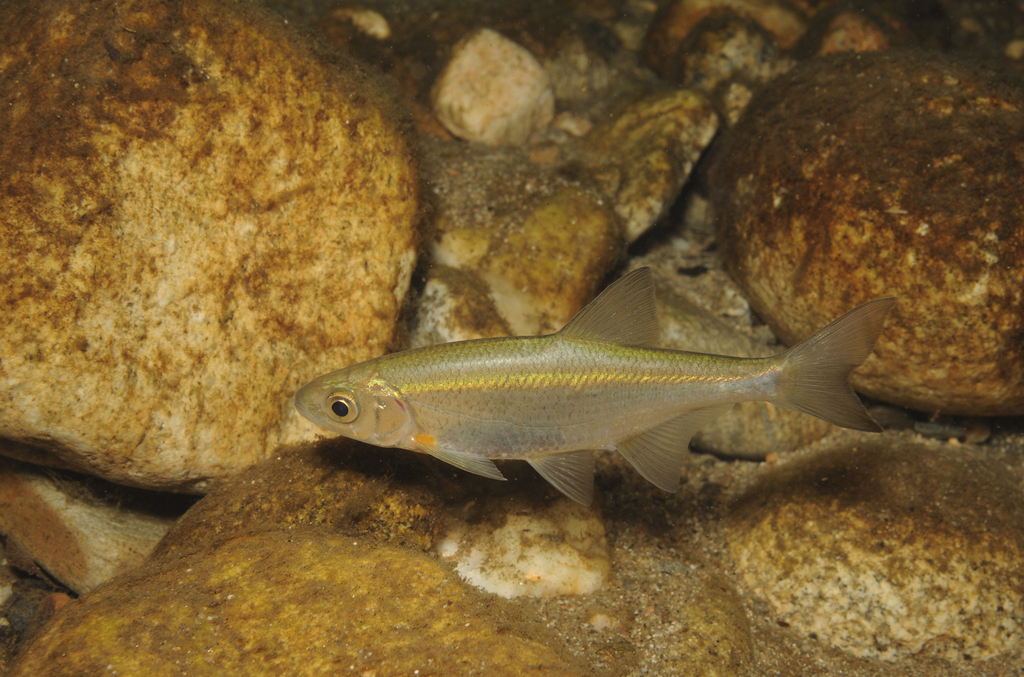
Schneider
Alburnoides bipunctatus
Alburnoides bipunctatus, known vernacularly as the schneider, spirlin, bleak, riffle minnow, and others, is a species of small (9-cm average length) freshwater fish in the Cyprinidae family. It is found in Afghanistan, Armenia, Austria, Azerbaijan, Belarus, Belgium, Bulgaria, Czech Republic, Croatia, Estonia, France, Georgia, Germany, Hungary, Iran, Latvia, Lithuania, Macedonia, Moldova, the Netherlands, Poland, Romania, Russia, Serbia, Slovakia, Switzerland, Turkey, Ukraine, and Uzbekistan. This fish inhabits rivers with very calm waters, and it eats dead insects...
From the article Alburnoides bipunctatus on Wikipedia (CC BY-SA), quoted section by section
Description
Alburnoides bipunctatus has 3 spines and 7 or 8 soft rays in its dorsal fin, with 3 spines and between 13 and 18 soft rays in its anal fin, of which between 12 and 17+1⁄2 are branched. The length of the snout is equal to or smaller than the diameter of the eye, which is roughly equal to the distance between the eyes. The mouth is terminal. The maximum total length is 18.5 cm (7.3 in), although 9 cm (3.5 in) is more typical, and the maximum weight is 30 g (1.1 oz).
Range & habitat
Alburnoides bipunctatus was thought to be widely distributed in Europe and western Asia, but following taxonomc revisions in the 2000s, A. bipunctatus sensu stricto is considered to be restricted to Europe. It occurs in Central and Western Europe in rivers draining into the Bay of Biscay, North Sea and Baltic Sea, fronm the Charente in France to the Vistula in Poland. In the Mediterranean basin it occurs only in southern France, from the Aude to the Argens, including the Rhône. The population in the Danube needs to be confirmed to be A. bipunctatus, as three distinct genetic lineages have been found in the upper, middle and lower sections of the Danube river system. It is also found along the rivers Prut, Siret and their affluents. This species is found in the lower lying stretches of streams and smaller rivers, where it prefers clear, flowing, well-oxygenated water with substrates made up of sand, gravel, pebbles or stones.
Wikipedia: “Distribution and habitat”
In human culture
Alburnoides bipunctatus belongs to the genus Alburnoides. This name suffixes -oides onto the genus name Alburnus, which is Latin for "whitefish" but also refers to the bleak, a name which means "pale" in English, in reference to the pale, non-lustrous colour of Alburnus alburnus. The suffix -oides is used to indicate that this taxon is similar to Alburnus, with the type species of the Alburnoides being Alburnus maculatus. The specific name, bipunctatus, means "two spotted", a reference to the anterior half of the lateral line, where each scale is marked with a pair of black specks, each made up of tiny dots.
Wikipedia: “Etymology”
Where it lives
Recorded sightings
—
geo-referenced records in GBIF, from museums, herbaria and field observers.
Drag the globe to turn it. Dots are where records exist, not a range map; darker means more records.
In the stacks
Searching the stacks…
Every page naming Alburnoides bipunctatus in the Biodiversity Heritage Library →
This page is assembled live from iNaturalist, GBIF, Wikipedia, the Source Library and the Internet Archive. It is not yet part of the hand-edited codex. iNaturalist taxon 93603.