- Animals
- ›Chordates
- ›Vertebrates
- ›Mammals
- ›Therians
- ›Placental Mammals
- ›Primates, Rodents, and Allies
- ›Rodents
- ›Mice, Rats, and Hamsters
- ›Muroids
- ›Hamsters, Voles, Lemmings, and Allies
- ›South American Mice and Rats
- ›Rice Rats
- ›Drymoreomys
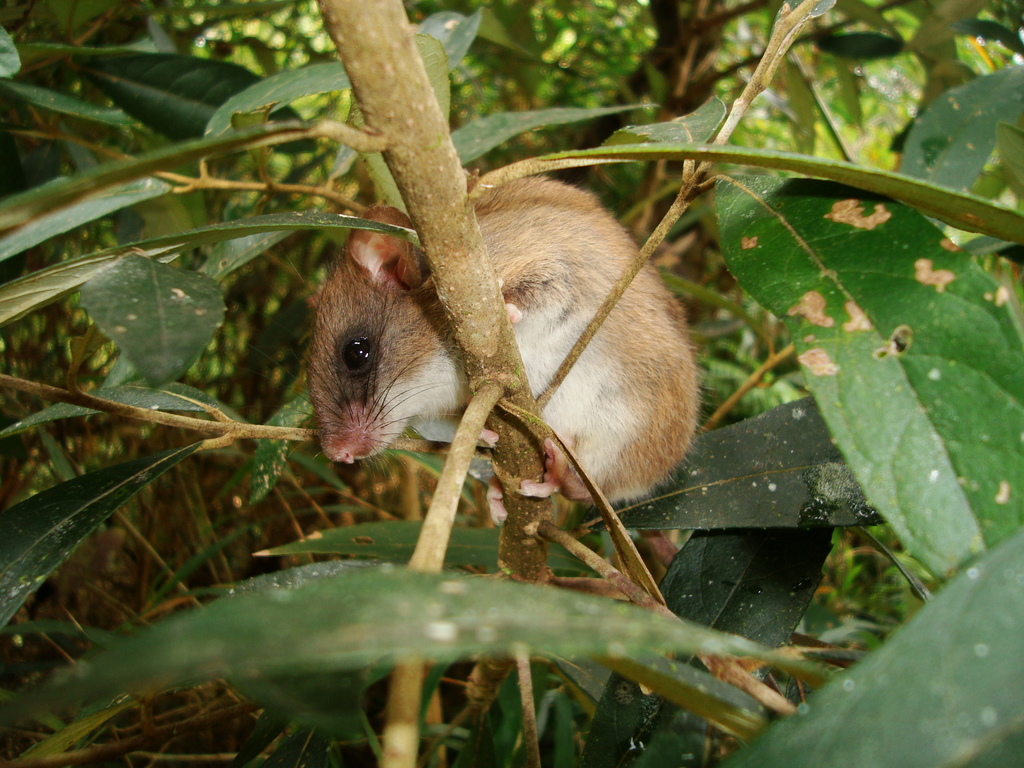
White-throated Montane Forest Rat
Drymoreomys albimaculatus
Drymoreomys is a rodent genus in the tribe Oryzomyini that lives in the Atlantic Forest of Brazil. The single species, D. albimaculatus, is known only from the states of São Paulo and Santa Catarina and was not named until 2011. It lives in the humid forest on the eastern slopes of the Serra do Mar and perhaps reproduces year-round. Although its range is relatively large and includes some protected areas, it is patchy and threatened, and the discoverers recommend that the animal be considered "Near Threatened" on the IUCN Red List. Within Oryzomyini, Drymoreomys appears to be most closely related to Eremoryzomys from the Andes of Peru, a biogeographically unusual relationship, in that the two populations are widely separated and each is adapted to an arid or a moist environment.
With a body mass of 44–64 g (1.6–2.3 oz), Drymoreomys is a medium-sized rodent with long fur that is orange to reddish-buff above and grayish with several white patches below. The pads on the hindfeet are very well developed and there is brown fur on the upper sides of the feet. The tail is brown above and below. The front part of the skull is relatively long and the ridges on the braincase are weak. The palate is short, with its back margin between the third molars. Several traits of the genitals are not seen in any other oryzomyine rodent.
From the article Drymoreomys on Wikipedia (CC BY-SA), quoted section by section
Range & habitat
Drymoreomys albimaculatus occurs in the Atlantic Forest on the eastern slopes of the Serra do Mar in the Brazilian states of São Paulo and Santa Catarina, at 650 to 1,200 m (2,130 to 3,940 ft) above sea level. It has not been found in the intervening state of Paraná, but is likely to occur there. The biogeographical pattern indicated by the relationship between Drymoreomys and the Andean Eremoryzomys is unusual. While there are some similar cases of relationships between Andean and Atlantic Forest animals, these involve inhabitants of humid forests in the Andes; Eremoryzomys, by contrast, lives in an arid area. Drymoreomys albimaculatus appears to be a specialist of dense, moist, montane and premontane forest. It has been found in disturbed and secondary forests as well as in pristine forest, but probably needs contiguous forest to survive. Reproductive activity has been observed in females in June, November, and December and in males in December, suggesting that the species breeds year-round. Although some of its morphological traits, such as the very large pads, are suggestive of arboreal (tree-dwelling) habits, most specimens were collected in pitfall traps on the ground.
Wikipedia: “Distribution and ecology”
Listen
Looking for field recordings…
Where it lives
Recorded sightings
—
geo-referenced records in GBIF, from museums, herbaria and field observers.
Drag the globe to turn it. Dots are where records exist, not a range map; darker means more records.
In the stacks
Searching the stacks…
Every page naming Drymoreomys albimaculatus in the Biodiversity Heritage Library →
This page is assembled live from iNaturalist, GBIF, Wikipedia, the Source Library and the Internet Archive. It is not yet part of the hand-edited codex. iNaturalist taxon 935862.