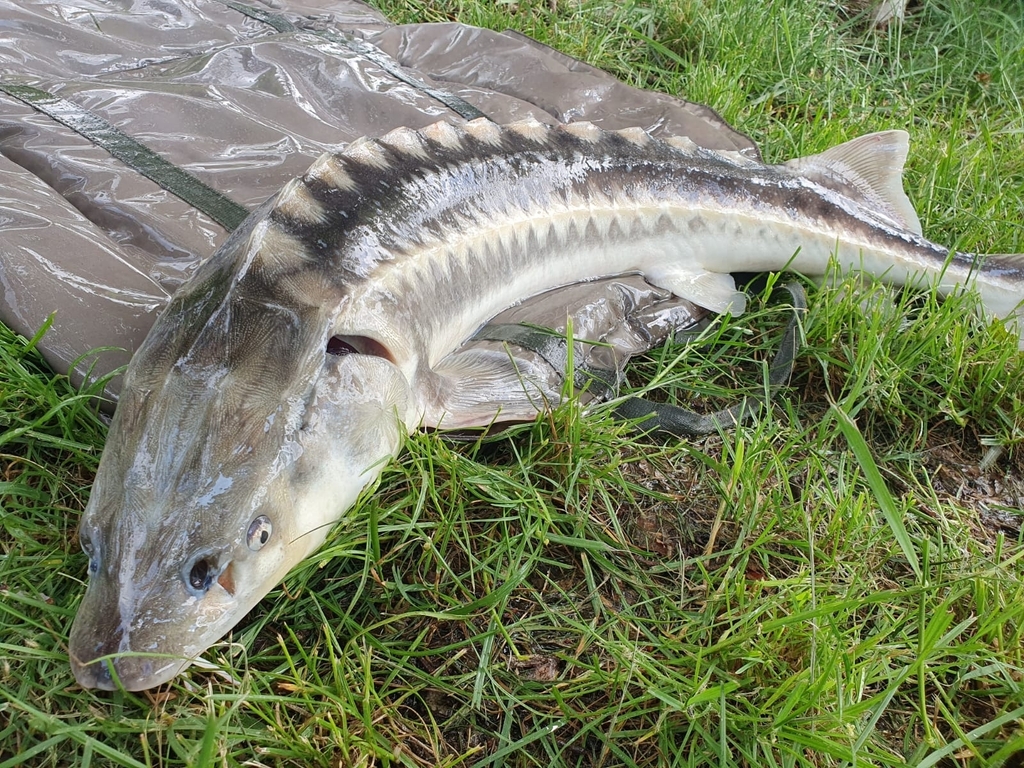
Danube sturgeon
Acipenser gueldenstaedtii
The Russian sturgeon (Huso gueldenstaedtii), also known as the diamond sturgeon or Danube sturgeon, is a species of fish in the family Acipenseridae. It is found in Azerbaijan, Bulgaria, Georgia, Iran, Kazakhstan, Romania, Russia, Turkey, Turkmenistan, and Ukraine. It is also found in the Caspian Sea. This fish can grow up to about 235 cm (93 in) and weigh 115 kg (254 lb). Russian sturgeon mature and reproduce slowly, making them highly vulnerable to fishing.
Prior to 2025, it was placed in the genus Acipenser, but this placement was found to be paraphyletic, and it is more accurately placed in the genus Huso.
From the article Russian sturgeon on Wikipedia (CC BY-SA), quoted section by section
Description
The Russian sturgeon can grow to 210 cm (83 in) but a more normal size is 110 to 140 cm (43 to 55 in). It has a relatively short and rounded snout with three pairs of unfringed barbels closer to the tip of the snout that to the mouth. The dorsal fin has 27 to 48 soft rays and the anal fin has 16 to 35. The number of scales along the lateral line varies from 21 to 50. This fish can be distinguish from the otherwise similar starry sturgeon by the shape of its snout, its barbels and scale arrangement. The upper surface is greyish-green, the lateral scales are pale and the belly white.
Range & habitat
The Russian sturgeon is native to the Black Sea, the Sea of Azov and the Caspian Sea. It is an anadromous fish and moves into the river systems that drain into these seas in order to make its way to spawning areas upstream. It is usually found near the bottom in fairly shallow water over sandy or muddy substrates.
Wikipedia: “Distribution and habitat”
Where it lives
Recorded sightings
—
geo-referenced records in GBIF, from museums, herbaria and field observers.
Drag the globe to turn it. Dots are where records exist, not a range map; darker means more records.
In the stacks
Searching the stacks…
Every page naming Acipenser gueldenstaedtii in the Biodiversity Heritage Library →
This page is assembled live from iNaturalist, GBIF, Wikipedia, the Source Library and the Internet Archive. It is not yet part of the hand-edited codex. iNaturalist taxon 93182.