- Animals
- ›Chordates
- ›Vertebrates
- ›Mammals
- ›Therians
- ›Placental Mammals
- ›Ungulates, Carnivorans, and Allies
- ›Carnivorans
- ›Felids
- ›Small Cats
- ›Prionailurus
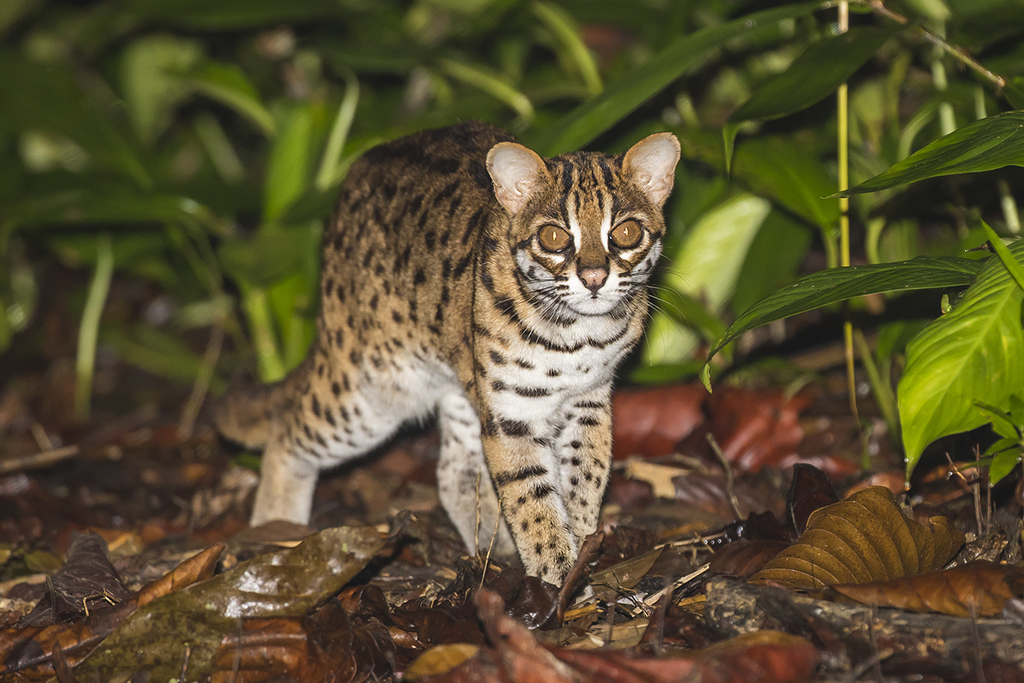
Sunda Leopard Cat
Prionailurus javanensis
The Sunda leopard cat (Prionailurus javanensis) is a small wild cat species native to the Sundaland islands of Java, Bali, Borneo, Sumatra and the Philippines that is considered distinct from the leopard cat occurring in mainland South and Southeast Asia.
From the article Sunda leopard cat on Wikipedia (CC BY-SA), quoted section by section
Description
Desmarest described the Sunda leopard cat from Java as a little smaller than the domestic cat with brown round spots on grey-brown coloured fur above and whitish underneath, a line from above each eye towards the back and longish spots on the back. He noted the similarity to the leopard cat from India. Like all Prionailurus species it has rounded ears. Like its mainland relative, the Sunda leopard cat is slender, with long legs and well-defined webs between its toes. Its small head is marked with two prominent dark stripes and a short and narrow white muzzle. There are two dark stripes running from the eyes to the ears, and smaller white streaks running from the eyes to the nose. The backs of its moderately long and rounded ears are black with central white spots. Body and limbs are marked with black spots of varying size and color, and along its back are three rows of elongated spots that join into complete stripes in some subspecies. The tail is about half the size of its head-body length and is spotted with a few indistinct rings near the black tip. The background color of the spotted fur varies from light grey to ochre tawny, with a white chest and belly. There are two main variants in the coloration. The cats from Java, Bali and Palawan are a light grey, sometimes yellow-grey, with very small spots that may not be clearly defined. …
Wikipedia: “Characteristics”
Range & habitat
The Sunda leopard cat inhabits the islands of Sumatra, Borneo, Java, Bali, Tebingtinggi, Palawan, Negros, Cebu and Panay. Its natural habitat is lowland tropical evergreen forest, but it has also adapted to human-modified landscapes with suitable vegetation cover, and inhabits agricultural areas such as rubber, oil palm, and sugarcane plantations. In Sabah's Tabin Wildlife Reserve, Sunda leopard cats had average home ranges of 3.5 km2 (1.4 sq mi). In Kalimantan, Sunda leopard cats were recorded in mixed swamp forest and tall interior forest at elevations below 20 m (66 ft) in the vicinity of Sabangau National Park between 2008 and 2018.
Wikipedia: “Distribution and habitat”
What it does
Sunda leopard cats photographed by camera traps in Kalimantan between 2008 and 2018 were foremost nocturnal, overlapping with the activity pattern of flat-headed cats (Prionailurus planiceps). Those recorded in an oil palm plantation in central Kalimantan were active from late afternoon to early morning and preyed foremost on ricefield rats and other rodents. Nine radio-collared Sunda leopard cats in Sabah used predominantly oil palm plantations and also logged dipterocarp forest adjacent to the Tabin Wildlife Reserve. They were observed up to 4 m (13 ft) above ground hunting rodents and beetles, and preyed foremost on Whitehead's spiny rat, dark-tailed tree rat, long-tailed giant rat, lizards, snakes and frogs. Males had larger home ranges than females, averaging 3.5 km2 (1.4 sq mi) and 2.1 km2 (0.81 sq mi), respectively. Each male's range overlapped one or more female ranges. Fecal samples collected of Sunda leopard cats in sugarcane fields in Negros island indicate that they feed foremost on rodents such as house mouse, Polynesian rat, ricefield rat and tanezumi rat. To a lesser extent, they also prey on amphibians, geckos, lizards and passerine birds occurring in these sugarcane fields. In western Java, Sunda leopard cats were encountered close to human settlements and resting on the ground.
Wikipedia: “Ecology and behaviour”
Listen
Looking for field recordings…
Where it lives
Recorded sightings
—
geo-referenced records in GBIF, from museums, herbaria and field observers.
Drag the globe to turn it. Dots are where records exist, not a range map; darker means more records.
In the stacks
Searching the stacks…
Every page naming Prionailurus javanensis in the Biodiversity Heritage Library →
This page is assembled live from iNaturalist, GBIF, Wikipedia, the Source Library and the Internet Archive. It is not yet part of the hand-edited codex. iNaturalist taxon 922736.