- Plants
- ›red algae
- ›true red algae
- ›Florideophycean algae
- ›Rhodymeniophycidae
- ›Gigartinales
- ›Solieriaceae
- ›Kappaphycus
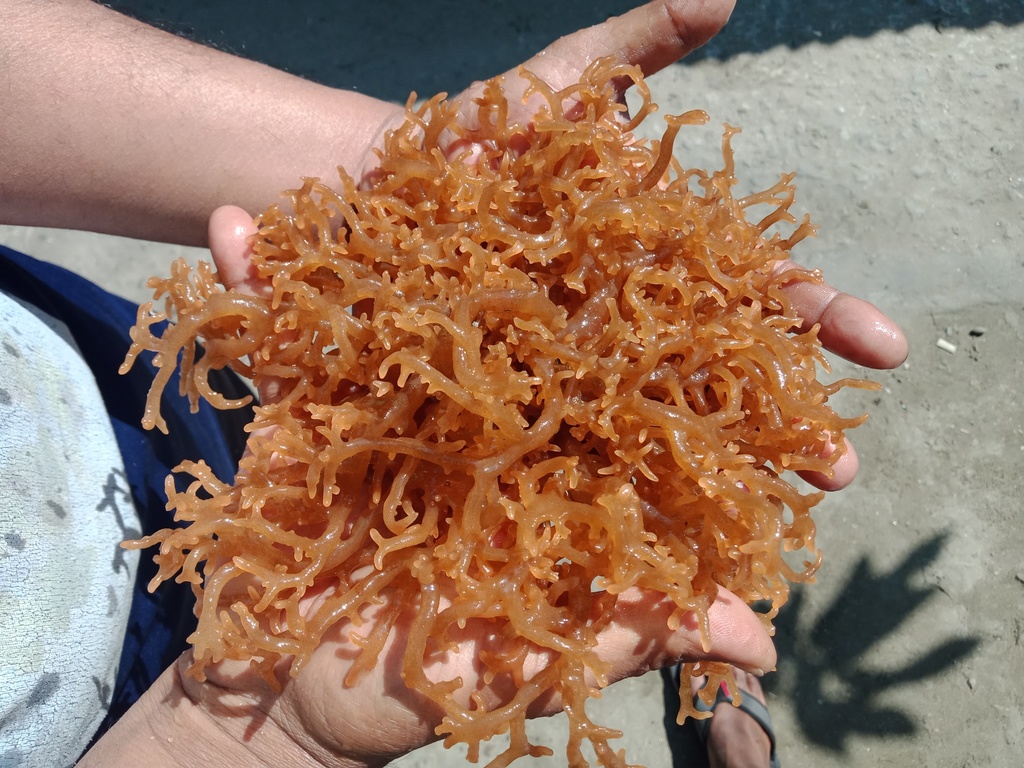
Kappaphycus alvarezii
Kappaphycus alvarezii, the elkhorn sea moss, is a species of red algae. The elkhorn sea moss varies in size, weight, and age. It is a dark greenish-brown hue and can sometimes be deep purple. The moss is cylindrical in shape throughout the seaweed. Its diameter averages 1.526 mm when dried. Near the base of the seaweed, its average length is from 1 mm to 17 mm and 1 mm to 2 mm in diameter. Firm algae are around 2 m tall, with axes and branches around 1–2 cm in diameter. They reproduce both sexually and asexually through vegetative propagation. Cross sections of the Elkhorn sea moss has a medulla composed of small thick-walled cells interspaced among large parenchyma cells. This moss is used for various types of foods that humans consume and can also be used to make a jelly-like dessert. Elkhorn sea moss is a good source of minerals and of high commercial interest. It is one of the most important commercial sources of carrageenans, a family of gel-forming, viscosifying polysaccharides. Farming methods affect the character of the carrageenan that can be extracted from the seaweed. It is very fast-growing, known to double its biomass in 15 days.
From the article Kappaphycus alvarezii on Wikipedia (CC BY-SA), quoted section by section
Range & habitat
The Elkhorn sea moss is located in the Pacific, French, and Indian Oceans, as well as the Caribbean sea, South China sea. It is located on the islands of Hawaii and Guam. Lastly, it is located in Fanning, Moana, Tonga, and Fiji.
Role within native habitat. The role this sea moss plays in its native habitat is to feed the fish in the surrounding area. It also produces and releases certain minerals which benefit the habitat in which it inhabits. It is found on reef flats and the edges of the reef varying in depth. The moss can be anywhere from 1–17 meters deep. It can also loosely attach itself to the coral. They can form large unattached fragments that can form a mat like structure. This algal mat can act as UV protection for fish and act as a source of food for the surrounding aquatic life. This sea moss has the ability to attach itself to the coral reefs which is when their abilities of invasion are noticed. Once they attach to the surface of the coral they have the ability to endure high wave energy environments. When they are anchored to the tissue of the coral they are able to rapidly divide and spread due to their high growth rates and high successful vegetative regeneration. Once this species invades the coral reefs or the surrounding area it allows for the settlement of epiphytes and shelter for the mesograzers. …
Wikipedia: “Habitat and ecology”
At the table
Kappaphycus is a major source of carrageenan. Carrageenan is an additive used for thickening and preserving foods and drinks. Carrageenan is used for their rheological properties such as emulsifiers, binders. It is also used for suspension or stabilization in a wide range of pharmaceutical carriers, processed food products, and cosmetics. It is used in things like toothpaste, dairy products, and jellies. Carrageenan is found within the cell wall of Kappaphycus, which contributes to the antioxidant potential and the presence of ascorbic acid, various phenolics, and vitamin A. Antioxidants defend against oxidative damage from reactive oxygen species. These species can damage cells by chain reactions. All cells contain antioxidants to reduce or prevent said damage. Different carrageenan types differ in composition and conformation, resulting in a wide range of rheological and functional properties. Carrageenans are used in a variety of commercial applications as gelling, thickening, and stabilizing agents, especially in food products such as frozen desserts, chocolate milk, cottage cheese, whipped cream, instant products, yogurt, jellies, pet foods, and sauces. Aside from these functions, carrageenans are used in pharmaceutical formulations, cosmetics, and industrial applications such as mining. Carrageenan is extracted from this seaweed in two ways. …
Wikipedia: “Uses”
In human culture
This alga is an introduced species and a noxious aquatic weed in Hawaii. This species was considered and introduced in many countries with the sole main purpose of increasing the commercial aquaculture carrageenan industry; the carrageenan is a biopolymer extracted from algae and used extensively in the food industry for the formation of gels to stabilize fat in food with dairy products. Regardless of the widespread introduction of the species, there have been few studies explaining that this species has formed natural populations surrounding farm plots. Kappaphycus alverezil has been introduced to a lot of different countries around the world for aquaculture purposes. Some of the countries that this species has been introduced to include China, Fiji, India, Indonesia, Japan, Malaysia, the Philippines, Vietnam, Tanzania, and the United States. Cultivation of the species occurs in the open water when cutting the specific algae off of rope lines replacing in shallow reefs in the flatter, shallower environments. They have not established natural populations in the areas surrounding farmland. They reproduce through vegetative propagation, resulting in the spread and dispersal of the species. They can also reproduce sexually. Due to their large size they are able to out-compete the native species of the reef. It's reproductive structures are tetrasporic and gametaphytic. …
Wikipedia: “History as an invasive species”
Where it lives
Recorded sightings
—
geo-referenced records in GBIF, from museums, herbaria and field observers.
Drag the globe to turn it. Dots are where records exist, not a range map; darker means more records.
In the stacks
Searching the stacks…
Every page naming Kappaphycus alvarezii in the Biodiversity Heritage Library →
This page is assembled live from iNaturalist, GBIF, Wikipedia, the Source Library and the Internet Archive. It is not yet part of the hand-edited codex. iNaturalist taxon 916563.