On eBird ↗
Ocellated Turkey
Live sightings near you, the range map, bar charts of when it is seen, and Macaulay Library photos and recordings.
Ocellated Turkey
Meleagris ocellata
The ocellated turkey (Meleagris ocellata) is a species of turkey residing primarily in the Yucatán Peninsula, Mexico, as well as in parts of Belize and Guatemala. A relative of the North American wild turkey (Meleagris gallopavo), it was sometimes previously considered in a genus of its own (Agriocharis), but the differences between the two turkeys are currently considered too small to justify generic segregation. It is a relatively large bird, at around 70–122 cm (28–48 in) long and an average weight of 3 kg (6.6 lb) in females and 5 kg (11 lb) in males.
The ocellated turkey lives only in a 130,000 km2 (50,000 sq mi) range in the Yucatán Peninsula in Mexico—which includes all or part of the states of Quintana Roo, Campeche, Yucatán, Tabasco, and Chiapas—as well as the northern and western parts of Belize and northern Guatemala.
From the article Ocellated turkey on Wikipedia (CC BY-SA), quoted section by section
Description
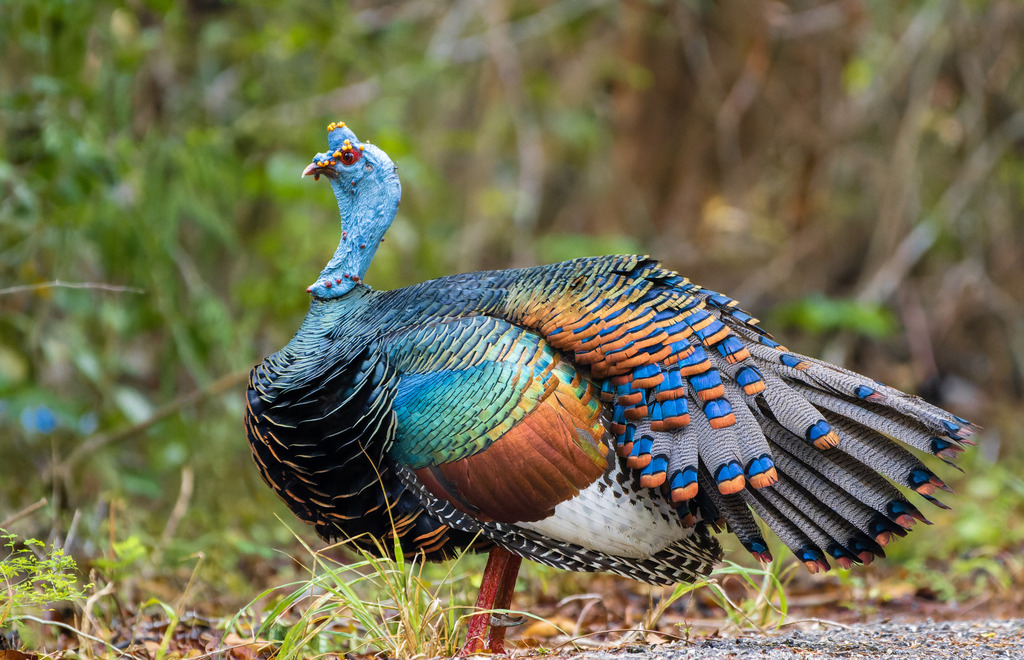
The body feathers of both sexes are a mixture of bronze and green iridescent color. Although females can be duller with more green, the breast feathers do not generally differ and cannot be used to determine sex. Neither sex possesses the "beard" typically found in wild turkeys. Tail feathers of both sexes are bluish-grey with an eye-shaped, blue-bronze spot near the end with a bright gold tip. The spots, or ocelli (located on the tail), for which the ocellated turkey is named, have been likened to the patterning typically found on peafowl. The upper, major secondary wing coverts are rich iridescent copper. The primary and secondary wing feathers have similar barring to that of North American turkeys, but the secondaries have more white, especially around the edges. Both sexes have blue heads with some orange or red nodules, which are more pronounced on males. The males also have a fleshy blue crown covered with nodules, similar to those on the neck, behind the snood. During breeding season this crown swells up and becomes brighter and more pronounced in its yellow-orange color. The eye is surrounded by a ring of bright red skin, which is most visible on males during breeding season. The legs are deep red and are shorter and thinner than on North American turkeys. …
What it does
The species is believed to have experienced a decline in response to land use changes and higher than sustainable harvest by migrant workers and subsistence hunters living in the Yucatán Peninsula region of Central America. A study conducted in the year 2011 indicated that the ocellated turkey made up a substantial amount of the diets of four prominent ethnic groups of the Yucatán Peninsula.
Wikipedia: “Ecology”
In human culture
The Mayans (who call it kuuts or yuum kuuts) have a story where the turkey's feathers were given to him by the nightjar who vouched for him to be anointed king of the birds by the Great Ancestor (Nohochacyum) in return for a reward. As the turkey completely forgot what he owed the nightjar, the latter complained to Nohochacyum who punished the former by changing his once-melodious voice to guttural thumps. It is associated with water, rain (especially through the deity Chaak) and fecundity; tribes like the Chʼortiʼ once offered its blood across their fields in hopes of a good harvest. Its carcasses were also offered to use by Mayan chiefs, even found in their tombs.
Wikipedia: “In culture”
Listen
Looking for field recordings…
Where it lives
Recorded sightings
—
geo-referenced records in GBIF, from museums, herbaria and field observers.
Drag the globe to turn it. Dots are where records exist, not a range map; darker means more records.
In the stacks
Searching the stacks…
Every page naming Meleagris ocellata in the Biodiversity Heritage Library →
This page is assembled live from iNaturalist, GBIF, Wikipedia, the Source Library and the Internet Archive. It is not yet part of the hand-edited codex. iNaturalist taxon 913.