- Animals
- ›Arthropods
- ›Myriapods
- ›Centipedes
- ›Tropical Centipedes
- ›Scolopendrid Centipedes
- ›Scolopendrinae
- ›Scolopendra
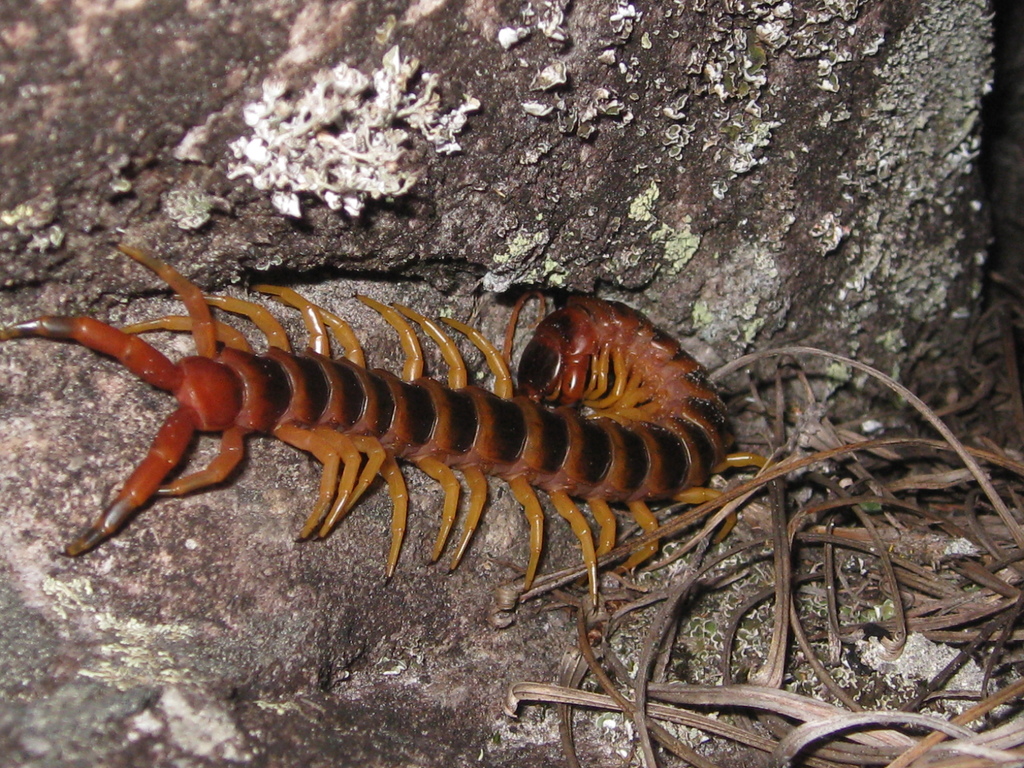
Amazonian Tricolor Centipede
Scolopendra viridicornis
Scolopendra viridicornis is a species of centipede in the family Scolopendridae which can be found within the Amazon Rainforest, the type locality being in Brazil. Due to the geographic distribution of this species it is known as the Amazonian giant centipede. This species is presumably a large aggressive predatory species like all other known Scolopendra species.
From the article Scolopendra viridicornis on Wikipedia (CC BY-SA), quoted section by section
What it does
As with the vast majority of species in this genus, Scolopendra viridicornis is carnivorous. It hunts actively, seizing any prey items small enough to be overpowered. Due to the large size of this centipede, its diet not only includes arthropods but may also consist of small vertebrates such as rodents, frogs, snakes and lizards. The centipede typically seizes and restrains prey with help from a muscular body and numerous legs, then delivers a venomous bite to subdue and kill the prey animal. It has also been known to scavenge when the opportunity presents itself. Scolopendra viridicornis is quite quick to flee when disturbed by a predator, running away with impressive speed. If pursued the centipede will raise its terminal legs in an attempt to draw any attack to its hind end. When a predator touches these raised limbs the centipede will use them to grip its aggressor and spin around to deliver a venomous bite. The centipede will then continue to flee until it finds safety.
Wikipedia: “Behavior and diet”
In medicine
In northeast Brazil, S. viridicornis is used in regional folk medicine as an analgesic. The species possesses a peptide in its body known as lacrain which exhibits strong antimicrobial effects against Gram-negative bacteria; this peptide is the first described peptide with antimicrobial activity from the body extract of a myriapod. Lacrain shows promise in terms of future uses due to a distinct lack of cytotoxic activity against human erythrocytes.
== References ==
Wikipedia: “Medical use”
Where it lives
Recorded sightings
—
geo-referenced records in GBIF, from museums, herbaria and field observers.
Drag the globe to turn it. Dots are where records exist, not a range map; darker means more records.
In the stacks
Searching the stacks…
Every page naming Scolopendra viridicornis in the Biodiversity Heritage Library →
This page is assembled live from iNaturalist, GBIF, Wikipedia, the Source Library and the Internet Archive. It is not yet part of the hand-edited codex. iNaturalist taxon 900746.