- Fungi Including Lichens
- ›Ascomycete Fungi
- ›Sac Fungi and Lichens
- ›Sordariomycetes
- ›Hypocreomycetidae
- ›Hypocreales
- ›Hypocreaceae
- ›Trichoderma
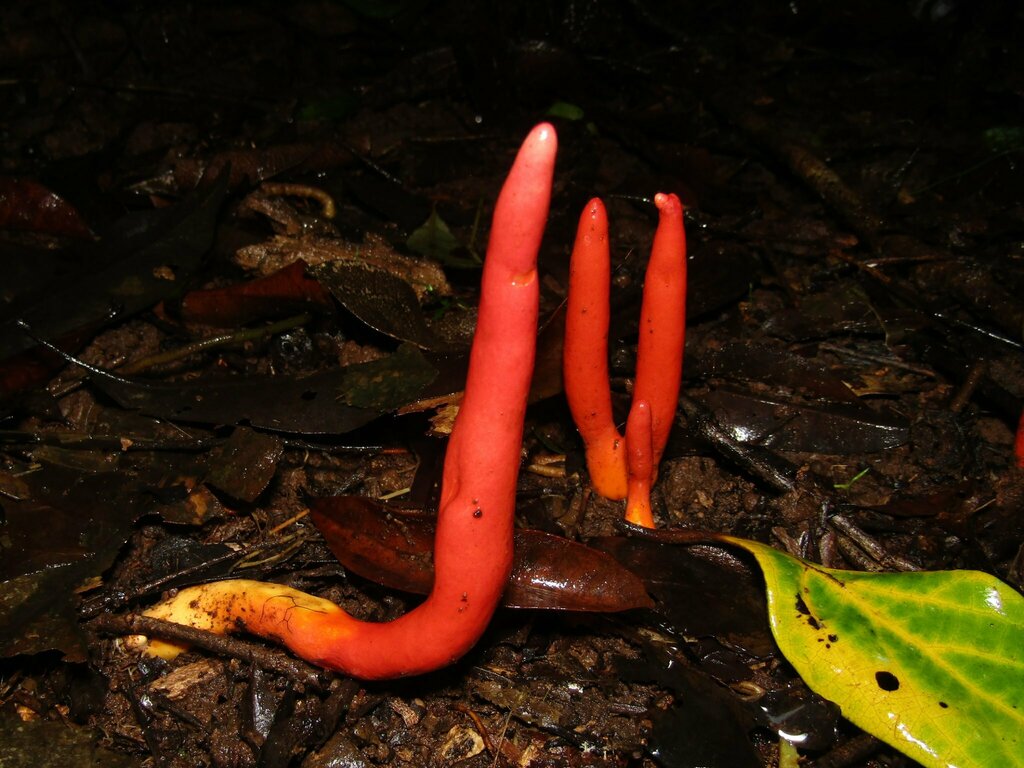
poison fire coral
Trichoderma cornu-damae
Trichoderma cornu-damae (Japanese: カエンタケ, Hepburn: kaentake), formerly Podostroma cornu-damae and also known as the poison fire coral, is a species of fungus in the family Hypocreaceae. The fruit bodies of the fungus are highly toxic if ingested, and have been responsible for several human fatalities as they contain an often fatal dose of the macrocyclic terpenoid mycotoxin satratoxin-H.
From the article Trichoderma cornu-damae on Wikipedia (CC BY-SA), quoted section by section
Description
The conidiophores (specialized fungal hyphae that produce conidia) are up to 400 μm high and about 2–4 μm wide in the main axial hyphae. The phialides are arranged in tufts with narrow angles at the top, similar to the branching hyphae found in other Trichoderma species. The conidia are roughly spherical with a truncate base in each spore, pale green in color, and measure 2.5–3.5 μm in diameter. Their surfaces are almost smooth, but sometimes appearing very faintly roughened with light microscopy.
Range & habitat
The fungus was once thought to be exclusive to mountainous areas within South Korea and Japan, but recent discoveries have been made in Indonesia, Papua New Guinea and Australia.
Wikipedia: “Range”
Toxicity
Several poisonings have been reported in Japan resulting from the consumption of the fungus. In 1999, one of a group of five people from Niigata Prefecture died two days after consuming one or two grams of fruit body that had been soaked in sake. In 2000, an individual from Gunma Prefecture died after eating the fried mushroom. Symptoms associated with consumption in these cases include gastroenteritis, hemophagocytosis, leukocytopenia, thrombocytopenia, peeling skin on the face and hands, scalp hair loss, and damage to the cerebellum resulting in speech impediment and problems with voluntary movement. In another instance, an autopsy revealed acute kidney and liver damage with associated disseminated intravascular coagulation. In one case of poisoning, the patient suffered from hemophagocytosis, in addition to severe leukocytopenia and thrombocytopenia, seven days after ingesting the fungus. Plasmapheresis and administration of granulocyte colony-stimulating factor were used to treat the blood abnormalities. The authors suggested that these treatments, in addition to the large volume of administered intravenous saline—9 liters (2.0 imp gal; 2.4 U.S. gal) over a 12-hour period—were responsible for his successful recovery. Human poisoning symptoms are similar to those observed previously with livestock that had consumed trichothecene mycotoxins. …
Where it lives
Recorded sightings
—
geo-referenced records in GBIF, from museums, herbaria and field observers.
Drag the globe to turn it. Dots are where records exist, not a range map; darker means more records.
In the stacks
Searching the stacks…
Every page naming Trichoderma cornu-damae in the Biodiversity Heritage Library →
This page is assembled live from iNaturalist, GBIF, Wikipedia, the Source Library and the Internet Archive. It is not yet part of the hand-edited codex. iNaturalist taxon 894836.