On eBird ↗
Ruffed Grouse
Live sightings near you, the range map, bar charts of when it is seen, and Macaulay Library photos and recordings.
Ruffed Grouse
Bonasa umbellus
The ruffed grouse (Bonasa umbellus) is a medium-sized grouse occurring in forests from the Appalachian Mountains across Canada to Alaska. It is the most widely distributed game bird in North America. It is not migratory. It is the only species in the genus Bonasa. The ruffed grouse is sometimes incorrectly referred to as a "partridge", an unrelated phasianid, and occasionally confused with the grey partridge, a bird of open areas rather than woodlands.
The ruffed grouse is the state game bird of Pennsylvania, United States.
From the article Ruffed grouse on Wikipedia (CC BY-SA), quoted section by section
Description
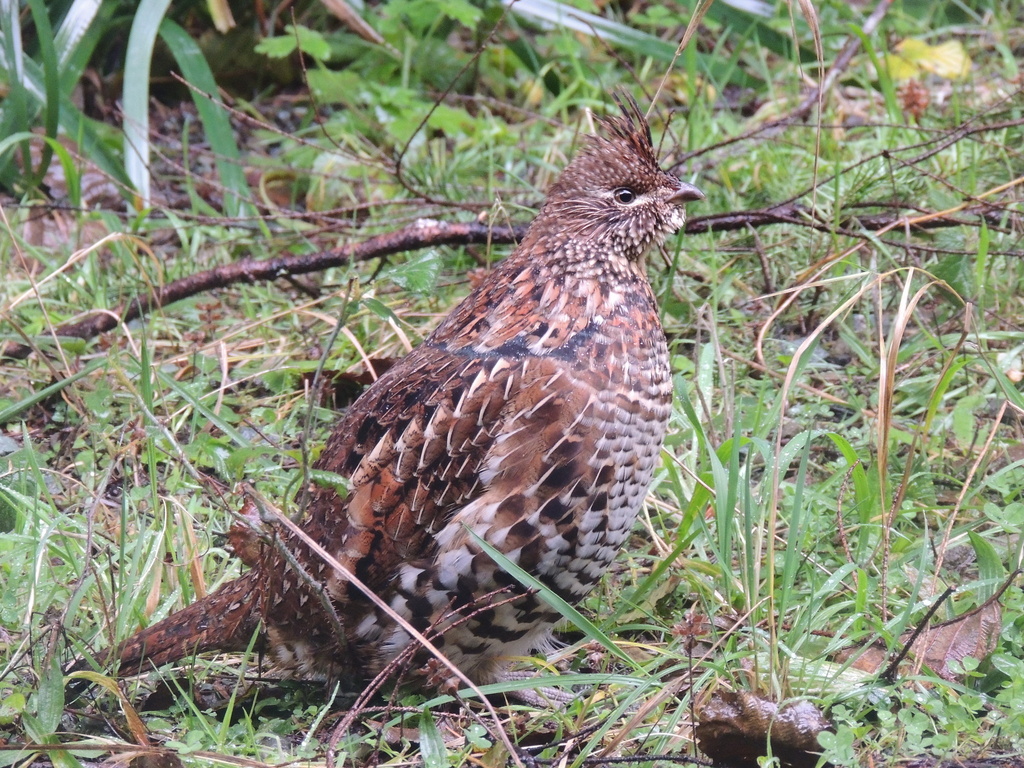
Ruffed grouse are chunky, medium-sized birds that weigh from 450–750 g (0.99–1.65 lb), measure from 40 to 50 cm (16 to 20 in) in length, and span 50–64 cm (20–25 in) across their short, strong wings. They have two distinct morphs - grey and brown. In the grey morph, the head, neck, and back are grey-brown; the breast is light with barring, with as much white on the underside and flanks. Overall, the birds have a variegated appearance; the throat is often distinctly lighter. The tail is essentially the same brownish grey, with regular barring and a broad black band near the end ("subterminal"). Brown-morph birds have tails of the same color and pattern. However, the rest of the plumage is much more brown, giving the appearance of a more uniform bird with less light plumage below and a conspicuously grey tail. All sorts of intergrades occur between the most typical morphs; warmer and more humid conditions favor browner birds in general.
The ruffs are on the sides of the neck in both sexes. They also have a crest on top of their head, which sometimes lies flat. Both sexes are similarly marked and sized, making them difficult to tell apart, even in hand. The female often has a broken subterminal tail band. At the same time, males tend to have unbroken tail bands, though the opposite of either can occur. Females may also do a display similar to the male. …
What it does
Like most grouse, they spend most of their time on the ground; mixed woodland rich in aspen seems to be particularly well-liked. These birds forage on the ground or in trees. They are omnivores, eating buds, leaves, berries, seeds, and insects. According to nature writer Don L. Johnson:
More than any other characteristic, it is the ruffed grouse's ability to thrive on a wide range of foods that has allowed it to adapt to such a wide and varied range of habitat on this continent. A complete menu of grouse fare might itself fill a book. One grouse crop yielded a live salamander in a salad of watercress. Another contained a small snake.
Wikipedia: “Ecology”
Listen
Looking for field recordings…
Where it lives
Recorded sightings
—
geo-referenced records in GBIF, from museums, herbaria and field observers.
Drag the globe to turn it. Dots are where records exist, not a range map; darker means more records.
In the stacks
Searching the stacks…
Every page naming Bonasa umbellus in the Biodiversity Heritage Library →
This page is assembled live from iNaturalist, GBIF, Wikipedia, the Source Library and the Internet Archive. It is not yet part of the hand-edited codex. iNaturalist taxon 890.