- Animals
- ›Molluscs
- ›Gastropods
- ›Heterobranchs
- ›Euthyneura
- ›Tectipleura
- ›Eupulmonata
- ›Common Land Snails and Slugs
- ›Helicina
- ›Arionoidei
- ›Roundback Slugs and Allies
- ›Roundback Slugs
- ›Arion
- ›Mesarion
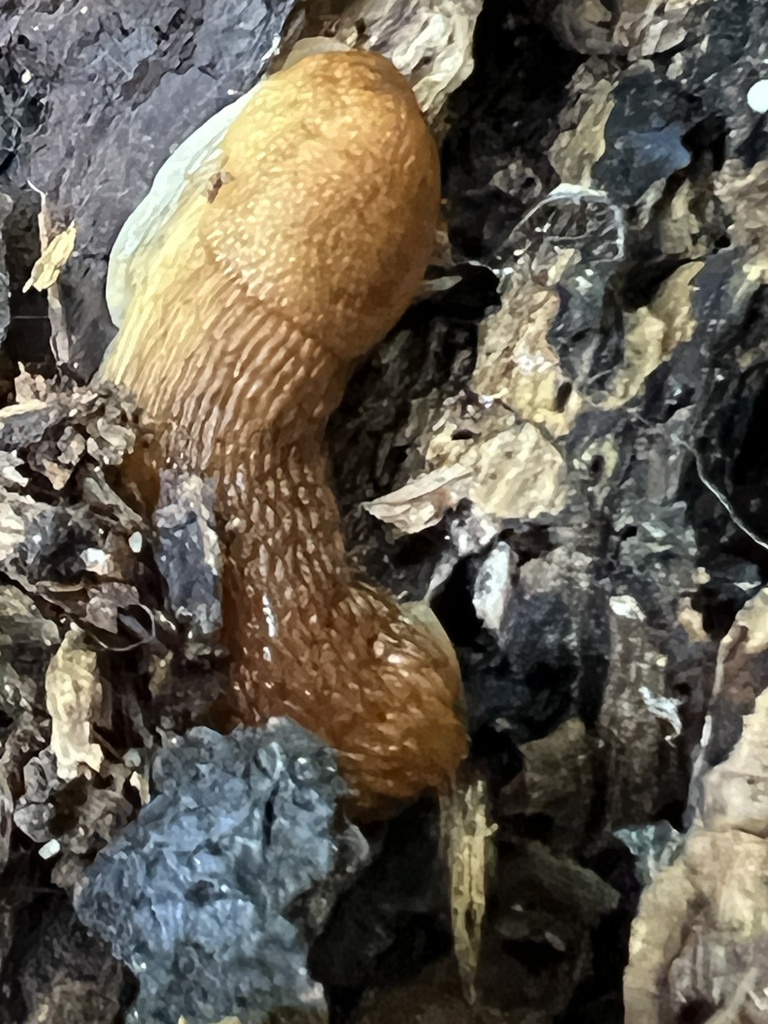
Arion transsylvanus
Arion transsylvanus is a species of terrestrial slug in the family Arionidae, the roundback slugs.
It is a member of the Arion subfuscus species complex and known mostly from Transylvania in Romania, where it appears to be the only species of this complex.
From the article Arion transsylvanus on Wikipedia (CC BY-SA), quoted section by section
Description
Adult A. transsylvanus are 40–70 mm long. Like other members of the genus Arion, they have a rounded end to the tail and the pneumostome is in the front half of the mantle. The colour varies even within a population from bright orange to dark brown. Lateral bands are often present but may be faint or absent. The mucus can be orange or colourless. A useful internal character is that the gonad sits above the digestive gland rather than buried mostly within it like the darker gonad of A. fuscus. Distinguishing A. transsylvanus from both A. fuscus and A. subfuscus is that openings of the epiphallus, bursa duct, and oviduct into the genital atrium lie all along a line.
Wikipedia: “Description and identification”
Range & habitat
The species occurs across the Transylvanian part of Romania. It has also been found at one site in eastern Poland and one site in Hungary; unlike in Romania, at these sites it co-occurred with its relative Arion fuscus. The Hungarian occurrence might be native since it was in forest habitat and the locality is a western continuation of the Carpathian Mountains where the species occurs in Romania. A survey in Ukraine did not find A. transsylvanus.
Wikipedia: “Distribution”
Where it lives
Recorded sightings
—
geo-referenced records in GBIF, from museums, herbaria and field observers.
Drag the globe to turn it. Dots are where records exist, not a range map; darker means more records.
In the stacks
Searching the stacks…
Every page naming Arion transsylvanus in the Biodiversity Heritage Library →
This page is assembled live from iNaturalist, GBIF, Wikipedia, the Source Library and the Internet Archive. It is not yet part of the hand-edited codex. iNaturalist taxon 874551.