On eBird ↗
Philby's Partridge
Live sightings near you, the range map, bar charts of when it is seen, and Macaulay Library photos and recordings.
Philby's Partridge
Alectoris philbyi
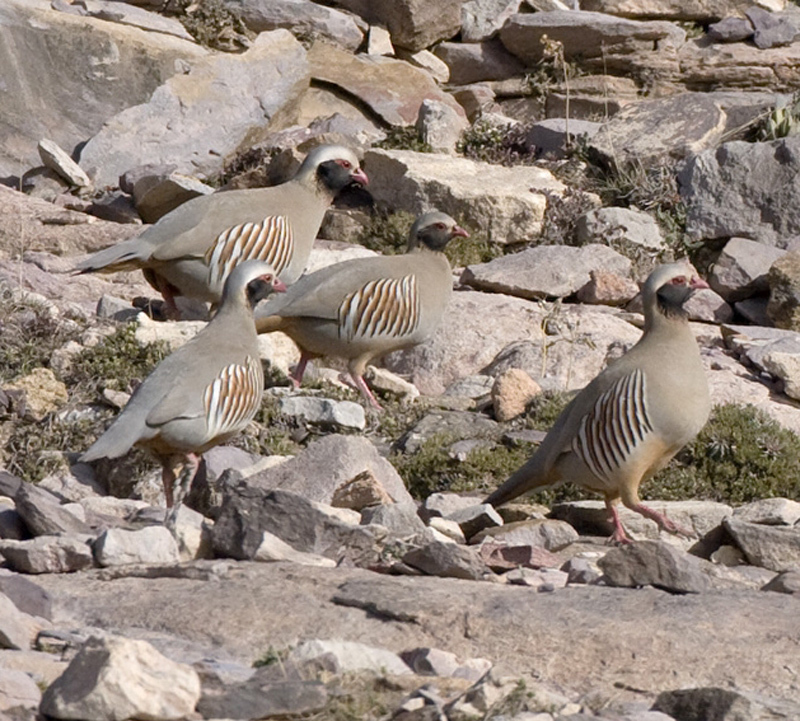
Philby's partridge (Alectoris philbyi) or Philby's rock partridge, is a relative of the chukar, red-legged partridge and barbary partridges and is native to southwestern Saudi Arabia and northern Yemen. Although similar in appearance to other Alectoris species, Philby's partridge can be distinguished by its black cheeks and throat. Although not currently listed as an endangered species, the Arab Spring and destruction of its fragile habitat in the tribal areas of Northern Yemen had led to concerns about the survival of this species. The name commemorates the British explorer St John Philby.
From the article Philby's partridge on Wikipedia (CC BY-SA), quoted section by section
Description
Philby's partridge is similar in appearance to the chukar partridge and has greyish-brown plumage with the flanks boldly banded in black and pale buff. It differs from that species in having black cheeks and throat, and a thin white line separates this from the greyish-blue head and nape. The beak and legs are pink.
Range & habitat
Philby's partridge is found in Saudi Arabia and Yemen. It lives on rocky slopes and scantily vegetated land, usually at altitudes between 4,500 and 9,000 feet (1,400 and 2,700 m).
Wikipedia: “Distribution and habitat”
What it does
Philby's partridge is a ground-dwelling bird. It feeds on seeds, other plant material and small invertebrates. The breeding season lasts from April to June and a clutch of five to eight eggs is laid in a nest on the ground. The eggs are pale buff flecked with pink and are incubated for around 25 days.
Wikipedia: “Behaviour”
Listen
Looking for field recordings…
Where it lives
Recorded sightings
—
geo-referenced records in GBIF, from museums, herbaria and field observers.
Drag the globe to turn it. Dots are where records exist, not a range map; darker means more records.
In the stacks
Searching the stacks…
Every page naming Alectoris philbyi in the Biodiversity Heritage Library →
This page is assembled live from iNaturalist, GBIF, Wikipedia, the Source Library and the Internet Archive. It is not yet part of the hand-edited codex. iNaturalist taxon 862.