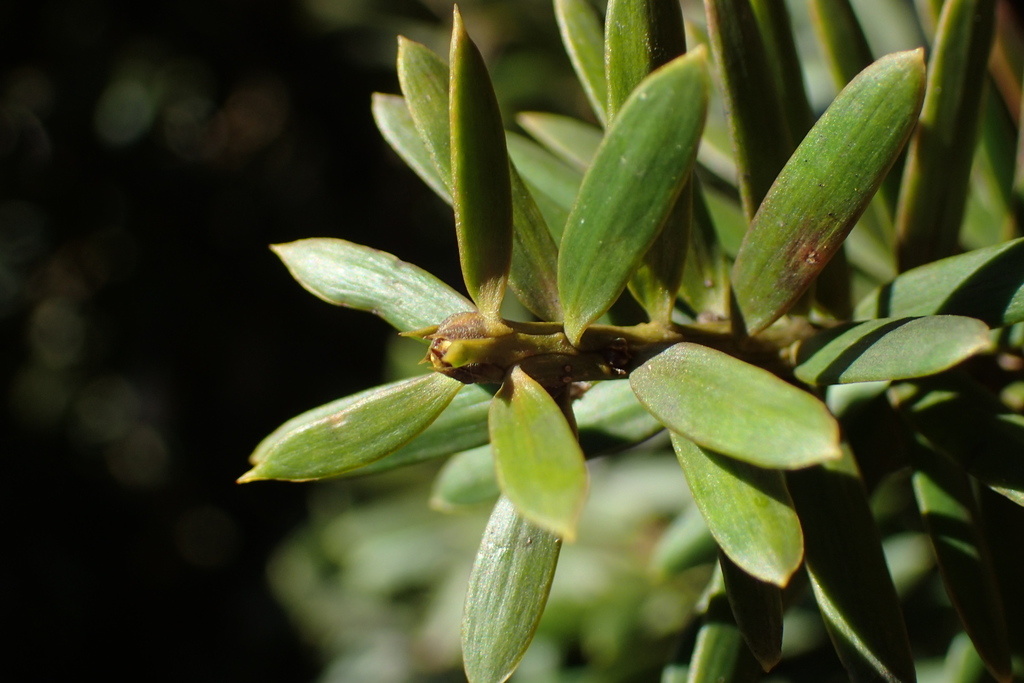
Tōtara
Podocarpus totara
Podocarpus totara (), the tōtara, is a species of coniferous tree in the family Podocarpaceae, endemic to New Zealand. Found across New Zealand, the tree can grow up to a height of 35 m (115 ft), and is known for its longevity.
The wood of tōtara is rot-resistant, and prized in Māori culture, and was often used as a material to create large-scale waka.
From the article Podocarpus totara on Wikipedia (CC BY-SA), quoted section by section
Description
The tōtara is a medium to large tree, which grows slowly to around 20 to 25 metres (66 to 82 feet) exceptionally to 35 m (115 ft); it is noted for its longevity and the great girth of its trunk. The bark peels off in papery flakes, with a purplish to golden brown hue. The sharp, dull-green, needle-like leaves are stiff and leathery, 2 cm (0.79 in) long. This plant produces highly modified cones with two to four fused, fleshy, berry-like, juicy scales, bright red when mature. The cone contains one or two rounded seeds at the apex of the scales. The largest known living tōtara, the Pouakani Tree, near Pureora in the central North Island, is over 35 m (115 ft) tall and nearly 4 m (13 ft) in trunk diameter at breast height. Bushmen discovered it in 1950. Other large trees are known in this area, while Whirinaki Forest, to the east, but also on deep recent volcanic soils, has groves of very tall tōtara (over 40 m (130 ft) in height).
Range & habitat
Podocarpus totara is found in both the North Island and the South Island, growing in both lowland, montane and lower subalpine habitats, at elevations of up to 600 metres (2,000 feet) It is rarely found on Stewart Island / Rakiura. Tōtara is commonly found in lowland areas where the soil is fertile and well drained. Tōtara is often found regenerating on farmland, as it is not eaten by livestock. Tōtara is so commonly found on Northland farms that some farmers consider the tree to be a weed.
Wikipedia: “Distribution and habitat”
How it is grown
Tōtara grows easily from fresh seed and cuttings. It has been planted in the United Kingdom as far north as Inverewe, Scotland. Several cultivars for garden use have been introduced. These include 'Albany Gold' and 'Aurea', both have yellow 'gold' foliage that darkens in winter; 'Pendula', which has a weeping growth habit that is especially pronounced in young plants; 'Silver Falls', also pendulous but with cream-edged foliage; and 'Matapouri Blue', which has a conical form and glaucous foliage.
Wikipedia: “Cultivation”
In human culture
Its Māori name comes from the Proto-Polynesian word *tootara (related to the word tara lit. 'thorn') which when passed down to descendant languages refer to spiny creatures, especially the porcupinefish (Diodon hystrix) due to its spiky leaves. The species epithet totara comes from the Māori language name. The spelling "totara" without the tohutō is also common in English.
Wikipedia: “Etymology”
Where it lives
Recorded sightings
—
geo-referenced records in GBIF, from museums, herbaria and field observers.
Drag the globe to turn it. Dots are where records exist, not a range map; darker means more records.
In the stacks
Searching the stacks…
Every page naming Podocarpus totara in the Biodiversity Heritage Library →
This page is assembled live from iNaturalist, GBIF, Wikipedia, the Source Library and the Internet Archive. It is not yet part of the hand-edited codex. iNaturalist taxon 85275.