- Animals
- ›Chordates
- ›Vertebrates
- ›Cartilaginous Fishes
- ›Sharks and Rays
- ›Rays
- ›Shovelnose Rays
- ›banjo rays
- ›Zapteryx
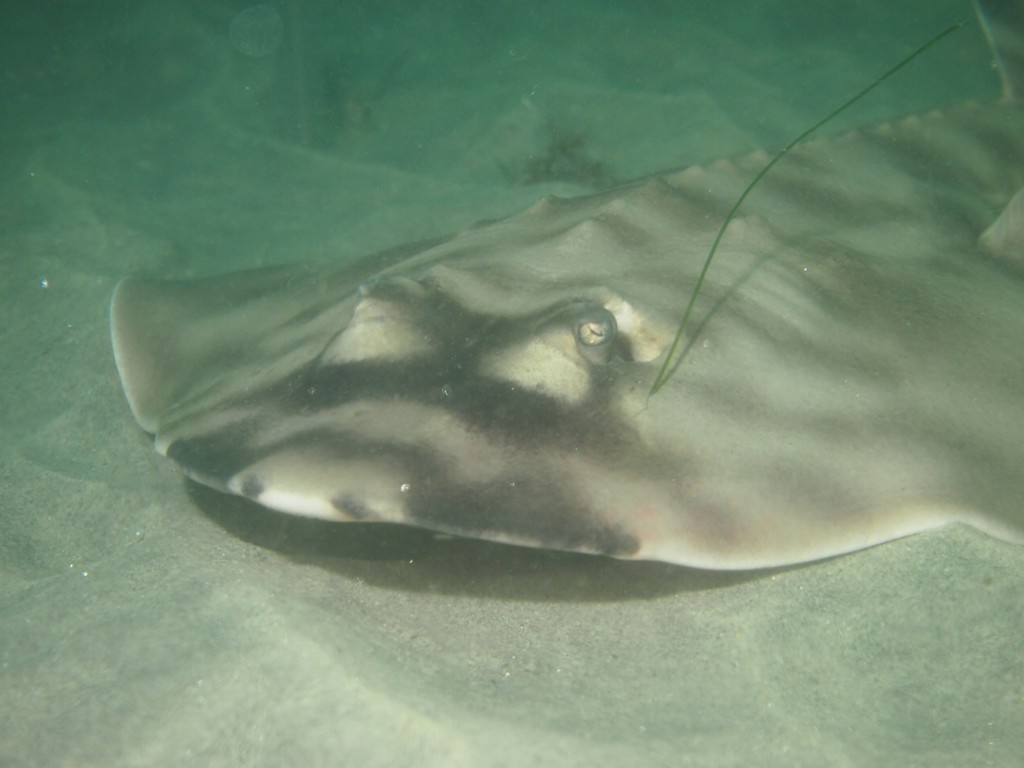
Banded Guitarfish
Zapteryx exasperata
The banded guitarfish, mottled guitarfish, prickly skate or striped guitarfish (Zapteryx exasperata) is a species of fish in the Trygonorrhinidae family. Originally Z. exasperata was placed in the Rhinobatidae family, however recent mitochondrial DNA analysis shows their placement into the new family of Trygonorrhinidae. They are found from shallow water to a depth of 200 m (660 ft) in the East Pacific from California, United States, to Mazatlan, Mexico, including the Gulf of California. The species has also been recorded further south (as far as Peru), but this likely involves its close relative, the southern banded guitarfish (Z. xyster).
From the article Banded guitarfish on Wikipedia (CC BY-SA), quoted section by section
Description
Banded guitarfish have diamond-shaped bodies that, as their name suggests, resemble guitars. Their coloration is dark gray to sandy brown with characteristic black or dark brown banding along the back. They generally have large eyes with a short, rounded snout. The tail is thick from the base of the disc to its rounded caudal fin and is equal or shorter in length to its disc. Banded guitarfish have a rough textured skin caused by prickles or tiny spikes throughout the dorsal surface with a line of large spikes in the middle running to the first dorsal fin. Since Z. exasperata is very closely related to Zapteryx xyster, they are relatively hard to differentiate from each other. Some distinguishing characteristics between the two are Z. exasperata has a disc that is equally long as wide and lacks yellow eyespots found on Z. xyster. The oldest banded guitarfish researched was estimated to be 22 years old. Females and males were found to have an average age of 18 and 14 years old, respectively. The maximum total length (TL) recorded is 124 cm. Banded guitarfish demonstrate allometric growth and sexual dimorphism as females are much larger than males.
Wikipedia: “Characteristics”
What it does
Banded guitarfish are a high trophic level species, being a top predator in benthic communities on coastal rocky reefs. They are mostly bottom feeders, but adults have been found to eat pelagic fish making them benthopelagic predators as well. Banded guitarfish are specialist feeders whose main prey consists of invertebrates, crustaceans (mainly crabs), and teleost's. Z. exasperata are thought to have an ontogenetic diet shift, meaning a change in diet over the lifespan of the organism. Both Juveniles and adults consume crustaceans (mainly consumed by juveniles) and demersal fish, mostly Daisy midshipman. Daisy midshipman uses the same rocky reef habitat and time for reproduction making it an abundant food source for banded guitarfish.
Wikipedia: “Diet”
Where it lives
Recorded sightings
—
geo-referenced records in GBIF, from museums, herbaria and field observers.
Drag the globe to turn it. Dots are where records exist, not a range map; darker means more records.
In the stacks
Searching the stacks…
Every page naming Zapteryx exasperata in the Biodiversity Heritage Library →
This page is assembled live from iNaturalist, GBIF, Wikipedia, the Source Library and the Internet Archive. It is not yet part of the hand-edited codex. iNaturalist taxon 85115.