- Animals
- ›Chordates
- ›Vertebrates
- ›Ray-finned Fishes
- ›Spiny-rayed fishes
- ›Wrasses and allies
- ›False scorpionfishes, wrasses, and parrotfishes
- ›Wrasses and Parrotfishes
- ›Parrotfishes
- ›Scarus
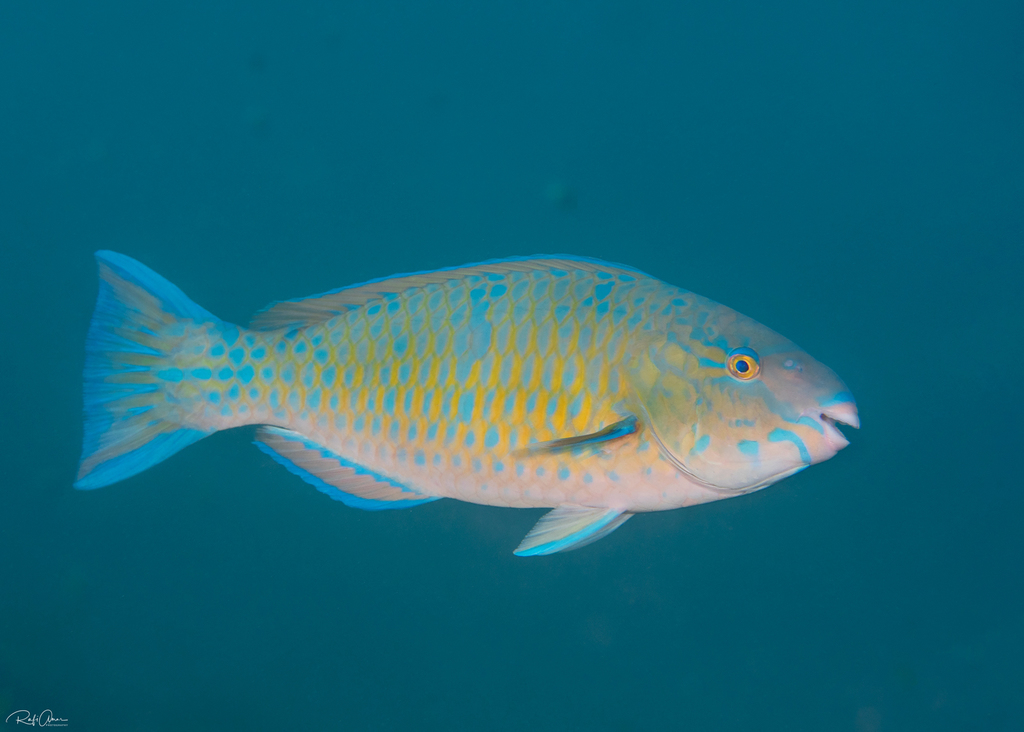
Blue-barred Parrotfish
Scarus ghobban
Scarus ghobban, also known as the blue-barred parrotfish, blue-barred parrotfish, blue trim parrotfish, cream parrotfish, globe-headed parrotfish, green blotched parrotfish, yellow scale parrotfish, and bluechin parrotfish, is a species of marine fish in the Scaridae family.
From the article Scarus ghobban on Wikipedia (CC BY-SA), quoted section by section
Description
This species is blue-green to green in colour and commonly grows to approximately 46 cm. Its appearance is variable. It may have a central stripe on the dorsal and anal fins that is pink in color. The underside of the body may be pinkish or yellowish. There may be blue markings around the area of the pectoral fin.
Range & habitat
Scarus ghobban is widespread throughout the Indo-Pacific, known from East Africa to Indonesia. It is also present in the Eastern Pacific, occurring in the Galápagos Islands as well as Japan, south to Australia and east to French Polynesia. Recently recorded in 2001 for the first time in the Mediterranean Sea off Israel, following an entry via the Suez Canal, it is now expanding northward in Levantine waters where it remains rare. Like other reef fish with a pelagic larval phase, regional currents facilitate high levels of gene flow, which in turn create high genetic diversity among the species.
Wikipedia: “Distribution”
What it does
Scarus ghobban grows quickly and can live up to 13 years. It tends to congregate in small schools. Scarus ghobban can rotate their mandible bone at a high velocity; this allows them to function as a scraper and facilitate hydrological transport of fine sediments.
Wikipedia: “Ecology”
Where it lives
Recorded sightings
—
geo-referenced records in GBIF, from museums, herbaria and field observers.
Drag the globe to turn it. Dots are where records exist, not a range map; darker means more records.
In the stacks
Searching the stacks…
Every page naming Scarus ghobban in the Biodiversity Heritage Library →
This page is assembled live from iNaturalist, GBIF, Wikipedia, the Source Library and the Internet Archive. It is not yet part of the hand-edited codex. iNaturalist taxon 84175.