- Animals
- ›Arthropods
- ›Chelicerates
- ›Arachnids
- ›Spiders
- ›Typical Spiders
- ›Entelegyne Spiders
- ›RTA Clade Spiders
- ›Oval calamistrum clade spiders
- ›Wolf Spiders and Allies
- ›Wandering Spiders
- ›Phoneutria
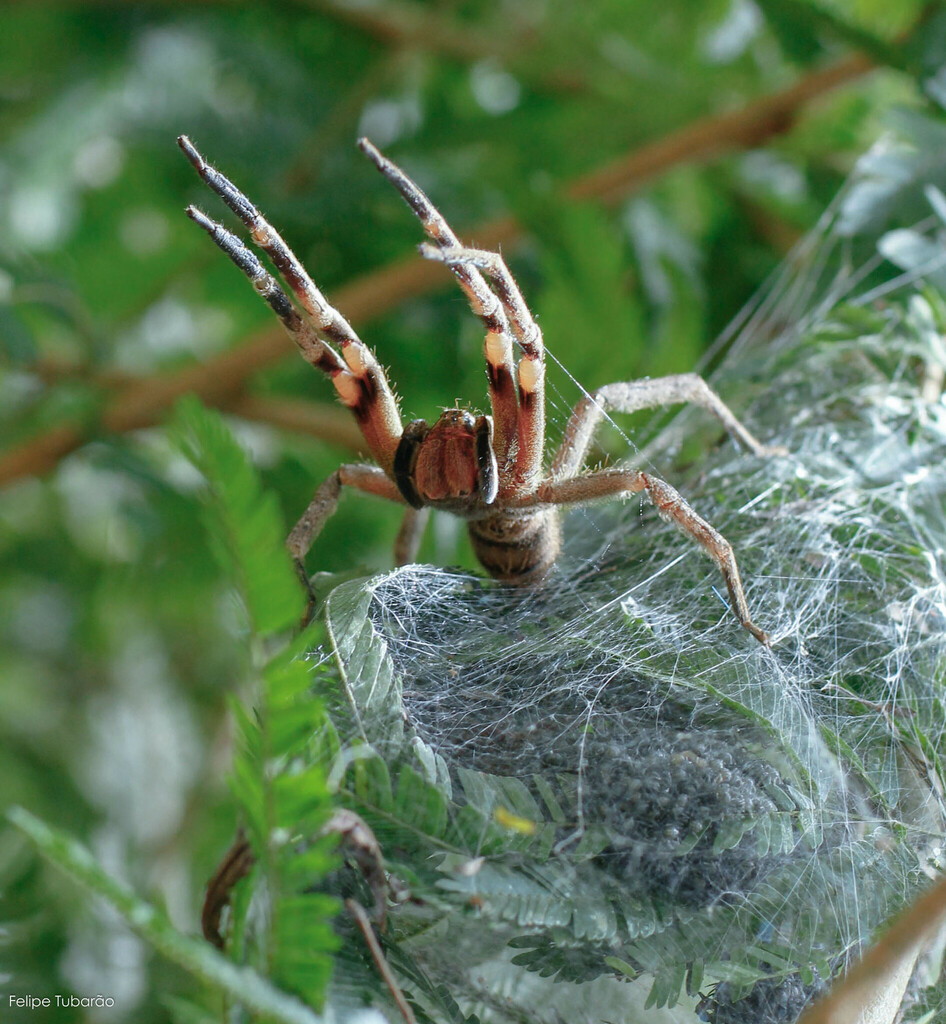
Phoneutria pertyi
Phoneutria pertyi is a species of spiders in the family Ctenidae, found in Brazil.
P. pertyi is very similar to P. nigriventer and P. eickstedtae, females have several basal grooves in the epiginal lateral apophysis, while they are absent in P. nigriventer. The maschos have the longest tibial pedipalp, or similar in length to the cambium, and the curved hook-shaped apex of the emboli. The dorsal shield of the prossoma is reddish-brown with golden bristles, the ocular area has light gray bristles and a dark brown oblique band, to the anterior dorsal shield on the edge of the prossoma. The cheliceras are dark brown with golden-yellow and white setae, a light brown sternum. The tibia pediplapo is dorsally brown with a golden median longitudinal stripe, retrolateral face with white stripe legs I and IV yellowish brown. Dorsally golden optosome, with dark-stained walls longitudinally in the median region, ventrally yellowish brown with or without a dark brown transverse band near the epihgastric groove, and four more conspicuous white lines in the posterior half of the opistogosome, area close to the rows with two dark brown side bands.
Where it lives
Recorded sightings
—
geo-referenced records in GBIF, from museums, herbaria and field observers.
Drag the globe to turn it. Dots are where records exist, not a range map; darker means more records.
In the stacks
Searching the stacks…
Every page naming Phoneutria pertyi in the Biodiversity Heritage Library →
This page is assembled live from iNaturalist, GBIF, Wikipedia, the Source Library and the Internet Archive. It is not yet part of the hand-edited codex. iNaturalist taxon 835895.