- Animals
- ›Arthropods
- ›Chelicerates
- ›Arachnids
- ›Spiders
- ›Typical Spiders
- ›Entelegyne Spiders
- ›Orbweavers and Allies
- ›Comb-footed Spiders
- ›Anelosiminae
- ›Anelosimus
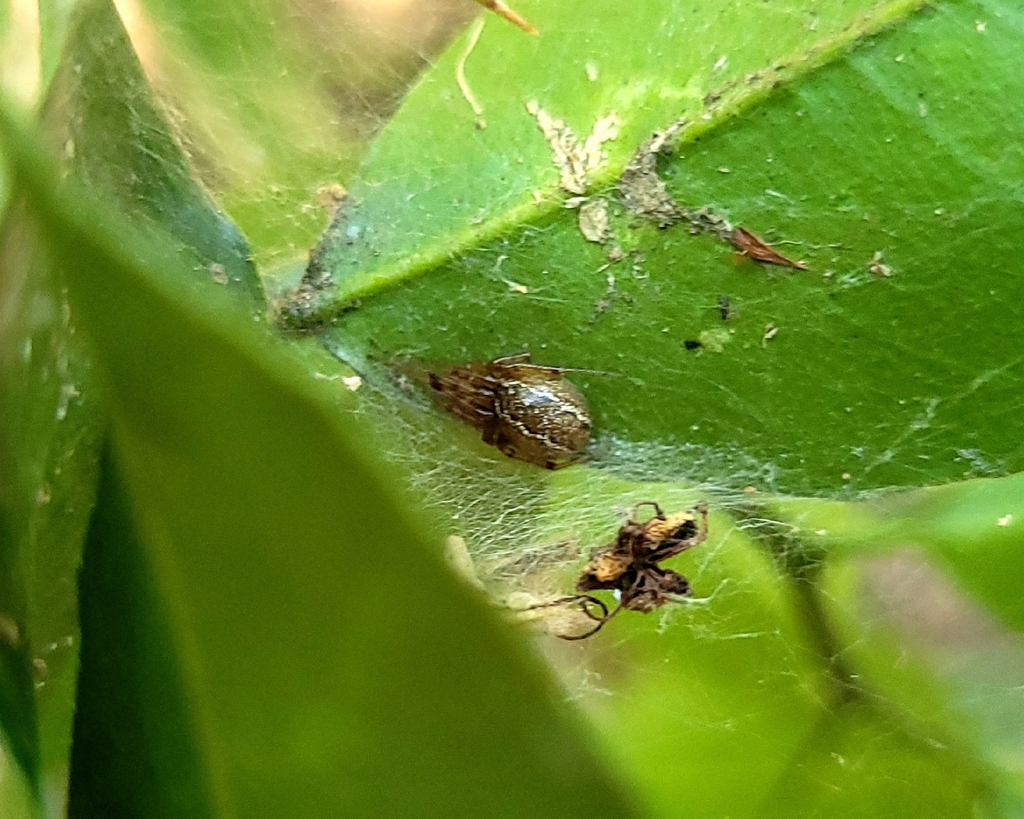
Anelosimus jabaquara
Anelosimus jabaquara is a species of spider found in subtropical, humid, lowland forests in Brazil. Anelosimus jabaquara was first described by Herbert W. Levi in 1956. These spiders cooperate to spin and repair the colonial web, capture prey, and care for the brood. Colony size is small, and the sex ratio is biased towards females.
From the article Anelosimus jabaquara on Wikipedia (CC BY-SA), quoted section by section
Description
Adult males are on average smaller than adult females. The mean male cephalothorax length is 1.38 cm, while the mean female cephalothorax length is 1.62 cm. Similar to other Anelosimus species, Anelosimus jabaquara has a minute colulus, three teeth on the anterior margin of the chelicerae and denticles on the posterior. The palpus distinguishes this species from others. The eyes are subequal in size. For males, the carapace and sternum are orange-yellow. The legs are dusky yellow. The abdomen is dusky with dorsal and ventral black bands. For females, the carapace is red, except for black rings around the eyes. The clypeus, chelicerae, and endites are orange, and the sternum and labium are red. The legs are light brown with darker segments on the distal end. The tibiae and femora have dark rings in the middle. The abdomen is dark brown with a dorsal medium band containing black spots.
What it does
Anelosimus jabaquara females have one brood per year, and develop through eight instars (stages). Males begin dying soon after copulation; males are not involved in brood care. Spiderlings go through their first instar while inside the egg sac. The spiderlings leave the egg sac in their second instar, however the protective behavior of the female remains. Females feed their spiderlings through regurgitation. This happens until the spiderlings reach the third instar, when they are then able to capture small prey on their own. During the fourth instar, the juveniles of one brood will mix with other broods, capturing prey together in groups. Females begin dying when their brood reaches the 5th instar.
Wikipedia: “Life cycle”
Where it lives
Recorded sightings
—
geo-referenced records in GBIF, from museums, herbaria and field observers.
Drag the globe to turn it. Dots are where records exist, not a range map; darker means more records.
In the stacks
Searching the stacks…
Every page naming Anelosimus jabaquara in the Biodiversity Heritage Library →
This page is assembled live from iNaturalist, GBIF, Wikipedia, the Source Library and the Internet Archive. It is not yet part of the hand-edited codex. iNaturalist taxon 834574.