- Plants
- ›Vascular Plants
- ›Lycophytes
- ›clubmosses and firmosses
- ›Clubmosses and Firmosses
- ›Lycopodioideae
- ›Diphasiastrum
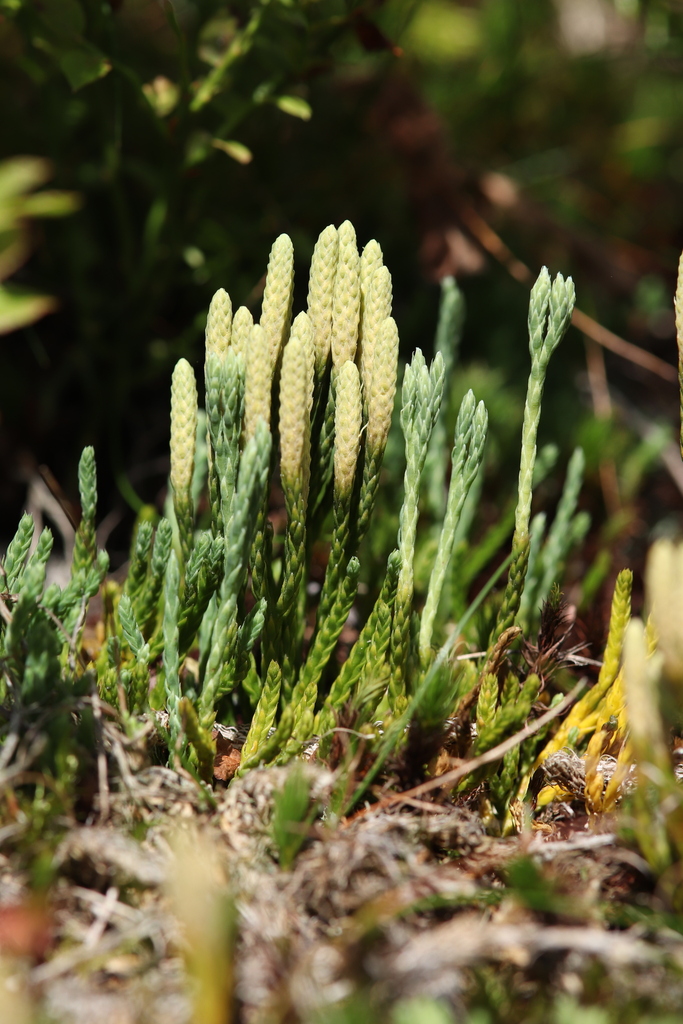
alpine clubmoss
Diphasiastrum alpinum
Diphasiastrum alpinum, the alpine clubmoss, is a species of clubmoss. This plant is a glaucous scale-leaved perennial pteridophyte. In Finland, the spores are produced June to September. It was first described by Carl Linnaeus in his Flora Lapponica, 1737, from specimens obtained in Finland.
From the article Diphasiastrum alpinum on Wikipedia (CC BY-SA), quoted section by section
Description
Diphasiastrum alpinum have 30-50 cm long stems, with 3-5 cm long branches. The stems are upright, 4-edged, growing densely in branchy bunches. The leaves are small, scale-like, wintering and parallel to the stem. The leaves are hollow at the bases. The spore-cases are in sessile, 1-1,5 cm long, densely cylindrical spore cones. The female stems produce strobili up to 3 cm (1 in) long. Diphasiastrum alpinum may hybridize with Diphasiastrum sitchense.
Range & habitat
It has a circumpolar distribution across much of the northern parts of the Northern Hemisphere: much of Canada, the northwestern United States, northern and central Europe, Russia, China and Japan. It is an indicator of alpine tundra and boreal climates. It is found in mountains and moors often with Calluna and grasses.
Wikipedia: “Distribution”
Where it lives
Recorded sightings
—
geo-referenced records in GBIF, from museums, herbaria and field observers.
Drag the globe to turn it. Dots are where records exist, not a range map; darker means more records.
In the stacks
Searching the stacks…
Every page naming Diphasiastrum alpinum in the Biodiversity Heritage Library →
This page is assembled live from iNaturalist, GBIF, Wikipedia, the Source Library and the Internet Archive. It is not yet part of the hand-edited codex. iNaturalist taxon 82393.