- Animals
- ›Molluscs
- ›Gastropods
- ›Heterobranchs
- ›Euthyneura
- ›Tectipleura
- ›Eupulmonata
- ›Common Land Snails and Slugs
- ›Helicina
- ›Arionoidei
- ›Roundback Slugs and Allies
- ›Roundback Slugs
- ›Arion
- ›Arion
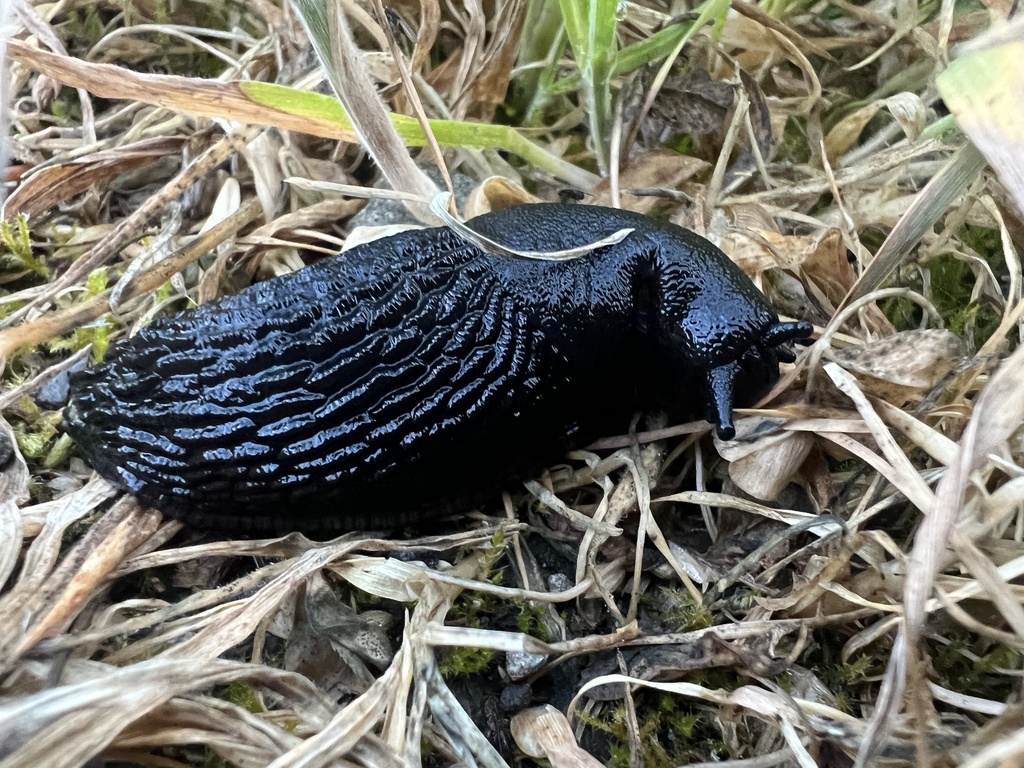
Black Slug
Arion ater
Arion ater, the black slug (also known as black arion, European black slug, or large black slug), is a large terrestrial gastropod mollusk in the family Arionidae, the round back slugs.
Many land slugs lack external shells, having a vestigial shell. Most slugs retain a remnant of their shell, which is usually internalized, unlike other terrestrial mollusks (such as snails) which have external shells. Without such shells, slugs produce mucus—that may also contain toxins—to deter predators. Terrestrial slugs produce two other forms of mucus that facilitate locomotion and prevent death from drying. Such mollusks are hermaphroditic. Slugs most often function as decomposers but are also often omnivores. Arion ater is one such slug, decomposing organic matter, preying on other organisms, and consuming vegetative matter including agricultural crops. Native to Europe, the black slug is an invasive species in Australia, Canada (British Columbia, Newfoundland, Quebec), and the United States (Pacific Northwest, Alaska).
From the article Arion ater on Wikipedia (CC BY-SA), quoted section by section
Description
Arion ater varies from 10–15 cm (3.9–5.9 in), reaching maturity at about 2.5 cm (0.98 in) and moves at a speed of up to 4.5 cm/min (1.8 in/min) The black slug is generally deep black, with some adults being brown or even white. Generally, pigmentation darkens directly with increasing latitude. Young specimens tend to be brown or ivory whitish, turning to grey before becoming characteristically black at maturity. Rust-brown individuals are arguably classified as a separate subspecies Arion ater rufus or species Arion rufus (red slug). The two can only be distinguished by dissecting the reproductive anatomy. The foot-fringe is black, the tubercles are large and elongate, and the sole is blackish grey. The atrium and vagina (genitalia) are considerably narrower than is the spermatheca (organ for storing sperm). The oviduct is narrow while the spermatheca is spherical. The black slug is omnivorous, and its diet includes fungi, carrion, earthworms, leaves, stems, dead plant material and dung. The food is shredded into tiny pieces by the radula and is then digested by enzymes. Like other terrestrial slugs, the black slug is a hermaphrodite, preferring to find a mate—often several—but can self-fertilize. After mating, the black slug seeks a dark, moist environment such as beneath mosses—occasionally within topsoil—to lay its eggs about 5 mm (0.20 in) in diameter. …
Range & habitat
This species is found in northern Europe (including Great Britain and Ireland), Canada, the Pacific Northwest, and most recently in Australia and some Caribbean countries:
Great Britain: often found in habitats more wooded and less human-dense than those in which A. ater rufus occurs Maladeta Mountains, Spain: often an agricultural pest Ireland, Italy, Germany, Scandinavia, and Gerês, Portugal Canada [invasive]: first document in 1941, established pest by 1960 British Columbia Newfoundland Quebec (specifically on Mont Bellevue in Sherbrooke) United States [invasive]: Within its native habitats, this species functions as a decomposer/consumer and often becomes an agricultural pest. This species is well-established in Washington and Oregon, and it is considered to represent a potentially serious threat as a pest, an invasive species which could negatively affect agriculture, natural ecosystems, human health or commerce. Therefore, it has been suggested that this species be given top national quarantine significance in the USA. Australia [invasive]: The Museum Victoria reports the black slug to have been first documented in Australia in 2001 with multiple reports of these slugs in cultivated gardens and farms since, but as of 2009, the species was still not considered to be an established species in Australia.
Wikipedia: “Distribution”
What it does
The black slug is mainly nocturnal and avoids exposure to sunlight, although in introduced areas, it has been observed to be active all parts of the day and night. It is omnivorous, eating carrion, fungi, animal feces, algae, lichen, and vegetation (living or decaying). These slugs prefer to eat on cloudy days or at night when temperatures are above 10 degrees Celsius. Mucus-production necessitates moist habitats, such as among leaf-litter, mosses, or fallen trees. Consequently, the black slug becomes most active after rainfall. A 1976 study compared black slug assimilation rates to that of similar slugs in the UK. The study determined the black slug feeds at similar rates to other European slugs (in terms of biomass), suggesting the black slug is an equally important decomposer/consumer in forest systems. The study theorized these high assimilation rates might result from abundant enzymes in slug digestive systems: amylase, invertase, cellulase, xylanase, and chitinase. The last might be especially indicative of how these slugs can consume large quantities of fungi such as Armillaria mellea. Microbiota within black slug digestive systems produce these enzymes—such as the bacteria that produce cellulase—enabling the slugs to break down lignocellulose. …
Wikipedia: “Ecology”
Where it lives
Recorded sightings
—
geo-referenced records in GBIF, from museums, herbaria and field observers.
Drag the globe to turn it. Dots are where records exist, not a range map; darker means more records.
In the stacks
Searching the stacks…
Every page naming Arion ater in the Biodiversity Heritage Library →
This page is assembled live from iNaturalist, GBIF, Wikipedia, the Source Library and the Internet Archive. It is not yet part of the hand-edited codex. iNaturalist taxon 82003.