- Animals
- ›Arthropods
- ›Chelicerates
- ›Arachnids
- ›Spiders
- ›Typical Spiders
- ›Entelegyne Spiders
- ›Orbweavers and Allies
- ›Long-jawed Orbweavers
- ›Leucauginae
- ›Leucauge
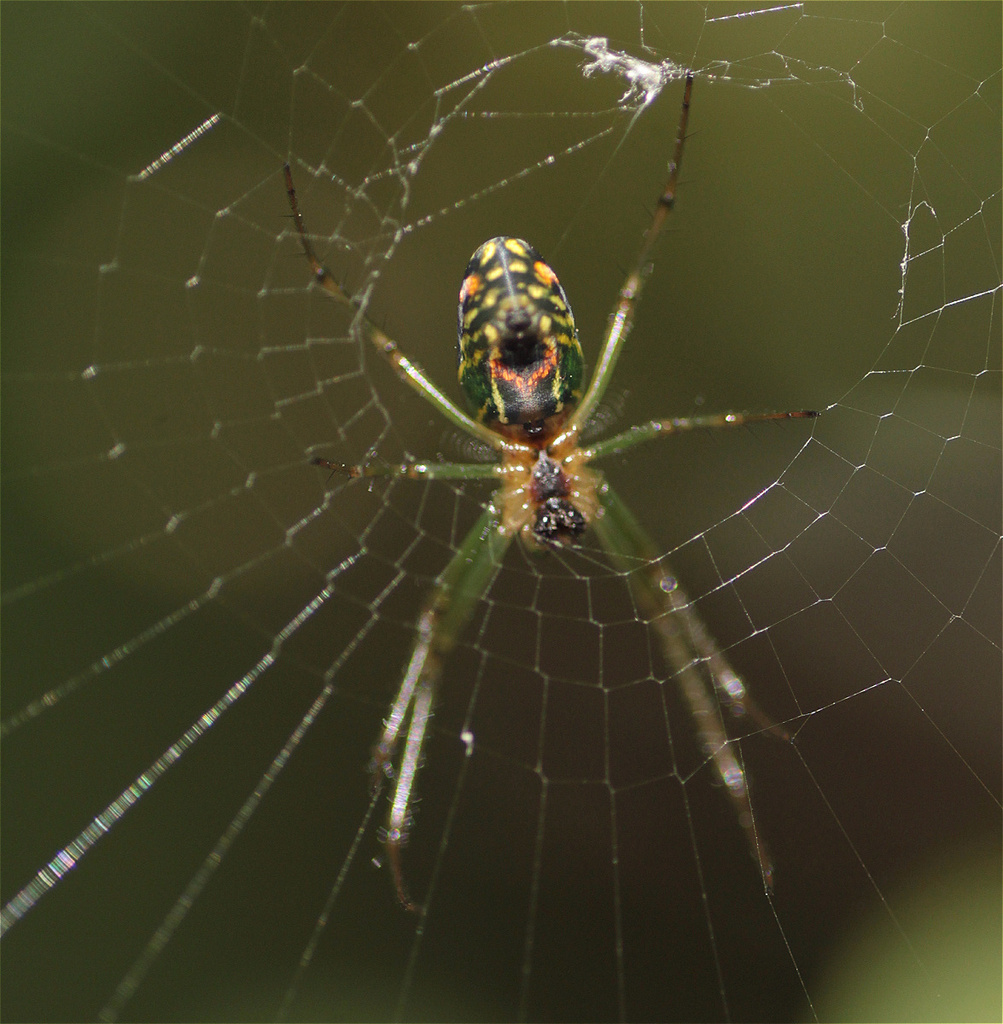
Leucauge mariana
Leucauge mariana is a long-jawed orb weaver spider, native to Central America and South America. Its web building and sexual behavior have been studied extensively. Males perform several kinds of courtship behavior to induce females to copulate and to use their sperm.
A particularly unusual feature of sex in L. mariana is the formation of mating plugs during copulation. These masses sometimes block the access of subsequent males to the female’s genitalia and can prevent copulations. Unlike other species, L. mariana forms the mating plug from materials contributed by both the female and the male; the male alone cannot make a functional plug. Most mating plugs in other animals are typically viewed as a male tactic used to increase his chances of paternity, without participation of the female. Female participation in creating a mating plugs, and her presumed benefit from them, have led to multiple studies of sexual selection on the sexual behavior of L. mariana.
From the article Leucauge mariana on Wikipedia (CC BY-SA), quoted section by section
Description
The sides and ventral surface of the abdomen have complex array of green, yellow, black, white and red markings; the abdomen’s dorsal surface, in contrast, is silvery white with dark streaks. The legs are mostly green. Predators and prey looking at the spider from above while it rests at the hub of its more or less horizontal web would see the complex color patterns on its ventral surface; these colors may help camouflage the spider. On the other hand, predators and prey looking up at the spider from below would see the silvery white pattern, which may also provide camouflage against clouds and the bright sky. The red markings may also serve as a warning to possible predators, as L. mariana emit a weak repugnant odor that can be sensed when a spider is held in the fingers very close to the nose. An early instar spiderling has a relatively large brain which displaces other organs in its cephalothorax, and also fills an outward bulge in the lower wall of the cephalothorax. This bulge gradually disappears as spiders grow to their adult size. Although the absolute size of the brain of an early instar L. …
Range & habitat
Leucauge mariana spiders are found from Mexico to Argentina. In the Valle Central in Costa Rica the spiders are very common among weeds in early secondary growth and along wooded streams. Before the arrival of humans, secondary vegetation of this sort grew near rivers, landslides and tree-fall gaps. The population densities in Costa Rica are much greater late in the rainy season and the beginning of the early dry season, but mature individuals are present year-round. Males are often found on either mature females' webs or on the webs of penultimate females.
Wikipedia: “Habitat”
What it does
Field-caught males and females can live for a week or longer in captivity without additional food if they are kept in a humid environment. Mature females in the field have been observed to live several weeks. It is believed that females lay multiple clutches of eggs, but this has not been confirmed in nature. In Mexico females laid eggs at sheltered sites (e.g. under leaves) in the leaf litter.
Wikipedia: “Life cycle and reproduction”
Where it lives
Recorded sightings
—
geo-referenced records in GBIF, from museums, herbaria and field observers.
Drag the globe to turn it. Dots are where records exist, not a range map; darker means more records.
In the stacks
Searching the stacks…
Every page naming Leucauge mariana in the Biodiversity Heritage Library →
This page is assembled live from iNaturalist, GBIF, Wikipedia, the Source Library and the Internet Archive. It is not yet part of the hand-edited codex. iNaturalist taxon 815545.