- Animals
- ›Chordates
- ›Vertebrates
- ›Birds
- ›Woodpeckers and Allies
- ›Woodpeckers
- ›Old World piculets
- ›Verreauxia
On eBird ↗
African Piculet
Live sightings near you, the range map, bar charts of when it is seen, and Macaulay Library photos and recordings.
African Piculet
Verreauxia africana
The African piculet (Verreauxia africana), sometimes placed in the genus Sasia, is a species of bird in the family Picidae. It is the only species placed in the genus Verreauxia.
It is found in Angola, Cameroon, Central African Republic, Republic of the Congo, Democratic Republic of the Congo, Ivory Coast, Equatorial Guinea, Gabon, Ghana, Liberia, and Uganda. This species is described as locally common and has a very large range, so the International Union for Conservation of Nature has rated its conservation status as being of "least concern".
From the article African piculet on Wikipedia (CC BY-SA), quoted section by section
Description
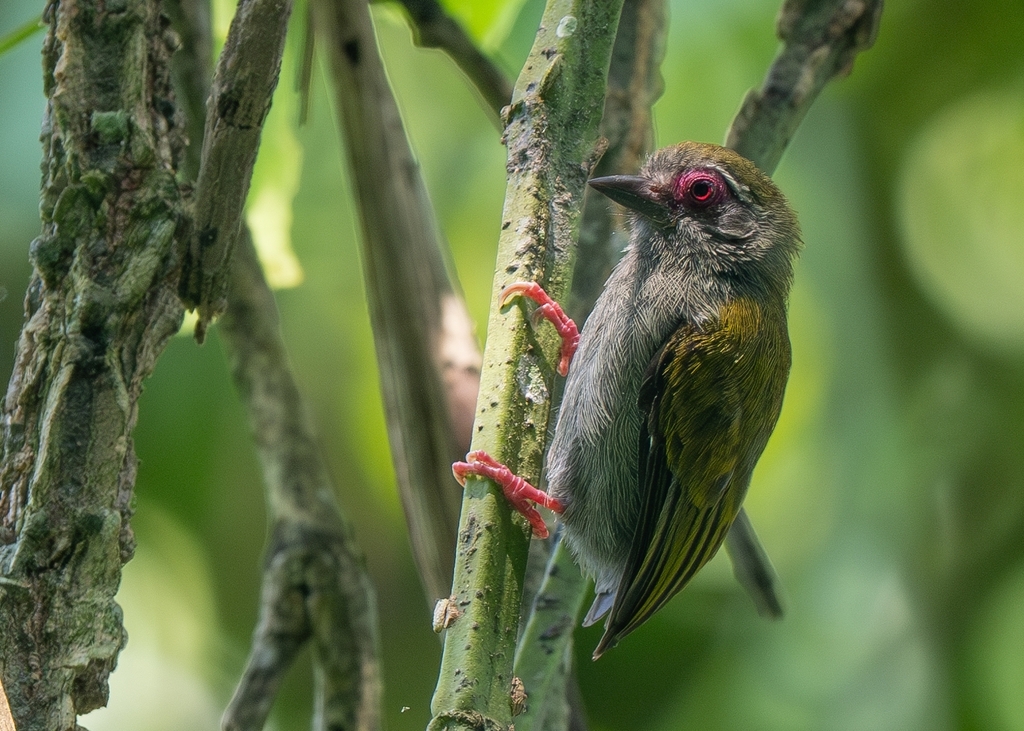
The African piculet is a small bird some 9 to 10 cm (3.5 to 3.9 in) long. The male has a chestnut or reddish forehead and a greyish-green or olive-green crown whereas the forehead in the female is the same colour as the crown. The rest of the upper parts are rather dark green tinged with yellow. The wings and tail are brownish-black. The throat and breast are darkish grey and the belly is a slightly paler grey. The beak is black, the eye red and the legs reddish. The juvenile is similar to the adult but has grey or buffy tones mixed into the general hue of the plumage.
What it does
The habitat of the African piculet is mainly lowland secondary forest. It is an active bird often seen flitting from place to place in pairs or threesomes, and sometimes joining mixed species flocks. It forages through the lower storeys of trees, bushes and dense vegetation. It is a relative of the woodpecker, and despite its small size, hammers its beak into branches and splits stems to get at beetle larvae. It also gleans other insects but seems uninterested in ants. Breeding has been observed between June and February in various parts of its range. The nest is built within 5 metres (16 ft) of the ground and the clutch size is usually two. Both parents are involved in raising the young.
== References ==
Wikipedia: “Ecology”
Listen
Looking for field recordings…
Where it lives
Recorded sightings
—
geo-referenced records in GBIF, from museums, herbaria and field observers.
Drag the globe to turn it. Dots are where records exist, not a range map; darker means more records.
In the stacks
Searching the stacks…
Every page naming Verreauxia africana in the Biodiversity Heritage Library →
This page is assembled live from iNaturalist, GBIF, Wikipedia, the Source Library and the Internet Archive. It is not yet part of the hand-edited codex. iNaturalist taxon 792894.