- Animals
- ›Chordates
- ›Vertebrates
- ›Birds
- ›Cranes, Rails, and Allies
- ›Rails, Gallinules, and Coots
- ›Gallirallus
On eBird ↗
Chestnut Rail
Live sightings near you, the range map, bar charts of when it is seen, and Macaulay Library photos and recordings.
Chestnut Rail
Gallirallus castaneoventris
The chestnut rail (Eulabeornis castaneoventris) is a species of bird in the family Rallidae. It is the only species in the genus Eulabeornis. It is found in the Aru Islands and northern Australia. Its natural habitat is subtropical or tropical mangrove forests.
From the article Chestnut rail on Wikipedia (CC BY-SA), quoted section by section
Description
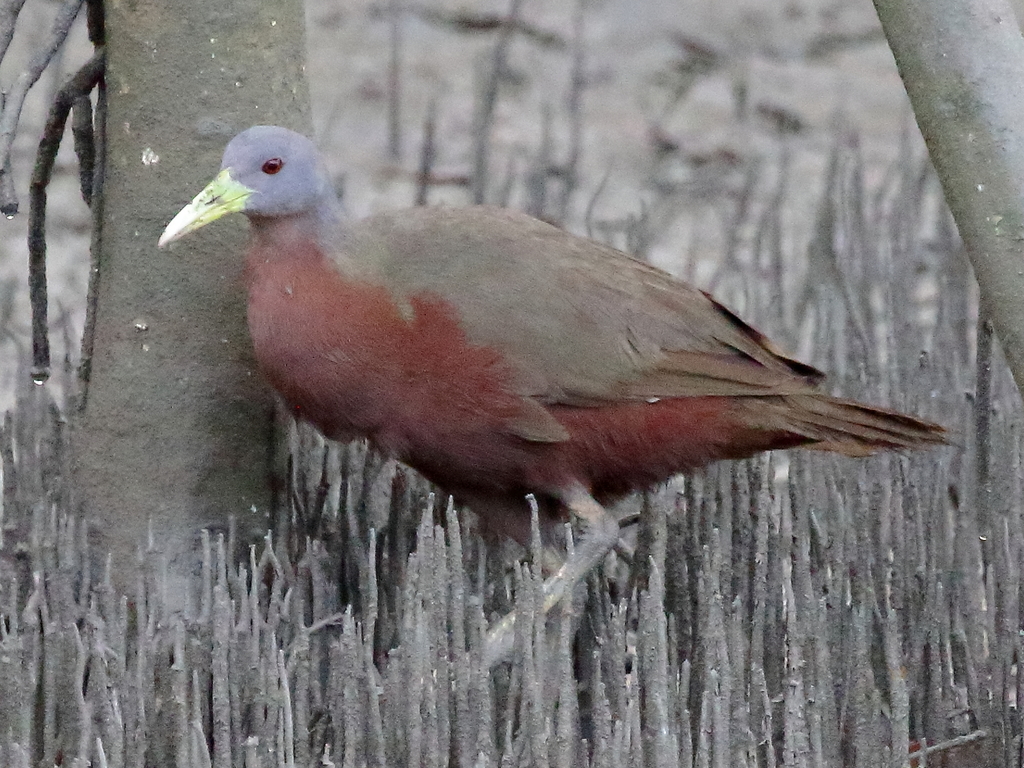
The chestnut rail is the largest rail in its habitat. The sexes are similar but males are larger than females, with the male being 52 cm (20 in) long and weighing 626–910 g (1.38–2.01 lb) while the female weighs 550–710 g (1.21–1.57 lb). It has a long tail, greenish bill, and pale yellow or green legs. The underparts are a pinkish-brown color, varying in brightness. In the olive color morph, the upperparts are more olive-brown colored while in the chestnut color morph they are a dark brown.
What it does
The chestnut rail mainly feeds on crustaceans, but will also consume small molluscs, insects, and centipedes. Their nests are shaped into platforms and range in size from 35–50 cm in diameter, and 5–10 cm in depth. They are built in mangrove trees out of predominantly mangrove sticks, along with some leaves and seedlings. Clutch size ranges from 2–5 eggs per brood. In dimensions, three eggs of one clutch were about 53 mm × 35 mm (2.1 in × 1.4 in) while one egg from a different clutch was 46 mm × 35 mm (1.8 in × 1.4 in). The chicks are a dark brown and leave the nest soon after hatching.
== References ==
Wikipedia: “Behavior”
Listen
Looking for field recordings…
Where it lives
Recorded sightings
—
geo-referenced records in GBIF, from museums, herbaria and field observers.
Drag the globe to turn it. Dots are where records exist, not a range map; darker means more records.
In the stacks
Searching the stacks…
Every page naming Gallirallus castaneoventris in the Biodiversity Heritage Library →
This page is assembled live from iNaturalist, GBIF, Wikipedia, the Source Library and the Internet Archive. It is not yet part of the hand-edited codex. iNaturalist taxon 792888.