- Plants
- ›Vascular Plants
- ›conifers
- ›conifers
- ›pine family
- ›pines, spruces, larches, and allies
- ›Pinus
- ›Pinus
- ›Trifoliae
- ›Sabinianae
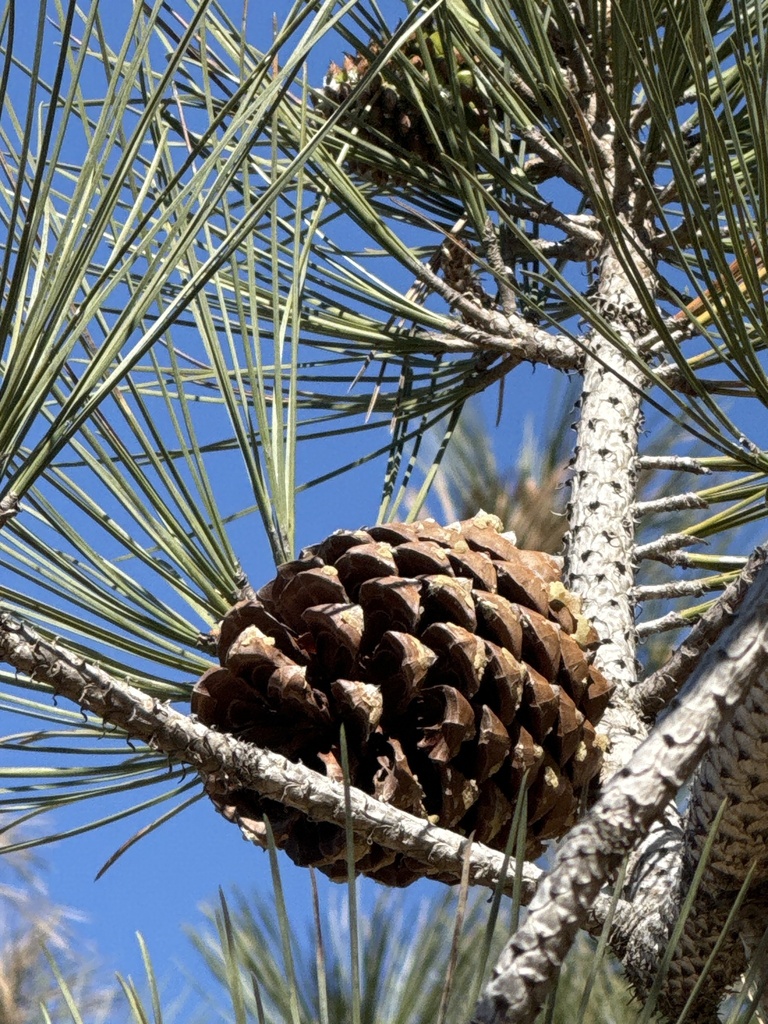
Torrey pine
Pinus torreyana
The Torrey pine (Pinus torreyana) is a rare pine species in California, United States. It is a critically endangered species growing only in coastal San Diego County, and on Santa Rosa Island, offshore from Santa Barbara in Santa Barbara County, and in Monterey County. The Torrey pine is endemic to the California coastal sage and chaparral ecoregion.
From the article Torrey pine on Wikipedia (CC BY-SA), quoted section by section
Description
Pinus torreyana is a broad, open-crowned pine tree growing to 8–17 meters (26–56 ft) tall in the wild, with 25–30 centimeters (9.8–11.8 in) long leaves ('needles') in groups of five. The cones are stout and heavy, typically 8–15 cm (3.1–5.9 in) long and broad, and contain large, hard-shelled, but edible, pine nuts. Like all pines, its needles are clustered into 'fascicles' that have a particular number of needles for each pine species; in the Torrey pine there are five needles in each fascicle. Like all pines, it has strobili, structures that function as a flower but look like a small cone, which for the Torrey pine look like a yellow bud in a male strobilus and like a small red cone in a female. Torrey pines are sometimes afflicted with witch's broom (or "gorilla's nest"), an unusually dense cluster of needles that looks somewhat like a bird's nest, caused by disease or other causes. There are two subspecies or varieties. These are said to be distinguished by the following characteristics, as well as possibly differing in the terpenoid (beta-phellandrene, limonene, cineole, etc.) profile.
Range & habitat
The extant population of Pinus torreyana is restricted to trees growing in a narrow strip along the Southern California coast in San Diego. There is also a population of the variety Pinus torreyana var. insularis in two groves on Santa Rosa Island, a California Channel Island off the coast of Santa Barbara, and in Pacific Grove on the foggy Monterey County coast, where a number of massive old specimens exist. The presence of Torrey pines along the semi-arid coast of San Diego and Santa Rosa Island (rainfall less than 15 inches per year) is probably a relict population of a much more extensive Ice Age distribution. Coastal fog during spring and summer along the San Diego and Santa Rosa Island coast provides just enough moisture to supplement the fairly low winter rainfall, allowing for survival of the species in the wild habitat zone.
Wikipedia: “Distribution”
What it does
The native habitat of Pinus torreyana is coastal sage scrub, a plant community, growing slowly in dry, sandy soil. The root system is extensive. A tiny seedling may quickly send a taproot down 60 centimeters (24 in) seeking moisture and nutrients. A mature tree may have roots extending 75 meters (246 ft). Exposed trees battered by coastal winds are often twisted into beautiful sculptural shapes resembling large bonsai, and rarely exceed 12 m (39 ft) tall. The seeds are eaten by birds and rodents. Like most pine tree species, the seeds have a wing attached to them, but in this species it is papery, breaks off easily, and is entirely non-functional, so this tree is entirely reliant upon animals to disperse its seeds. The scrub jay (Aphelocoma californica) is the most important species when it comes to dispersal of the seeds (on the mainland). Scrub jays and perhaps also squirrels are thought to be spreading the species into adjacent parklands from gardens around San Diego. The caterpillars of the moth Gloveria arizonensis have been confirmed to feed on this tree in the wild. Stratification, which is the process of subjecting seeds to (moist) cold, encourages germination in Torrey pine seeds
Wikipedia: “Ecology”
How it is grown
Although considered endangered in the wild, Torrey pine is often planted as an ornamental tree around San Diego, coastal and inland southern California, and even the Central Valley. A single tree planted in a suburb of San Diego in the 1940s or 1950s has grown tall and straight, and to a large size, 108 feet (33 m). Shipley Nature Center states it can grow to 148 ft (45 m) in height in cultivation. It is sold by at least ten different plant nurseries in California as of 2020.
Wikipedia: “Cultivation”
In human culture
In San Diego County it is considered a local icon, where it lends its name to Torrey Pines State Natural Reserve, Torrey Pines State Beach, Torrey Pines Golf Course, Torrey Pines High School, and Torrey Pines Gliderport, as well as numerous local roads, parks, and businesses (e.g., Torrey Pines Bank, Torrey Pines Property Management Company, Torrey Pines Landscape Company, and Torrey Pines Law Group.)
Wikipedia: “Culture”
Where it lives
Recorded sightings
—
geo-referenced records in GBIF, from museums, herbaria and field observers.
Drag the globe to turn it. Dots are where records exist, not a range map; darker means more records.
In the stacks
Searching the stacks…
Every page naming Pinus torreyana in the Biodiversity Heritage Library →
This page is assembled live from iNaturalist, GBIF, Wikipedia, the Source Library and the Internet Archive. It is not yet part of the hand-edited codex. iNaturalist taxon 78587.