- Animals
- ›Arthropods
- ›Chelicerates
- ›Arachnids
- ›Spiders
- ›Mygalomorphs
- ›Avicularioidea
- ›Tarantulas
- ›Western Baboon Spiders
- ›Heteroscodra
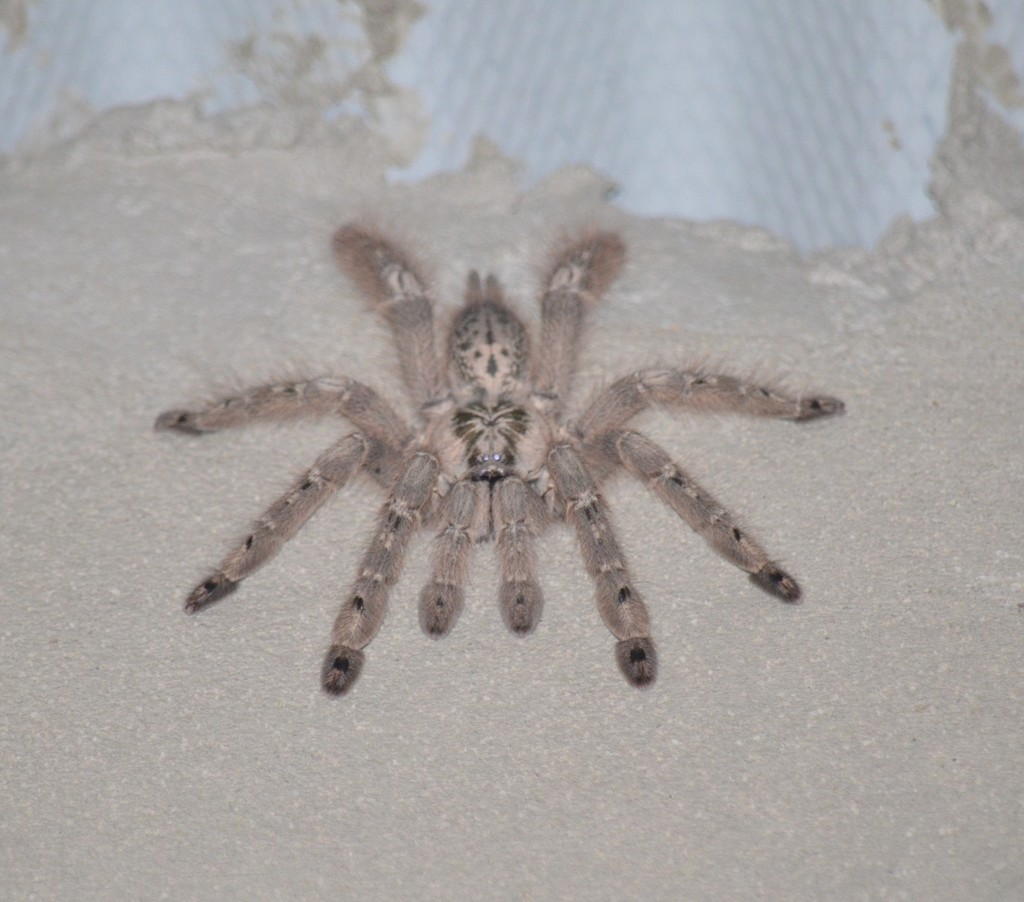
Togo Starburst Baboon Spider
Heteroscodra maculata
Heteroscodra maculata is an Old World species of tarantula which was first described in 1899 by Reginald Innes Pocock. This species native to West Africa and is found primarily in Togo and Ghana. This species has many common names, of which Togo starburst and ornamental baboon are most frequently encountered.
From the article Heteroscodra maculata on Wikipedia (CC BY-SA), quoted section by section
Description
Heterscondra maculata are members of the subfamily Stromatopelminae. These tarantulas are originated from West Africa. Being an "Old World species", these tarantulas have highly potent venom and are not recommended for handling.
What it does
Heteroscodra maculata specimens are quite fast, defensive and possess medically significant venom. Due to their lack of urticating hairs, they tend to bite as a primary defense. They are an arboreal species, though younger specimens have been noted to burrow during their first few months of life. In the wild, these spiders reside in tree hollows, logs, and dense foliage, constructing retreats lined with thick silk sheets. Females tend to reproduce readily, though sexual cannibalism may occur. Egg sacs are reported to contain between 75 and 130 spiderlings.
Wikipedia: “Behavior”
Toxicity
The venom of Heteroscodra maculata is medically significant, known to cause intense pain and muscle spasms in humans. The venom includes toxins like δ-theraphotoxin-Hm1a and δ-theraphotoxin-Hm1b. along with these toxins, it also includes Π-Theraphotoxin-Hm3a. Unlike venoms that destroy tissue or cause widespread inflammation, these toxins activate the NaV1.1 voltage-gated sodium channels located in mechanical pain receptors (A-delta fibers). Because these toxins trigger intense hypersensitivity without causing thermal sensitivity or neurogenic swelling, they have become an useful tool in neurological research for studying how the human body processes chronic pain.
Wikipedia: “Venom”
Where it lives
Recorded sightings
—
geo-referenced records in GBIF, from museums, herbaria and field observers.
Drag the globe to turn it. Dots are where records exist, not a range map; darker means more records.
In the stacks
Searching the stacks…
Every page naming Heteroscodra maculata in the Biodiversity Heritage Library →
This page is assembled live from iNaturalist, GBIF, Wikipedia, the Source Library and the Internet Archive. It is not yet part of the hand-edited codex. iNaturalist taxon 779717.