- Animals
- ›Arthropods
- ›Crustaceans
- ›Typical Crustaceans
- ›Malacostracans
- ›Decapods, Isopods, and allies
- ›Decapods and Krill
- ›Decapods
- ›Crabs, Lobsters, Shrimps, and Allies
- ›Crayfishes and Lobsters
- ›Northern Hemisphere Crayfishes
- ›Cambarid Crayfishes
- ›Faxonius
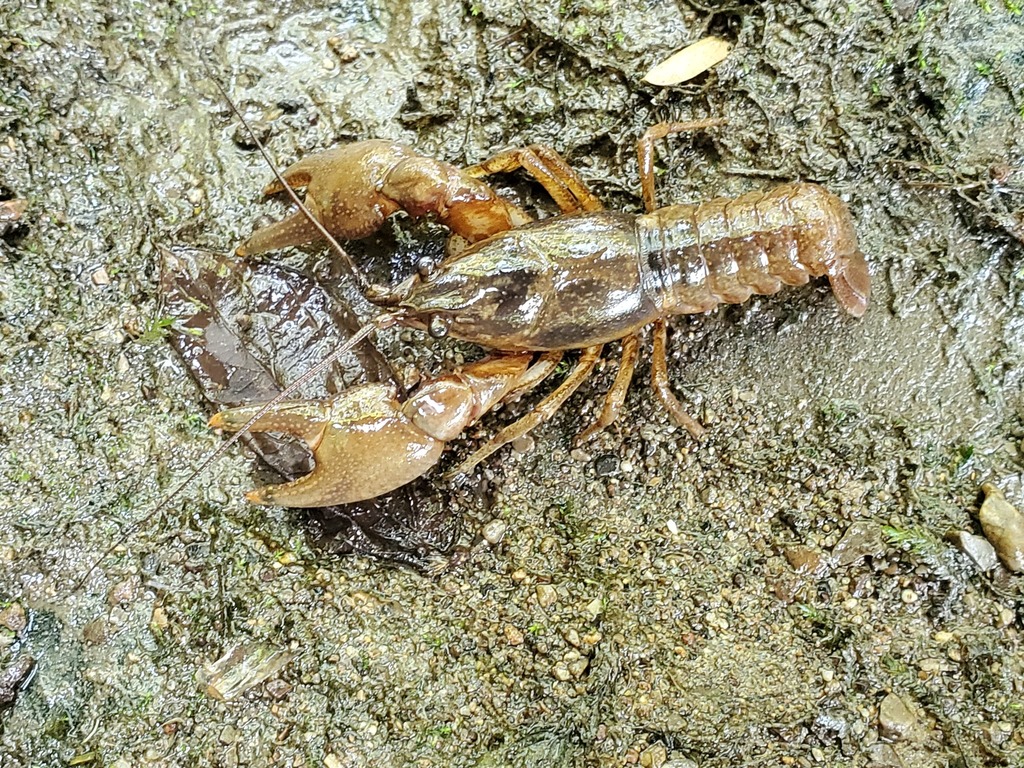
Nashville Crayfish
Faxonius shoupi
Faxonius shoupi, the Nashville crayfish, is a freshwater crustacean native to the Mill Creek Basin in Nashville, Tennessee. Prior to August 2017, the species was called Orconectes shoupi. Faxonius shoupi is protected under the Endangered Species Act (ESA) as an endangered species. However, the crayfish has recently been put up for delisting by the United States Fish and Wildlife Service.
From the article Faxonius shoupi on Wikipedia (CC BY-SA), quoted section by section
Description
The Nashville crayfish has an orange and black coloration, four pairs of legs, and two elongate pinchers with red tips. The crayfish has a lighter-colored saddle on its back and on the sides of its head. A sigmoidal cleft of the annulus ventralis, or sperm receptacle, is found on larger females. The Nashville crayfish is on the larger side of crayfish, growing to be up to 7 in (180 mm) long.
Range & habitat
In general, crayfish eat algae, insects, worms, snails, fish eggs, leaves, and mussels. They forage mostly during the night from sunset to midnight and usually return to their burrows during daylight hours. Female Nashville crayfish can be found under large slab rocks while carrying eggs and young.
Wikipedia: “Diet and habitat”
What it does
Males with larger chelae tend to be sexually dominant. This is because they are able to hold the female tighter and increase their copulation time. The Nashville crayfish can be aggressive and will attack its opponent by chasing, cornering, or driving it backward. There is little information about the Nashville crayfish's territorial behavior toward its shelter. However, most crayfish are very territorial and will be aggressive to protect their burrows.
Wikipedia: “Behavior”
In human culture
Very little is known about Nashville crayfish life history. Most of the research that has been done about the reproduction strategies of this crayfish have been on males. Male crayfish switch between two forms during mating season. The reproductive form is known as "form 1" and the non reproductive form is known as "form 2". The form 1 male gonopod has been described to be shaped "short-curved". This gonopod shape differs from other species' gonopods in the same genus, Faxonius. This is a form of reproductive isolation known as "lock and key", where individuals are prevented from hybridization through the genital shape. Due to the lack of research on this particular species, the rest of the life history section are assumptions based on other crayfish. Reproduction typically begins in late summer and early fall. This is when males will switch from form 2 to form 1. Females will lay their eggs during the late winter and early spring. Each female lays several hundred eggs. Most of these eggs will die before hatching or in the early stages of life.
Wikipedia: “Life history”
Where it lives
Recorded sightings
—
geo-referenced records in GBIF, from museums, herbaria and field observers.
Drag the globe to turn it. Dots are where records exist, not a range map; darker means more records.
In the stacks
Searching the stacks…
Every page naming Faxonius shoupi in the Biodiversity Heritage Library →
This page is assembled live from iNaturalist, GBIF, Wikipedia, the Source Library and the Internet Archive. It is not yet part of the hand-edited codex. iNaturalist taxon 776091.