- Plants
- ›Vascular Plants
- ›conifers
- ›conifers
- ›cypress family
- ›Cypresses, Cedars, Junipers, and Allies
- ›Juniperus
- ›Sabina
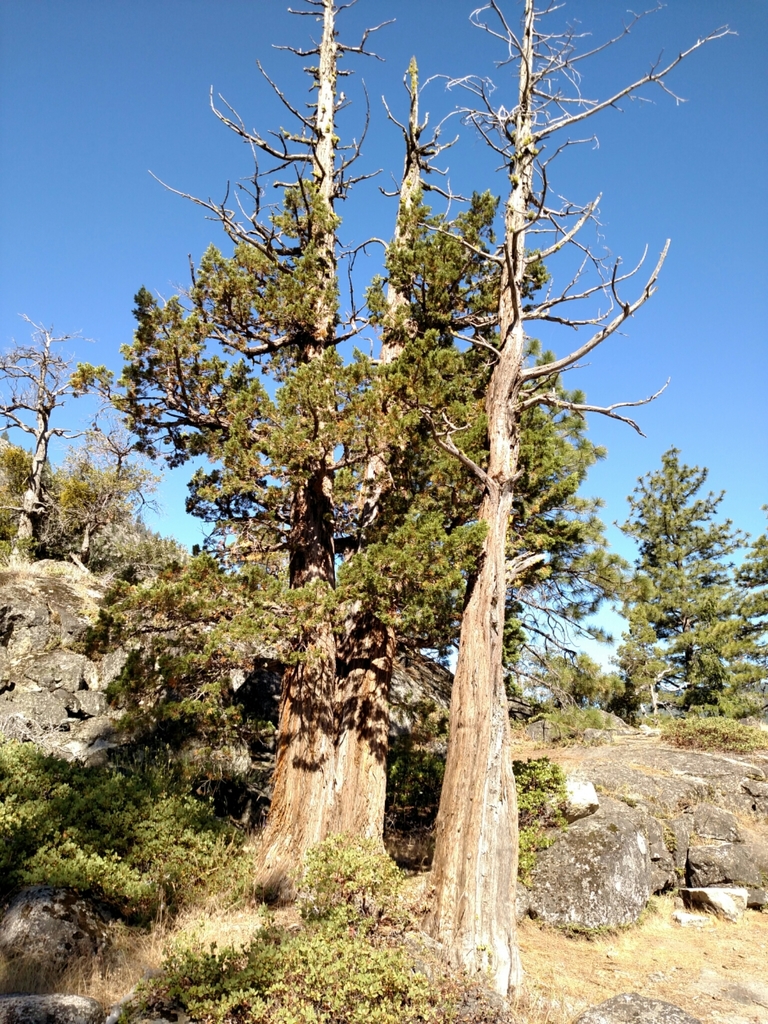
Sierra juniper
Juniperus grandis
Juniperus grandis, with the common names Sierra juniper, Sierra western juniper, and western juniper, is a tree or tall shrub that is endemic to the Western United States. It is sometimes considered a variety of subspecies of Juniperus occidentalis, also known as the western juniper.
From the article Juniperus grandis on Wikipedia (CC BY-SA), quoted section by section
Description
Juniperus grandis is a medium-sized tree, growing to 12–26 metres (39–85 feet) tall. It has a stout trunk with red-brown bark, growing up to 3 m (10 ft) in diameter. The whorled leaves are scale-like and closely appressed. Most plants are dioecious, but about 5–10% are monoecious. Its fleshy and berry-like cones are 5–9 millimetres (3⁄16–3⁄8 inch) in diameter. Its pollination period is May and June. The seeds are wingless. Based on dendrochronological evidence from the 2,675-year-old Scofield Juniper, Sierra junipers are the fourth longest-lived tree species after the Great Basin bristlecone pine, alerce and giant sequoia.
Range & habitat
Juniperus grandis is native to the Sierra Nevada in eastern California and western Nevada; and the White and Inyo Mountains, San Gabriel and San Bernardino Mountains, and higher elevations of Mojave Desert mountains, in Southern California. It is found in exposed, dry, rocky slopes, flats, pinyon–juniper woodland, and temperate coniferous forest habitats, including the Sierra Nevada upper montane forest and Sierra Nevada subalpine zone ecoregions. It grows at elevations of 100–3,100 m (330–10,170 ft).
== References ==
Wikipedia: “Distribution and habitat”
Where it lives
Recorded sightings
—
geo-referenced records in GBIF, from museums, herbaria and field observers.
Drag the globe to turn it. Dots are where records exist, not a range map; darker means more records.
In the stacks
Searching the stacks…
Every page naming Juniperus grandis in the Biodiversity Heritage Library →
This page is assembled live from iNaturalist, GBIF, Wikipedia, the Source Library and the Internet Archive. It is not yet part of the hand-edited codex. iNaturalist taxon 77599.